
Subscribe to our Blog
We're committed to your privacy. SayOne uses the information you provide to us to contact you about our relevant content, products, and services. check out our privacy policy.


Generating table of contents...
What if the biggest revenue killer in your Shopify store wasn't traffic but the customers who almost bought? This case study discusses how an e-commerce store succeeded in reducing cart abandonment with SayOne’s abandoned cart recovery flow.
A mid-sized e-commerce store built on Shopify and dealing in fashion and accessories observed high store traffic. Even though many shoppers added products to the cart, they never completed checkouts, despite Shopify’s checkout emails. SayOne solved the store’s challenges by building a recovery flow using Klaviyo and Shopify. They observed a significant reduction in cart abandonment and revenue growth.
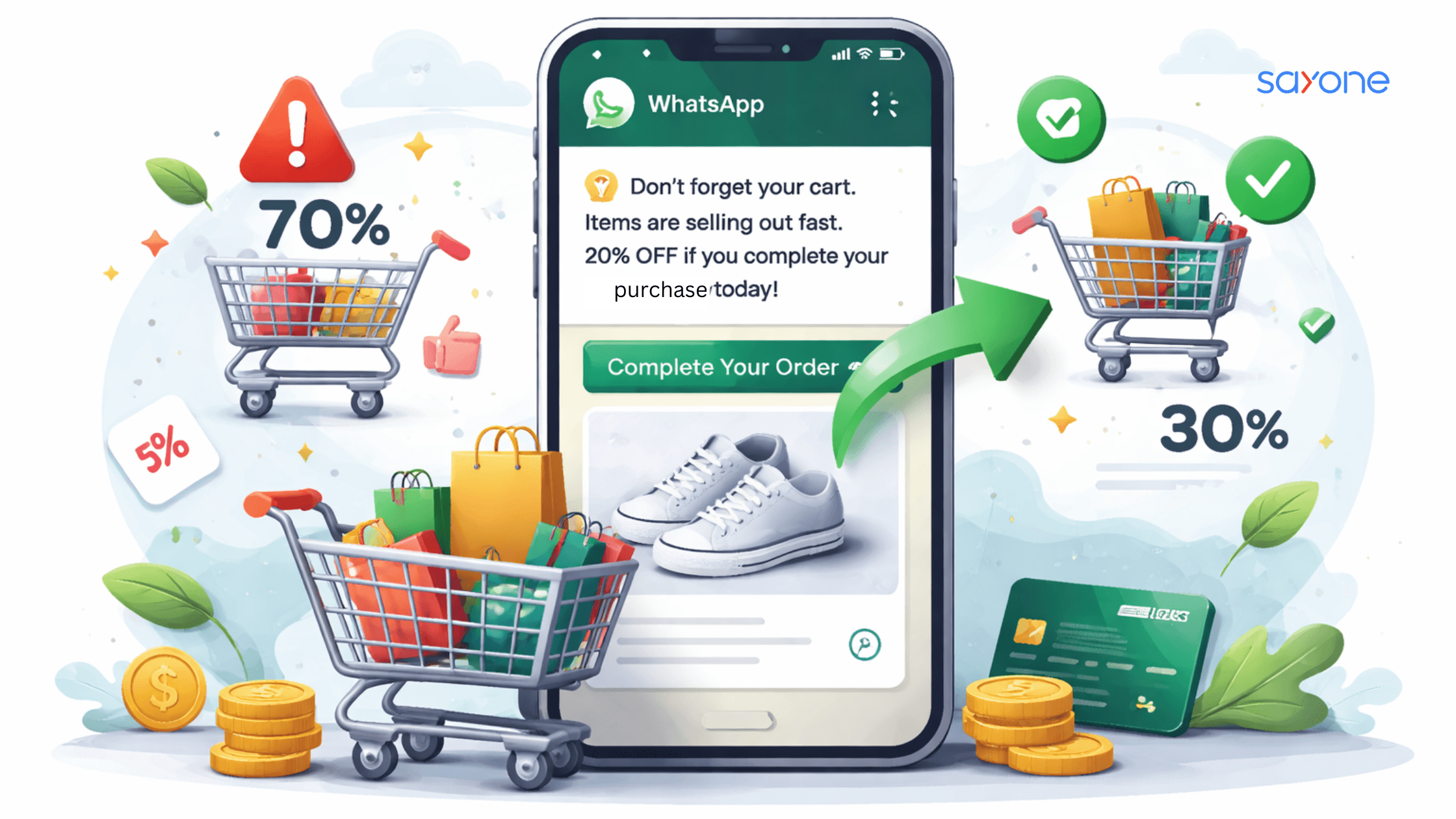
With Shopify’s native recovery setup, the e-commerce store experienced the following challenges. High cart abandonment rate The store saw a cart abandonment rate of over 70%, which led to significant lost revenue. While the majority were mobile shoppers, they frequently abandoned due to small screens, complex checkout forms, or simple distractions.
Shopify’s built-in abandoned checkout email feature only sends a single generic reminder one hour after abandonment. The lack of personalization and follow-up sequence kept recovery rates very low.
Even when email reminders were sent, the open rates were limited to 20-50%, leading to 2-5% click through rates and minimal conversions.
Despite healthy site traffic, solid conversion on completed checkouts, and attractive products, the high volume of abandoned carts translated into significant monthly revenue leakage.
We addressed these challenges by integrating Shopify with Klaviyo and WhatsApp to trigger personalized recovery conversations in real time. The system solved the challenges in the following ways:-
Instead of a single generic email, the store now runs a structured 3-4 touch sequence across email and WhatsApp. The layers include immediate gentle reminders, mid-term urgency-building messages with social proof, and final incentive-driven messages for re-engagement.
Replaced low-visibility emails with WhatsApp as the main high-engagement channel, for first and follow-up, shifting to instant and conversational messaging.
The flow now captures and triggers on both "Added to Cart" and "Started Checkout" events, reaching anonymous browsers.
Every message is personalized by including dynamic cart items, images, tailored offers, and a friendly tone.
High-value carts now receive premium offers automatically, while low-engagement users getlow-intensive follow-ups.
The implementation was completed in three weeks, during which we overcame the following challenges:
The abandoned cart recovery flow generated the following results post-implementation:
Recovered revenue from abandoned carts increased by 35%, directly contributing to incremental sales without increasing ad spend or acquisition costs.
The flow captured 30% of previously lost carts, meaning the store converted roughly one in every three to four abandonments into revenue.
Average time from abandonment to purchase reduced from days to under 30 minutes, owing to the real-time messages.
By using WhatsApp as the primary platform, the recovery open rates jumped from 15% via email to 90% on WhatsApp.
Discount usage in recovery flows dropped by 29% as personalized conversations resolved doubts without immediately relying on price reductions.
Repeat purchase rate increased by 16% as post-purchase WhatsApp engagement strengthened trust and encouraged future buying behavior.
Timing is an important factor in abandoned cart recovery, as sending a WhatsApp message within 30 minutes of cart abandonment resulted in higher conversions.
Syncing Shopify cart data with Klaviyo and WhatsApp API needed careful mapping of events to avoid delayed or duplicated messages.
The recovery flows should align with seasonal promotions, loyalty programs, and retargeting campaigns to maximize revenue.
With the increase in purchases, the e-commerce store is now expanding the WhatsApp channel into the post-purchase phase to drive higher customer lifetime value.
If you are struggling with similar cart abandonment challenges on Shopify, contact us to implement a Klaviyo abandoned cart flow enhanced with WhatsApp.
We're committed to your privacy. SayOne uses the information you provide to us to contact you about our relevant content, products, and services. check out our privacy policy.

We collaborate with visionary leaders on projects that focus on quality