
Subscribe to our Blog
We're committed to your privacy. SayOne uses the information you provide to us to contact you about our relevant content, products, and services. check out our privacy policy.


Generating table of contents...
You might have already heard of AI agents that follow instructions to complete a task given, by breaking it into subtasks, follow the step and stop when done. Many people assume AI agents and agentic AI are the same, and fail to fully understand the real difference. While you are already familiar with generative AI and AI agents, this blog aims to make the concept of agentic AI clear.
Agentic AI is an AI system that can independently decide what to do next to reach a goal. It does not require step-by-step instructions to perform, instead it operates autonomously to achieve its goal. The agentic AI system can set its own sub-goals, change strategy mid-way, use tools when needed, re-evaluate if something isn’t working and keep going until the goal is achieved.
In the simplest terms, an AI agent executes tasks while an agentic AI pursues outcomes. For example, if an AI agent is like a GPS that gives turn-by-turn directions, agentic AI is a human driver who knows when to brake, notices traffic signals, reroutes, and still reaches the destination.
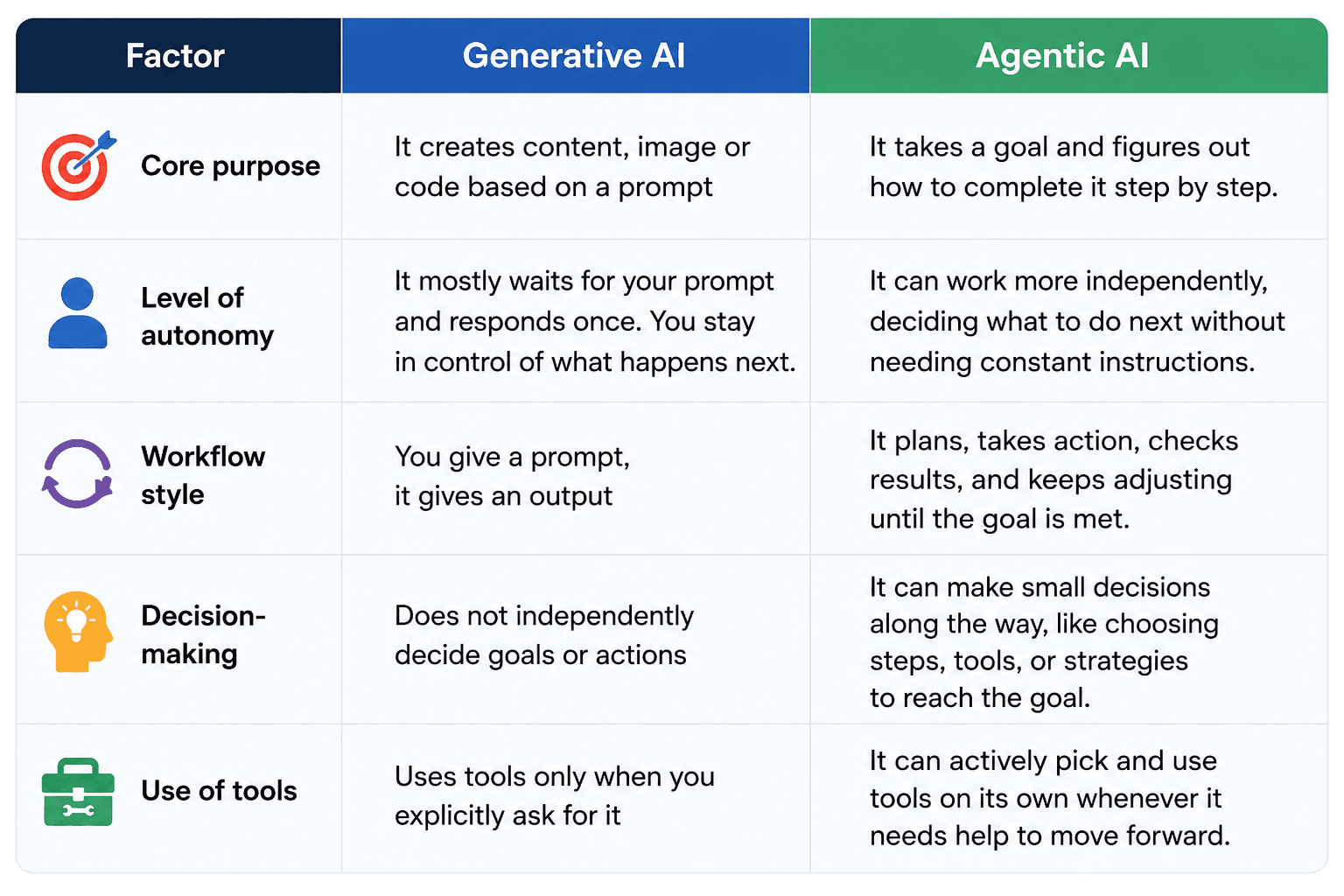
Generative AI responds to prompts while agentic AI independently plans multi-step tasks and adapts based on results. Here is a clear comparison between generative AI and agentic AI on multiple factors.
Agentic AI use cases include autonomous customer support, autonomous code deployment, managing cybersecurity, and real-time supply chain optimization.
Autonomous troubleshooting agents resolve customer issues end-to-end by understanding the problem, accessing knowledge bases, creating tickets and following up.
Autonomously plans tasks, writes code, runs tests, identifies errors, fixes issues and deploys updates, towards a goal, without step-by-step human interference.
Reviews invoices, identifies discrepancies, routes approvals, follows up on pending payments, and generates reports.
Agentic AI detects threats, investigates suspicious activities, takes containment actions and escalates critical incidents when necessary.
The software platforms and toolkits that developers use to build agentic AI systems include LangChain, CrewAI, AWS Bedrock, and ReACT pattern, each optimized for different business needs and complexity levels. These frameworks offer developers built-in support for planning, memory, tool integration, decision-making, multi-step workflows and agent collaboration.
The framework connects AI models with business tools and handles memory of previous conversations and decisions. They find it useful in customer service bots that learn from interactions and document analysis workflow. They have low to medium complexity and are available as open-source with just infrastructure costs.
Allows multiple AI agents to work like a team on complex problems, assigning each with a specific role. They are best used for market research automation, competitor analysis, and content creation at scale. Similar to LangChain, CrewAI is open-source with just infrastructure costs, however the complexity is medium.
Suitable for building agentic AI systems for enterprises that have security and compliance requirements. They make it easier for large organizations to manage audits, and ensure secure AI agent behaviour. They offer medium to high complexity and are available in a pay-per-use model.
The agents solve problems by reasoning each step and acting on them. This framework is more reliable and transparent than agents that react immediately without proper reasoning.
Successful agentic AI adoption requires well-defined guardrails, pilot testing, clear escalation protocols, and continuous human oversight.
Agentic AI systems sometimes confidently state false information or draw false conclusions. To avoid this, it is important to add human verification checkpoints especially for critical decisions.
When one step fails, the entire workflow can break as the later steps depend on earlier ones. This can be mitigated by building “circuit breakers” that stop the process if quality drops and monitor each step individually.
Every data accessed by agents must stay protected. This can be ensured by using encryption, limiting what information agents can access and ensuring secure APIs.
Regulations require organizations to explain how personal data is used and give individuals control over their information. To maintain this, document all data usage, get proper consent and maintain audit trails and build data deletion capabilities.
Agentic AI marks a significant shift in how businesses use AI, from systems that simply respond to requests to systems that can actively work toward outcomes. Success, however, depends on balancing autonomy with accountability through robust governance, security controls and human oversight.
Businesses that invest in this foundation today will be better prepared to deploy intelligent agents that enhance efficiency, speed up decision-making and automate complex workflows at scale. As adoption grows, agentic AI is likely to become a key building block of the next generation of digital transformation initiatives.
Subscribe to our blog to solve real business problems with agentic AI.
Agentic AI involves the ability to understand information, come up with plans and solutions, act upon it, and react accordingly without requiring human input at every stage. Generative AI, on the other hand, operates by taking action when asked to do so, while agentic AI systems have the capacity to set goals, divide a problem into tasks, utilize appropriate resources, and learn from the output.
Claude has agentic capabilities as it works with a set of tools. Claude can analyze complex situations and utilize functions to take action and learn accordingly. However, Claude cannot initiate action by itself but needs a user or application to do so. Claude has agentic and generative characteristics in that it generates language and uses tools to perform its work.
The agentic AI system operates according to a continuous loop of comprehending the task, coming up with a plan for it, implementing the plan by deploying the necessary resources, assessing the outcome, and, if required, restarting the process again.
Traditional AI software requires explicit instructions for each task, whereas agentic AI figures out the approach independently based on goals. Agentic AI learns from outcomes and adapts its strategy, while traditional software executes the same programmed logic regardless of results.
Agentic AI is the technology, whereas AI agents are the software systems that implement agentic AI to autonomously complete tasks. Agentic AI is the umbrella term for autonomous, decision-making AI systems. An AI agent is a specific application built using agentic AI principles.
We're committed to your privacy. SayOne uses the information you provide to us to contact you about our relevant content, products, and services. check out our privacy policy.

We collaborate with visionary leaders on projects that focus on quality