
Subscribe to our Blog
We're committed to your privacy. SayOne uses the information you provide to us to contact you about our relevant content, products, and services. check out our privacy policy.


Generating table of contents...
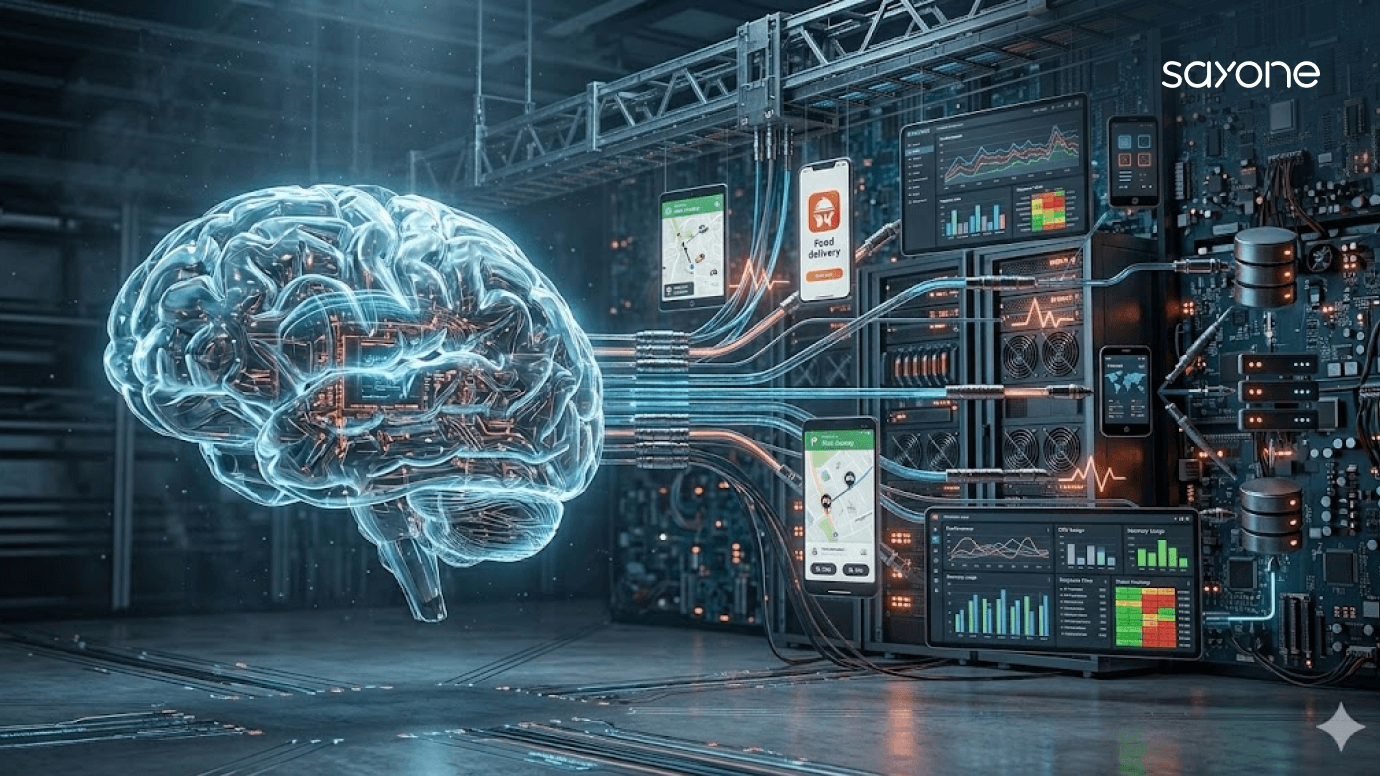
Think about your application crashing at peak traffic, but just minutes ago, the application monitoring dashboard showed everything green. This might be a very relatable situation to many others, too, despite having application performance monitoring tools that seem to work perfectly until your users complain about issues. The real issue is not with your team but your monitoring system, which relies on reactive monitoring based on thresholds and rules. As a result, issues surface only after users feel the slowdown. That’s when the need for a predictive monitoring system becomes significant, and AI is the most efficient enabler of it.
Unlike modern APM tools that look at individual metrics and act on isolated alerts, AI analyzes how the entire system works over time using the following methods:
AI uses machine learning to analyze time-series behaviour, which helps to understand how performance patterns evolve over different time frames across different traffic environments. This enables the system to compare the application’s behaviour to the already determined “normal” behaviour.
The system creates a transaction baseline by learning how key user actions perform normally, such as during logins, checkouts, payments, or search requests. The system uses these baselines as a standard to compare current behavior, instead of using static thresholds.
While traditional APMs monitor isolated systems, AI analyzes changes across interconnected systems. This helps performance monitoring tools to identify issues before they spread across systems.
AI analyzes infrastructure dependencies to understand how different services influence each other. It can detect when an issue in one backend service begins causing failures or delays in another customer-facing application.
It also recognizes anomaly clusters, where multiple small abnormalities occur together. Individually, these signals may not look harmful, but when AI sees rising latency, growing retry requests, and increasing queue delays happening simultaneously, it recognizes the early signs of a larger operational issue.
Over the years, AI learns recurring behavioural patterns that commonly occur before an issue arises. These patterns, called operational signatures, help identify potential risks much earlier.
AI solves the majority of the drawbacks of the modern APM system without replacing the tool, but by integrating AI into it seamlessly. Here is how an AI-integrated system transforms how application performance is analyzed.
Since traditional APM used rule-based monitoring, it led to a huge increase in false alerts that misguided the team and wasted their time. Slowly, teams began ignoring more than half of the alerts, thinking them false, and the real issues got lost in the noise. In the case of AI-integrated monitoring, these false alerts are reduced to as low as 1-2% as they focus on collective signals and compare based on the baseline rather than focusing on individual signals.
Instead of reacting to issues after it has already affected experience, AI enables identifying hidden issues like gradual degradation much before they affect the user experience. This reduces detection delays, incident escalation, and downtime impact.
Your team doesn’t need to spend hours manually searching through logs and microservices to map the cause of the issue. The AI APM platform continuously analyzes live behavioral data to identify correlations, dependency relationships, and abnormal behaviours to identify the root cause without delay.
Businesses gain measurable benefits in the form of lower downtime costs, higher service reliability, more stable operations, improved operational focus, higher customer retention and revenue efficiency, higher development velocity, and reduced cloud costs.
AI does not fully reason like experts in your team. It uses statistics to identify deviations, correlations, probabilities, and behavioural anomalies. So, AI should not be used as a complete alternative to human expertise, especially in architecture decisions and remediation strategy. The real advantage of AI is that it analyzes relationships at a scale humans realistically cannot process manually.
Future APM does not react to issues that have already happened, but forecasts potential issues before they affect the users. From answering “What’s wrong?” to “What will go wrong?” through continuous learning and forecasting, it is shifting from reactive to predictive monitoring with AI. The capability of AI that powers much of this intelligence is machine learning. Machine learning is a branch of AI that enables systems to learn patterns from data without being explicitly programmed for every situation. In the context of APM, machine learning helps monitoring systems learn how applications normally behave by analyzing large amounts of operational and telemetry data over time. The difference between tools that confuse you and tools that protect you is intelligence. APM monitoring systems become truly modern when they are capable of continuous learning, pattern recognition, and context awareness. That’s what machine learning brings.
Now is your time to upgrade your APM from reactive to predictive, or your application loses its potential interactions and customer satisfaction. SayOne has partnered with businesses to make their performance monitoring accurate by 98% through machine learning, without replacing their existing system. Learn how machine learning can be integrated into your current APM tool to maximize the accuracy of performance analysis, and adopt it soon.
AI-integrated APM forecasts issues before they affect users while traditional monitoring systems react only after thresholds are breached. The former uses machine learning to analyze patterns over time, correlates signals across systems and reduces noise, which makes monitoring proactive instead of reactive.
Yes, AI can predict performance risks during high traffic by comparing transaction baselines and analyzing anomaly clusters. This helps businesses avoid downtime during critical sales periods.
AI links technical metrics like latency and error rates to business outcomes such as conversions or churn. They map performance to KPIs to show how slowdowns directly affect revenue, retention, and customer satisfaction.
Machine learning compares behaviour against learned baselines instead of static rules. This reduces the probability of false alerts to a significant extent. This saves time for teams otherwise spent on analyzing the fake alerts.
While AI increases the efficiency of performance analysis to a huge extent, it cannot guarantee 100% detection and struggles to identify new failure patterns. AI APM works only when the data is clean, consistent and the models are tuned to evolve with application complexity.
We're committed to your privacy. SayOne uses the information you provide to us to contact you about our relevant content, products, and services. check out our privacy policy.

We collaborate with visionary leaders on projects that focus on quality