
Subscribe to our Blog
We're committed to your privacy. SayOne uses the information you provide to us to contact you about our relevant content, products, and services. check out our privacy policy.


Generating table of contents...
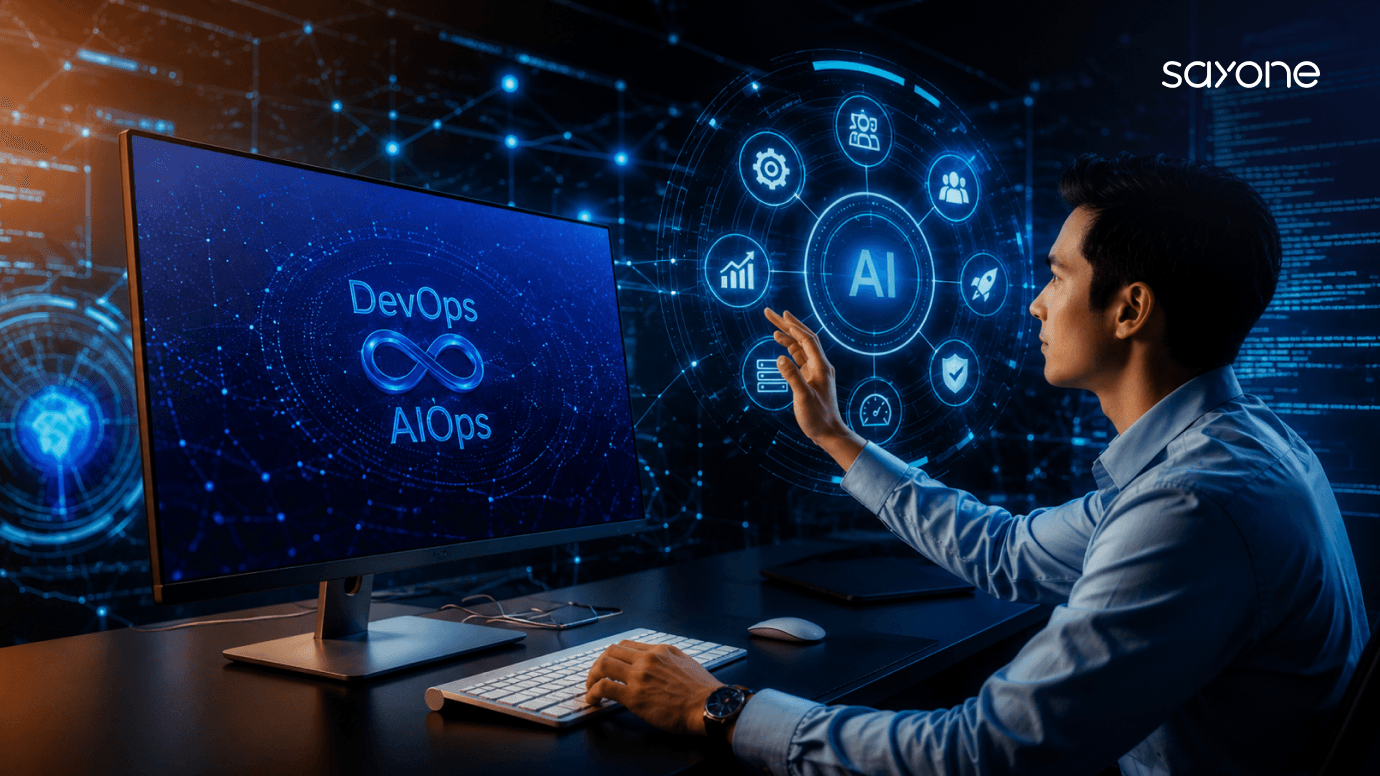
You might have noticed your DevOps team struggling with alerts, but what they are struggling with even more is finding the one that matters among these 200 notifications. Even today, your deployment pipeline requires manual approvals at three different checkpoints and you are hiring faster than you're automating. This is going to change with AI as it can amplify what your best engineers already do. That’s why businesses are increasingly adopting AIOps solutions.
AIOps is basically AI applied to operations. This means that your infrastructure is able to learn from patterns, forecast issues before they occur, and make decisions on its own that currently are made by your team. In other words, you are providing a nervous system for your infrastructure that works round the clock. Your team currently reacts to 500 alerts per day, while your AIOps platform learns what combinations of signals are important and what action to take.
Your engineers today could be filtering out 99% of alerts because the signal-to-noise ratio is horrible. But with AI, you’re able to group related alerts into incidents, understand which alerts are predictive of downtime, and filter out the noise. One engineer said they filtered their 200 daily alerts down to 12 within just two weeks, dropping alert response time by 60% and identifying real problems faster.
An AI observability platform recognizes when a deployment causes a performance degradation it's seen before and can automatically roll it back, without human involvement. As a result, the mean time to recovery (MTTR) drops to seconds and velocity increases as deployment becomes less risky.
By using historical logs to make predictions on potential problems such as CPU spikes or memory exhaustion in Kubernetes, the observability capabilities provided by AI can help prevent performance-related problems. They help organizations save money from avoiding outages, unneeded infrastructure costs, and unscheduled scaling.
Your team spends 30% of incident response time digging through logs, traces, and metrics to understand what happened. An AI agent observability tool can map the dependency chain automatically, showing which service change caused which downstream effect. This can lead to incident resolution time drops by 40-50% and enables proper fact-finding sessions.
AI-powered observability tools analyze real-time system behavior to predict potential issues before they occur. For example, they can identify a high probability of Redis timeouts based on current query patterns and recommend preventive actions. This enables teams to resolve risks before they become incidents, reduce unplanned downtime, minimize after-hours firefighting, and improve operational confidence and reliability.
The gap between wanting to adopt AIOps and actually deploying it successfully isn't technical but organizational. Even when the technology exists and the tools are mature, implementation can fail if the team isn't ready or the approach doesn't fit your architecture. That's why we built a methodology that treats your team as the center of everything we do.
We spend time with your DevOps team, SRE leads, and engineering managers to understand their operational pain points, current observability stack, team maturity, risk tolerance, and expected metrics.
Based on your environment and constraints, we choose the right tools that fit your stack, design your data collection strategy, map the implementation sequence and create your success metrics.
At this stage, we don’t implement for you, but with you in steps such as building foundation, intelligence layer, refinement and optimization, handoff and scaling.
The process to successful adoption does not end at implementation but continues as optimization, business reviews, and ongoing support.
We have helped DevOps teams across industries, from Series B startups to Fortune 500 enterprises, adopt AIOps without the chaos of rip-and-replace migrations. Teams typically see improvements within their first 60 days.
Without a six-month consulting engagement, you can still determine if AIOps is necessary for you.
These three data points will tell you exactly how much value AIOps adoption could unlock for your team.
DevOps teams that move first gain real competitive advantage. So, if you are willing to change or react to how AI can transform DevOps, it's best to move fast. To help you begin, let's talk about what AIOps could do for your specific situation. Schedule a 20-minute strategy call with our DevOps experts. We'll show you what's possible and zero in on your biggest opportunity.
It is a platform that uses monitoring, logging, and tracing technology, enhanced with AI capabilities. This tool helps to monitor the health of the infrastructure and predict any potential issues in advance, allowing automation of actions needed.
The concept of CI/CD is Continuous Integration and Continuous Deployment. It is one of the practices of DevOps used for automation of the process of integration, testing, and deployment of the code.
Using AI in DevOps allows improving the processes of prediction of problems, automating the process of deployments, and decreasing the number of alerts.
AI observability tools like Datadog AI observability or AI agent observability tools employ machine learning to group notifications, detect anomalies, and automate incident management. They assist in filtering out noise and identifying valuable insights.
AIOps services offer guidance on introducing AI technologies into IT operations, including deployment of observability platforms, automation of incident response, and delivering tangible results in terms of performance improvement.
We're committed to your privacy. SayOne uses the information you provide to us to contact you about our relevant content, products, and services. check out our privacy policy.

We collaborate with visionary leaders on projects that focus on quality