
Subscribe to our Blog
We're committed to your privacy. SayOne uses the information you provide to us to contact you about our relevant content, products, and services. check out our privacy policy.



Generating table of contents...
Choosing the right CRM consulting service provider is equally important as selecting the right CRM. Most organizations invest weeks comparing between Salesforce, Zoho, and NetSuite, yet select an implementation partner in just a few days, although this decision would determine whether the project will be successful or not.
It is in this very area that the CRM consulting services should help and where most of the buyers end up in trouble. A consultant who understands Salesforce configuration is not automatically the right fit for a Zoho rollout, and a NetSuite CRM specialist may know almost nothing about the data-migration traps hiding in your existing spreadsheet-and-email workflow. This guide breaks down what CRM consulting services actually cover, why the failure rate has stayed stubbornly high for a decade, and how to evaluate a CRM consulting company before you commit a budget and a full quarter of your team's time.
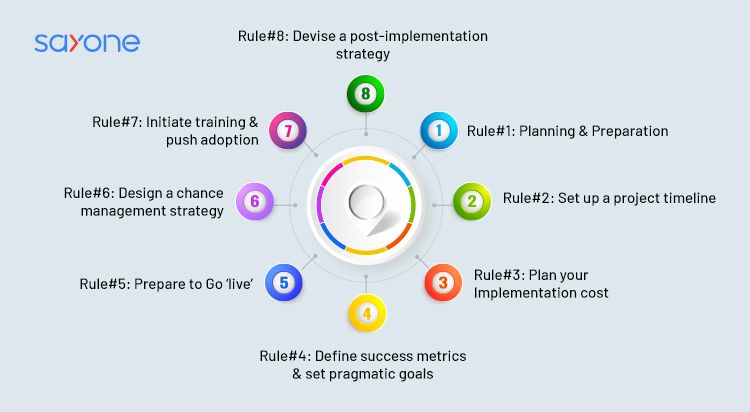
A competent engagement usually spans four phases:
Buyers often shop for the middle two phases and skip the first and last, which is precisely how a technically correct implementation ends up abandoned within a year. A CRM consulting partner worth hiring will push back on any scope that skips discovery or adoption planning, rather than simply pricing the RFP as written. That pushback is a useful filter on its own. A vendor who accepts a scope with no discovery phase is usually optimizing for closing the deal, not for whether your team will still be using the system at renewal time.
Not every CRM rollout needs an outside consultant. A small group making the switch from spreadsheets to an out-of-the-box CRM that does not have many integrations can usually implement on their own, particularly using a platform such as Zoho that is geared toward such an approach. The formula shifts, however, when multiple systems that need to integrate with your CRM (ERP, support desk, marketing automation software) are required, or more than just a few custom objects and workflows are needed, or your sales staff is big enough that a poor implementation will impact revenues. Then the expense of a professional implementation partner is usually less than the expense of a poorly done internal implementation that will need to be fixed down the road.
CRM failure rates have not improved much in a decade. Independent research puts the current CRM failure rate at 55 percent, building on earlier estimates in the 47-to-50-percent range, with "failure" defined as a deployment that did not meet its planned business objectives, including projects cancelled outright before completion.
The recurring causes are rarely about the software itself. Poor requirements gathering, customer data migrated without prior standardization, no executive sponsor pushing adoption internally, and training that ends the week after go-live all show up far more often in incident assessments than any specific platform limitation. A consulting partner's real value is process discipline in dealing with these failure points, not knowledge of a certain vendor's admin console. If a prospective partner's pitch is entirely about the platform and never once mentions change management or adoption metrics, that is worth noting before you sign anything.
Yes, and buyers frequently underestimate by how much. Salesforce consulting work increasingly involves configuring Agentforce and other AI-driven automation layered on top of core CRM objects, which requires a partner comfortable with both traditional CRM architecture and emerging agentic-AI tooling, not just classic workflow rules. Zoho consulting engagements tend to be faster and cheaper to scope because Zoho's ecosystem is more self-contained, but that same simplicity means a generalist partner can quietly underestimate integration work with existing finance or support tools. NetSuite CRM work usually sits inside a broader ERP conversation, since NetSuite bundles CRM functionality with financials, which changes both the internal stakeholder list and the technical dependency chain from day one.
None of this means you need three separate specialists on retainer. It means the CRM consulting company you choose should be able to name the specific technical differences between platforms as they apply to your use case, not just confirm that they hold certifications across all three. A partner who answers a platform question with "we can do any of them equally well" is often a partner who has not actually built on all three at production scale.
Certifications and case studies are a starting point, not a decision. The table below breaks down what actually separates a dependable CRM implementation partner from a risky one across the criteria that matter most during due diligence.
| Evaluation Criteria | What a Strong Partner Shows | Red Flag to Watch For |
|---|---|---|
| Discovery process | A documented process for mapping your sales workflow and data sources before quoting | A fixed quote given before any discovery call |
| Platform-agnostic advice | Willingness to say a different CRM (or no new CRM at all) fits your case better | Every conversation ends up recommending the platform they resell |
| Data migration approach | A defined plan for data cleansing, deduplication, and validation | No mention of data quality until after the contract is signed |
| Post-launch adoption support | Training plans, adoption metrics, and a defined check-in cadence after go-live | Engagement ends at go-live with no adoption follow-up |
| References | Named clients on the same CRM platform, ideally similar company size | Generic "trusted by many businesses" claims with no verifiable names |
Have each partner on your short list describe the process that would be required to navigate an actual problem: duplicate customer accounts in two different databases or an old data export where no one can remember the rules anymore. The way the partner answers this question says much more about the partner than any presentation ever could. It is also worth having a partner refer to a difficult project rather than only easy wins. This is a better predictor of a successful partnership.
 If you are evaluating Salesforce consulting partners specifically, Salesforce's own program changes are worth understanding before you shortlist anyone. In March 2026, Salesforce consolidated 170 legacy partner competencies into 28 core areas and moved from four partner tiers down to two, tying more than a billion dollars in partner incentives to verified customer outcomes rather than seat counts sold. In practice, this means partner badges and tier labels you may have relied on in past evaluations now carry different weight than they did even a year ago, and it is worth asking any Salesforce consulting partner directly which of the new 28 competency areas they hold, and why those specific competencies match your project, rather than trusting a legacy tier name alone.
This kind of program shift is also a reminder that a partner's platform credentials expire and change over time. Ask when a partner's certifications and competencies were last renewed, not only whether they exist somewhere on a website. A partner actively investing in the newer, outcome-based competencies is signaling something different than one still leaning on a tier badge earned under the old system.
Pricing varies widely by platform, scope, and company size, but a few patterns hold across most engagements. Discovery and requirements work is typically priced separately from implementation. Skipping it to save a few thousand dollars upfront is the single most common way CRM implementation cost overruns happen later in a project. The cost associated with data migration will be much higher depending on how unclean your current data is as opposed to the actual amount of records that you have. An export of 50,000 records is usually cheaper to migrate compared to an export of 10,000 records that has duplicates and errors all over the place. Post go live support is something that should be planned for before anything else.
Instead of getting a huge quote for everything rolled into one package, request itemized estimates for each aspect separately such as discovery, configuration, data migration, integration, training, and post-launch services. If a partner is unwilling to provide an itemized estimate, chances are that the partner has not really estimated the scope of work, even though they may sound very confident about it during a phone conversation. It also makes sense to find out what will happen if data migration turns out to require more effort than estimated.
Most CRM engagements go wrong for the same reason ERP and BI platform decisions go wrong: the tool gets chosen, and sometimes even purchased, before anyone has mapped the underlying sales process and data reality underneath it. SayOne runs discovery first, evaluating your existing CRM or spreadsheet-based workflow, your team's process maturity, and your integration requirements, before recommending whether Salesforce, Zoho, or NetSuite fits, and building the migration and configuration plan around that assessment rather than a generic template.
That discovery-first approach is the same one behind related Salesforce implementation work we have delivered, and it carries over to custom CRM builds for specialized industries, where off-the-shelf configuration alone rarely covers industry-specific workflow needs. The global CRM market is projected to reach $126.17 billion in 2026, growing at a 12.4 percent CAGR, so the cost of choosing the wrong platform or the wrong partner only compounds as that market keeps expanding. It is worth anchoring your final decision in verified buyer feedback, such as reviews on Gartner Peer Insights, rather than a vendor's own case studies alone.
If you are choosing a CRM consultant and want a discovery-first assessment of your Salesforce, Zoho, or NetSuite options instead of a generic pitch, talk to SayOne about your systems and your sales process.
The standard approach in the CRM consulting service offering includes four stages, which are discovery of your sales process and source data, selecting or validating a CRM platform, implementing and migrating data, and post-implementation adoption services. Customers that allocate budget for the implementation stage but not for discovery or adoption are those who risk ending up with a useless solution.
Cost is highly dependent upon platform, scale, and the extent of quality issues that comes with your current data, and reputable partners will provide you with estimates for discovery, configuration, data migration, training, and post-live support as separate components rather than a total amount. Consider a single total estimate without any detailed breakdown to mean that your project has not been scoped yet.
Simple deployments within one department using an independent system such as Zoho can be launched in a matter of weeks, whereas complicated rollouts involving multiple departments using Salesforce and NetSuite with many integrations can require two to four months. This process becomes even more time-consuming when data cleansing or customization is needed, which is precisely why a discovery phase needs to come before any launch date.
For small teams transitioning from spreadsheets to minimal integration CRM, can be achieved without an outside partner, especially on platforms such as Zoho designed for easy integration. But once you get into the situation where there are several other systems to be integrated, you need lots of customization, or your sales force is large enough to affect revenue if the implementation fails, a consultant is always cheaper than doing it again.
Independent research puts the CRM implementation failure rate at 55 percent, and the recurring causes are rarely about the software itself: poor requirements gathering, uncleaned data migrated as-is, no executive sponsor driving adoption, and training that stops the week after go-live. A consulting partner's real value is discipline around these known failure points, not just familiarity with a specific platform's admin console.
We're committed to your privacy. SayOne uses the information you provide to us to contact you about our relevant content, products, and services. check out our privacy policy.

We collaborate with visionary leaders on projects that focus on quality