
Subscribe to our Blog
We're committed to your privacy. SayOne uses the information you provide to us to contact you about our relevant content, products, and services. check out our privacy policy.


Generating table of contents...
Migrating to a headless CMS sounds like a backend decision, but it isn't. If you get the sequencing wrong, you lose search rankings or break customer-facing pages, or both, often in the same week.
That risk is why engineering leads treat a CMS migration as the project they're most nervous about all year, more than a new feature launch or an infrastructure upgrade. The hardest part is not the technology, but the redirects, content modeling, and cutover sequencing.
This guide walks through how to move to Strapi without the two outcomes buyers fear most: a search visibility drop that takes months to recover from, and downtime that shows up in a support queue before anyone on your team notices.
The market data explains the urgency. The headless CMS software market is on track to grow from $2.0 billion in 2026 to $6.2 billion by 2033, a 17.5% CAGR that outpaces most enterprise software categories. That growth is a direct response to a problem traditional CMS platforms can't solve on their own, delivering the same content to a website, a mobile app, in-store kiosks, and partner APIs without maintaining several separate content pipelines.
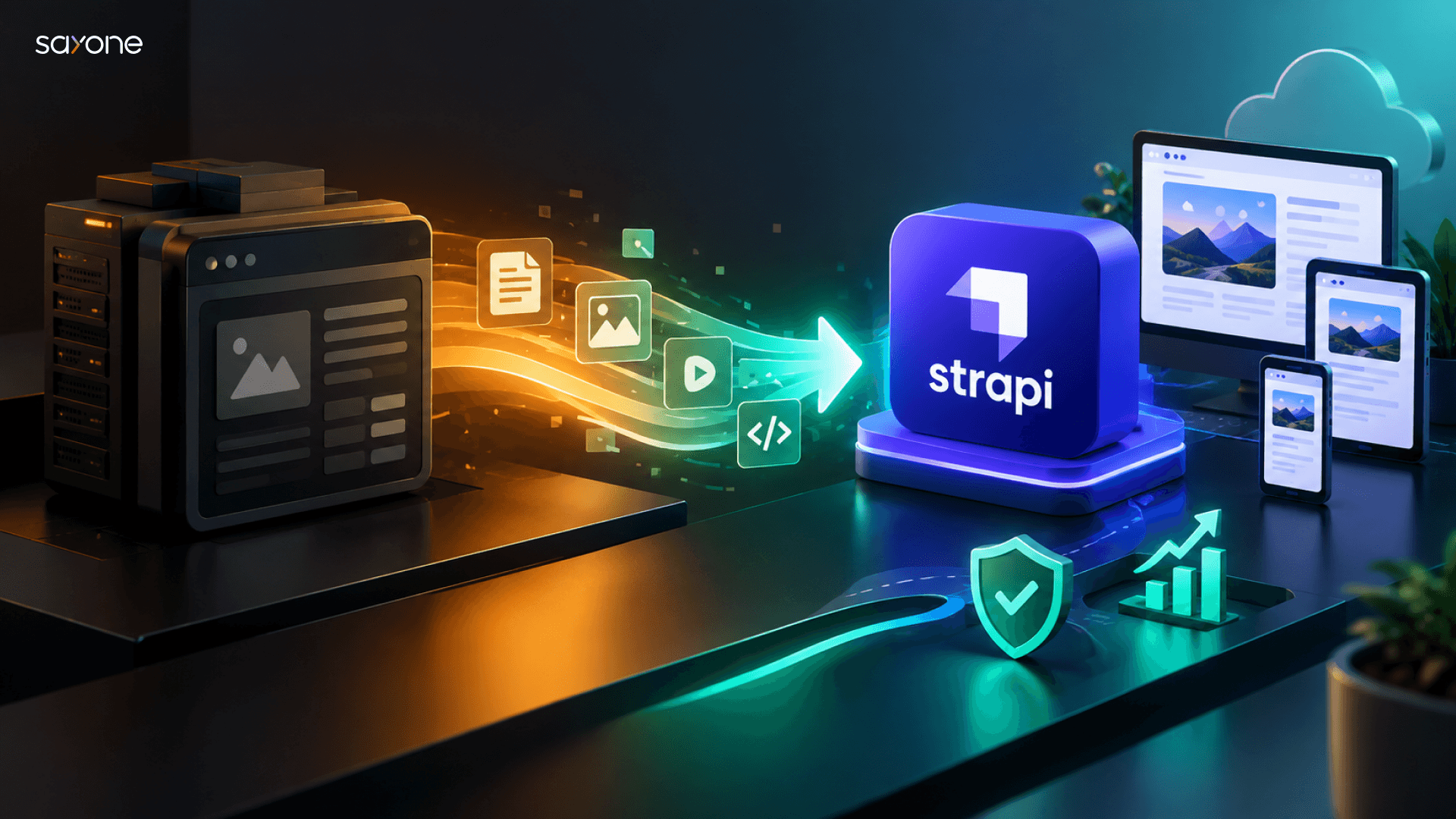
We went through this exact decision internally. When SayOne revamped its own website on Strapi, pairing the API-first approach with Next.js compressed the entire migration and redesign into seven days with no data loss. That's proof that the architecture itself isn't the bottleneck in a headless CMS migration. How the migration is sequenced is.
Beyond redesign speed, teams tend to cite the same two drivers. Content teams are tired of waiting on developers to publish a landing page, and product teams need the same content model to power a website, an app, and a partner integration without triplicating the effort. A traditional CMS forces content and presentation to live in the same system, so every new channel (a mobile app, a kiosk, a partner API) turns into a separate integration project instead of a new API consumer reading from the same content source.
There's also a talent-related argument that rarely makes it into the pitch deck. Headless architectures let frontend and backend teams work in parallel instead of blocking on each other, because the content API is a stable contract both sides can build against independently. For teams already running an agile release cadence, that alone can cut weeks off a typical feature timeline.
There are three things that tend to go wrong, and they usually happen in this order.
None of these are architecture problems. They're planning problems, and every one of them is avoidable with the right sequence. This is exactly what a migration playbook needs to get right before a single line of Strapi configuration is written.
There's a fourth failure mode worth naming separately, and it's scope creep. A CMS migration is tempting to bundle with a full redesign, a new design system, and a rebrand, all shipped in the same release. As Google's guidelines suggest, switching domains, CMS, and visual layout at the same time will make it very difficult to determine which of those changes caused the problem if something goes wrong. It would be better to distinguish between "What was changed?" and "What to look into?"
Google's own site migration guidance is direct about what matters most. Change one thing at a time, and use server-side 301 or 308 redirects for every URL that moves. As Google makes it clear, "301 and other permanent redirects do not cause any loss in PageRank," and traffic decrease usually results from lack or wrong redirects.
Preserve as many filenames and URL slugs as the new architecture will allow. Contentful's migration guidance makes the same point from the partner side. Teams that keep URL structures intact recover search visibility fastest, while teams that redesign the URL scheme and swap the CMS in the same project take the longest to stabilize.
Build patience into the plan, too. Google notes it can take "a few weeks or more" for a medium-sized site's new URLs to fully replace the old ones in search results, longer for larger sites, and recommends keeping every redirect live for at least a year while ranking signals transfer across. Cutting redirects early, even six months in, is one of the more common and entirely avoidable causes of a second traffic dip.
Downtime is expensive enough that it deserves its own line item in the migration plan. Enterprise-scale outages average over $1 million per hour once lost conversions and support load are factored in, and even modest sites see real costs climb once a migration window runs long. A migration is not the moment to gamble on an all-at-once cutover.
The practical fix is a dual-run architecture. Stand up Strapi as the content source of truth while the existing site keeps serving live traffic, sync content in both directions during a defined transition window, and switch DNS or routing only after the new stack has served a shadow-traffic sample without errors. This is the same phased-rollout discipline behind MACH-style architecture migrations. Start with a proof-of-concept slice of the site, expand once it's stable in production, and never move the whole site in a single deployment window.
![][image2]
Content modeling is very important in Strapi migrations. If it goes well, you can save months of future work, and if not, you may end up creating a second migration project eighteen months later.
Audit every content type in the legacy CMS before creating a single Strapi schema. Strapi's own migration guidance frames this as the central challenge of any headless move. Without an API-first content model designed up front, teams end up bolting structure onto content after the fact, which is slower and more error-prone than modeling it correctly the first time.
Map relationships, not just fields. A blog post that mentions an author, a category, and associated products requires this relationship to be retained as a structured reference in Strapi rather than a flat text reference. Otherwise, any subsequent integration would have to recreate this structure from scratch. The same discipline is what allowed SayOne to extend headless CMS benefits like omnichannel delivery and independent frontend development, into a real production timeline instead of a slide-deck promise.
The two migration paths diverge in ways that change both timeline and risk profile. The table below summarizes where the real differences show up in practice.
| Dimension | Traditional CMS-to-CMS Migration | Headless Strapi Migration |
|---|---|---|
| Content-Presentation Coupling | Tightly coupled; templates migrate with content | Fully decoupled; content model is presentation-agnostic |
| Redirect Complexity | Usually lower; URL structure often preserved | Can be higher if the new frontend restructures URLs |
| Downtime Risk | Higher with single-cutover exports | Lower with dual-run staging via API endpoints |
| Omnichannel Readiness | New integration needed per channel | New channels reuse the same content API |
| Developer Effort Upfront | Lower; templates ship with the platform | Higher; content modeling done up front |
| Typical Timeline (mid-size site) | 2–6 weeks | 3–8 weeks (no re-migration needed later) |
The practical takeaway is that a headless migration approach requires doing more upfront design with content modeling, but it pays off with a system that is not required to migrate again whenever a new channel is created. The traditional CMS migration process is typically quicker but the same coupling issue still remains, which means that you will be repeating yourself within a few years when the platform cannot accommodate more content.
The timeline can differ depending on the amount and complexity of the content, but some trends become apparent during most projects. For example, migrating a website with several hundreds of pages and a small set of content types takes up to two to four weeks after the completion of the content modeling phase. This is fairly close to the timeline SayOne quotes for Strapi projects.
A larger property with tens of thousands of pages, multiple locales, and several downstream integrations should plan for a phased rollout measured in months, not weeks, with search visibility monitored continuously through each phase rather than only at the end. Whatever the timeline, resist the temptation to compress redirect testing and content QA phases to hit an internal deadline. Every week saved by skipping validation tends to cost two or three weeks later, diagnosing a ranking drop or a broken content relationship after the fact.
Review Google Search Console daily for the first month. Pay attention to older URLs falling out of the index while newer URLs become indexed, and fix any sudden increase in crawl errors as soon as possible, rather than letting it backlog. Make sure to have a fresh copy of the sitemap submitted regularly, because an outdated sitemap is one of the main causes why migration takes too long to complete.
On the internal side, conduct a full regression test for all types of content, not just for the homepage and key landing pages. This is when relationship fields and rich-text embeds will silently fail during the headless migration.
Finally, keep the old redirect map documented and versioned, even after traffic stabilizes. Six months later, when someone asks why an old campaign URL still works, that map is the difference between a five-minute answer and a re-investigation.
We treat a CMS migration as an SEO project and an engineering project at the same time, not a developer task that happens to touch search rankings. That's the standard we held our own migration to, and it's the standard behind the Strapi CMS development services we run for clients with custom API design, role-based access control, internationalization, and admin panel customization, typically delivered in two to four weeks depending on content complexity.
SayOne has managed migrations that protect search rankings and ensure clients retain their hard‑earned traffic without disruption. If you're planning a move to Strapi and want a second set of eyes on the redirect map before the transition, talk to our Strapi team, and we'll tell you honestly whether your timeline is realistic.
The real range is two weeks to several months, and the readiness of content modeling determines how long you will stay on either side of that range rather than just the number of pages. A team which comes ready with all the content types, relationships, and a map of redirects will get through a mid-sized website in no time. A team which needs to scope content architecture only once the project starts will find the timeline elongating regardless of the actual number of pages in the website.
The difference shows up a year or two later. A traditional CMS-to-CMS move can be faster to execute because content and templates travel together, but it leaves the same content-presentation coupling in place, so the next time you need a new channel or a platform change, you're doing this whole project again. A Strapi migration spends more time upfront on content modeling specifically so the next channel is a new API consumer, not a new migration. If you're confident this is the only CMS change you'll make for years, traditional may still be the pragmatic choice.
At least a year, but trust your analytics over the calendar. Watch direct and referral traffic still hitting the old URL patterns specifically; once that traffic has been negligible for a few consecutive months beyond the one-year mark, the redirects are doing less work and can reasonably be retired. Pulling them the moment a year passes without checking whether traffic to old URLs has actually gone quiet is how teams end up walking a redirect back in a hurry.
Beyond content types and their relationships, check three things that rarely make the first pass of an audit: media assets referenced by URL rather than uploaded natively, which break silently if the old file paths disappear; custom meta fields used for SEO or schema markup that don't have an obvious home in a generic content type; and any content that was hand-edited directly in the old CMS's database or admin panel outside the normal publishing flow, since that's exactly the content most likely to get missed by an automated export.
The most common mistake is treating it as an IT-only project. The people who will actually publish into Strapi day to day need to review and sign off on the new content model before launch. A content model that makes perfect sense to the engineers who built it can be genuinely confusing to editors who weren't part of designing it, and that friction shows up as slower publishing and workarounds for months if it isn't caught early.
We're committed to your privacy. SayOne uses the information you provide to us to contact you about our relevant content, products, and services. check out our privacy policy.

We collaborate with visionary leaders on projects that focus on quality