
Subscribe to our Blog
We're committed to your privacy. SayOne uses the information you provide to us to contact you about our relevant content, products, and services. check out our privacy policy.



Generating table of contents...
React Native still powers a large share of the cross-platform mobile apps shipping to iOS and Android from one codebase. Finding the engineer who can actually deliver on that promise is a separate problem from finding someone who lists React Native on a résumé.
Most companies start a search by posting a job description and hoping for the best. The replies fill up with marketplace freelancers, staffing shops, and generalist mobile agencies, and the buyer is left guessing which one can actually ship production code. This guide sets out what to test for when hiring React Native developers, which engagement model fits which project, what the hire should realistically cost, and the contract terms worth locking down before work begins.
React itself remains one of the most widely used front-end libraries among professional developers, at 46.9% adoption. That pool of React engineers is where most React Native hiring draws from, which is also why the hiring process so often turns up candidates who know React well but have never touched a native module.
The broader software engineering labor market supports the demand too. The U.S. Bureau of Labor Statistics projects 10% employment growth for software developers between 2025 and 2035, well ahead of the average occupation, with a median annual wage of $135,980 as of May 2025.
Team structure matters here as much as headcount. The most recent survey found that more than 80% of respondents work in teams of five developers or fewer. On a team that size, one weak hire does not get absorbed quietly. It shows up in the sprint immediately.
A résumé that lists React Native tells you almost nothing. What predicts whether someone can ship a React Native app under real constraints is a narrower set of skills, and most interview processes never get around to testing them.
Ask candidates to walk through, in detail, rather than just confirm they've "worked with" each of the following:
Can they describe writing or debugging a native module in Swift or Kotlin, and explain what happens when a bridge call fails silently on one platform but not the other?
Have they used Flipper or Hermes to find a JS-thread bottleneck, and can they explain the difference between a UI-thread stutter and a JS-thread one?
TypeScript overtook both Python and JavaScript to become GitHub's most-contributed-to language in 2025, growing its contributor base by 66.6% year over year, according to GitHub's Octoverse 2025 report. Most production React Native codebases are TypeScript-first now, so a candidate who can only write loosely typed JavaScript will slow a team down rather than speed it up.
Ask them to justify a choice between Redux, Zustand, or built-in React state for a specific scenario, rather than just name the one they used last. The same State of React Native survey found Redux drew more negative feedback than any other state-management library, while React's own built-in state handling scored better among respondents.
Expo's EAS Build is now used by 71% of surveyed React Native developers, alongside Xcode and Android Studio for platform-specific builds. A candidate who has only ever run expo start on a managed workflow may not be ready for a project with custom native modules.
Unit tests around business logic, integration tests around navigation and data flow, and at least a working opinion on when end-to-end testing is worth the maintenance cost.
A short paid trial task, scoped to two or three days of real work against your actual codebase or a representative sample, filters out more unqualified candidates than any number of interview questions.
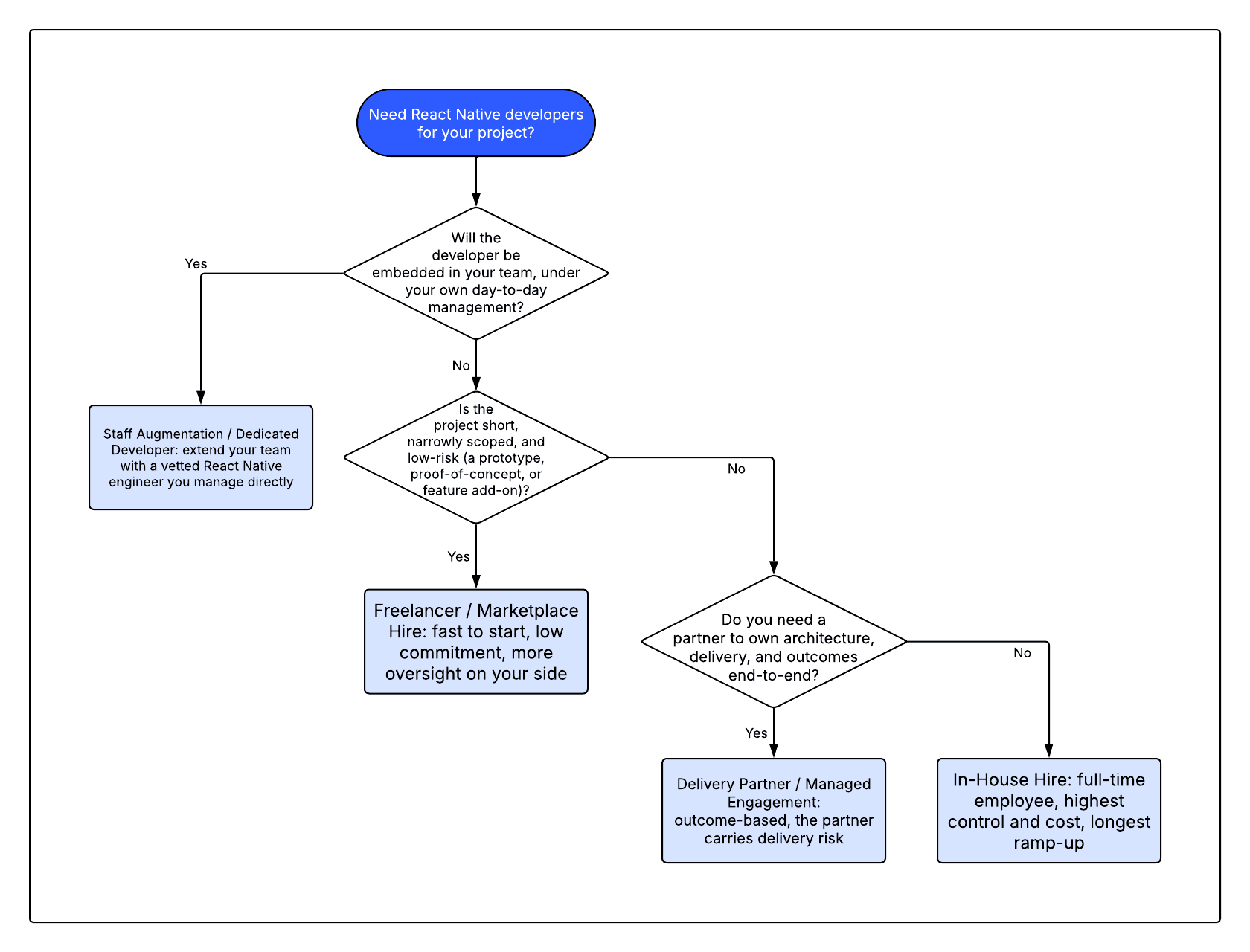 Once you know what to test for, the next decision is how to structure the hire. There are four common models, and the right one depends on how long the work lasts and how much day-to-day oversight you want to provide.
On one React Native engagement, a client needed a specialist to resolve a Bluetooth-printer integration that only misbehaved on certain Android devices. The fix took six weeks of focused native-module work and then nothing further. A staff-augmentation hire solved that cleanly. A full-time requisition would have left the role unfilled for months after the work was already done.
The four models, in brief:
A full-time employee, embedded in your team permanently. Highest control and cost, and the longest ramp-up, but the right call when React Native work is a permanent, growing part of your roadmap.
You bring in a vetted engineer who works inside your existing team and reporting structure, without the overhead of a full-time requisition. Our guide on what a dedicated development team is and when to hire one covers this model in more detail.
Fast to start and low commitment, but you carry most of the oversight, code review, and architecture decisions yourself. Workable for small, well-scoped features; risky for anything load-bearing.
You hand off an outcome, not a seat. The partner carries delivery risk, architecture decisions, and often QA. Our comparison of hiring dedicated developers versus outsourcing walks through how to decide between managing the work yourself and handing it off.
Most organizations don't pick one model and stay there for the life of a product. 80% of executives plan to maintain or increase their investment in outsourced engagement models, while 70% say they've selectively brought work back in-house over the last five years. Treat the choice as a decision you'll likely revisit, not a one-time commitment. If your organization is already running a broader IT staff augmentation program, adding a React Native specialist to it is usually the fastest path to a vetted hire.
The table below compares the four models across the factors that matter most when you're hiring React Native developers.
| Engagement Model | Day-to-Day Control | Cost Structure | Ramp-Up Speed | Best Fit |
|---|---|---|---|---|
| In-House Hire | Full control, direct management | Salary, benefits, and overhead | Slowest (recruiting plus onboarding) | Permanent, growing React Native workload |
| Staff Augmentation / Dedicated Developer | High, managed like your own team | Predictable rate, no benefits overhead | Fast (days to a few weeks) | Defined-scope work needing day-to-day oversight |
| Freelance / Marketplace Hire | Low, you own code review and architecture | Lowest upfront, variable quality risk | Fastest to start | Small, well-scoped features |
| Delivery Partner / Managed Engagement | Outcome-based, partner owns delivery | Scoped to outcome, not hours | Moderate (ramp time for the team) | Full feature builds or ongoing product ownership |
Cost depends on seniority, the complexity of the native-module work involved, region, and how long the engagement runs, so any single number without those details attached is not useful. A few anchors are worth knowing.
For an in-house role, the U.S. Bureau of Labor Statistics puts the median annual wage for software developers at $135,980 as of May 2025, a useful benchmark even though React Native specialists with native-module experience often command a premium over that median. Staff augmentation and dedicated-team engagements typically price below a fully loaded in-house hire once recruiting, benefits, and ramp-up time are counted in, while freelance and marketplace rates vary widely by region and track record. Delivery-partner engagements are usually quoted against a defined scope and outcome rather than an hourly rate, which shifts delivery risk onto the partner rather than your internal team.
Ask any prospective hire or partner to break down their rate by activity: development, code review, QA, and project management are often bundled into one number, and unbundling it is the only way to compare quotes honestly.
The contract terms matter as much as the technical vetting, and they get skipped far more often than they should.
Confirm in writing that all code, including any custom native modules, transfers to you on payment, not on some later milestone.
Require setup instructions, architecture notes, and comments on any non-obvious native bridging code as a condition of final payment, not an optional extra.
Build in a fixed period, typically 30 to 90 days, during which the developer or partner fixes defects in their own work at no additional cost.
Especially relevant for staff augmentation and delivery-partner models, where the people doing the work may not be your direct employees.
A few patterns show up repeatedly in React Native engagements that go wrong:
The candidate cannot explain, in their own words, how the JavaScript bridge works or why it matters for performance.
Their portfolio links to apps they "contributed to" with no detail on which parts were theirs.
They resist a paid trial task or a code review of recent work.
Their quoted rate sits well below typical market rates with no explanation, which usually means subcontracting to someone with less experience than advertised.
They can't name a React Native app they shipped that is still live and maintained today.
Any one of these is worth a direct follow-up question. Two or more together are a reason to keep looking.
React Native earns its place when you need one team shipping to iOS and Android at a similar pace, with most of the UI and business logic shared across platforms. It is a weaker fit for apps built around heavy 3D rendering, deep AR features, or platform APIs that have no mature React Native bridge yet, where fully native development or a framework comparison is worth doing first. Our breakdown of React Native versus Flutter covers how to make that call before you start hiring for either stack.
The teams that hire well for React Native treat it as three separate decisions made in order: what to test for, which engagement model fits the work, and what contract terms protect the outcome. Skipping any one of the three is usually where a hiring mistake traces back to.
SayOne works across all four engagement models described above as part of our React Native development company services, from a single staff-augmentation hire to a fully managed delivery team. If you'd like a second opinion on a candidate, a team structure, or a project scope before you commit, get in touch with our team.
Yes, for most apps that need to ship on iOS and Android from a shared codebase and don't depend on heavy native rendering. It remains one of the most widely adopted cross-platform frameworks, and recent surveys of React Native teams show steady investment in tooling such as Expo's EAS Build rather than teams abandoning the stack.
A React developer builds browser-based interfaces with the DOM, while a React Native developer builds mobile interfaces that compile to native iOS and Android components and often has to write or debug native modules in Swift or Kotlin. The two skill sets overlap on JavaScript and component architecture, but a strong React developer is not automatically ready for the native-bridging work a mobile app requires.
Cost varies by seniority, region, and engagement model, so there is no single figure that applies everywhere. The U.S. Bureau of Labor Statistics puts the median annual wage for software developers at $135,980 as of May 2025, which is a reasonable anchor for an in-house hire in the United States, while staff augmentation, freelance, and delivery-partner pricing each follow a different structure.
A freelancer suits a small, well-defined feature where you can handle the code review and architecture decisions yourself, while a dedicated team or delivery partner fits ongoing or architecturally complex work where you want someone else accountable for the outcome. The right choice depends more on how much oversight you want to provide than on budget alone.
Ask them to walk through a native module they have written or debugged, explain how they have diagnosed a performance issue using a profiler like Flipper or Hermes, and justify a state-management choice for a specific scenario rather than just naming a library they have used. Candidates who can only describe surface-level JavaScript work usually have not done the native-side debugging a production app eventually requires.
A staff-augmentation or dedicated-developer hire can usually start within one to three weeks once a vetted candidate is identified, while a full in-house hire typically takes six to ten weeks through sourcing, interviews, and offer negotiation. A short paid trial task before the final decision adds a few days but substantially lowers the risk of a bad hire.
We're committed to your privacy. SayOne uses the information you provide to us to contact you about our relevant content, products, and services. check out our privacy policy.


We collaborate with visionary leaders on projects that focus on quality