
Subscribe to our Blog
We're committed to your privacy. SayOne uses the information you provide to us to contact you about our relevant content, products, and services. check out our privacy policy.



Generating table of contents...
Apple's ecosystem has grown stricter over the past two app review cycles. App Review now scrutinizes privacy manifests, background permissions, and third-party SDK behavior more closely than it did two years ago, and enterprise buyers are funding more native mobile work as a result of broader digitalization budgets. Mordor Intelligence's enterprise mobile application development market research tracks continued growth in enterprise mobile spend through the back half of the decade, driven largely by organizations replacing fragile web wrappers with native apps that can pass compliance review on the first attempt.
That shift changes what "hiring an iOS developer" actually means. It is no longer just a question of who can write Swift. It is a question of who can navigate App Store policy, manage offline data sync, and hand over a codebase someone else can maintain after they leave. Get the hire or the engagement model wrong, and the cost shows up later: a rejected build two days before a launch event, or a codebase so tightly coupled to one person's habits that nobody else can safely touch it.
This guide walks through what to test for, which engagement model fits your situation, what a release-ready partner should be able to show you, realistic cost ranges, the ownership terms worth writing into a contract, and the red flags that tend to predict expensive rework.
A resume full of "5 years of iOS development" tells you little. What matters is whether a candidate or team can demonstrate judgment on the specific decisions that determine whether an app ships cleanly:
Most new development is SwiftUI-first, but large existing codebases still run on UIKit, and a developer who only knows one will struggle on mixed projects. Ask for a walkthrough of when they would reach for UIViewRepresentable to bridge the two, not just a definition of each framework.
Swift's structured concurrency model (async/await, actors) has matured, and Stack Overflow's 2026 Developer Survey technology data still shows Swift holding a loyal, if smaller, share of working developers compared to cross-platform languages, meaning the available talent pool rewards careful screening over assuming competence by default.
Ask how they would structure local persistence (Core Data, SwiftData, or a custom layer) so the app behaves correctly when connectivity drops mid-transaction.
A developer who can explain why they chose MVVM, TCA, or a simpler pattern for a specific app's complexity is more valuable than one who defaults to the same architecture regardless of project size. For a broader look at how these choices play out across platforms, see this breakdown of modern mobile app architecture patterns.
Ask candidates to walk through a real decision they made on a past project and what they would do differently now. Hesitation or vague answers on these points are a stronger signal than anything on a resume.
There is no single right way to bring in iOS talent. The decision mostly comes down to two questions: do you already have someone in-house who can own architecture and code review, and do you want a partner to own the delivery outcome or simply add capacity to your team.
The diagram below walks through that decision, and it maps onto four common models:
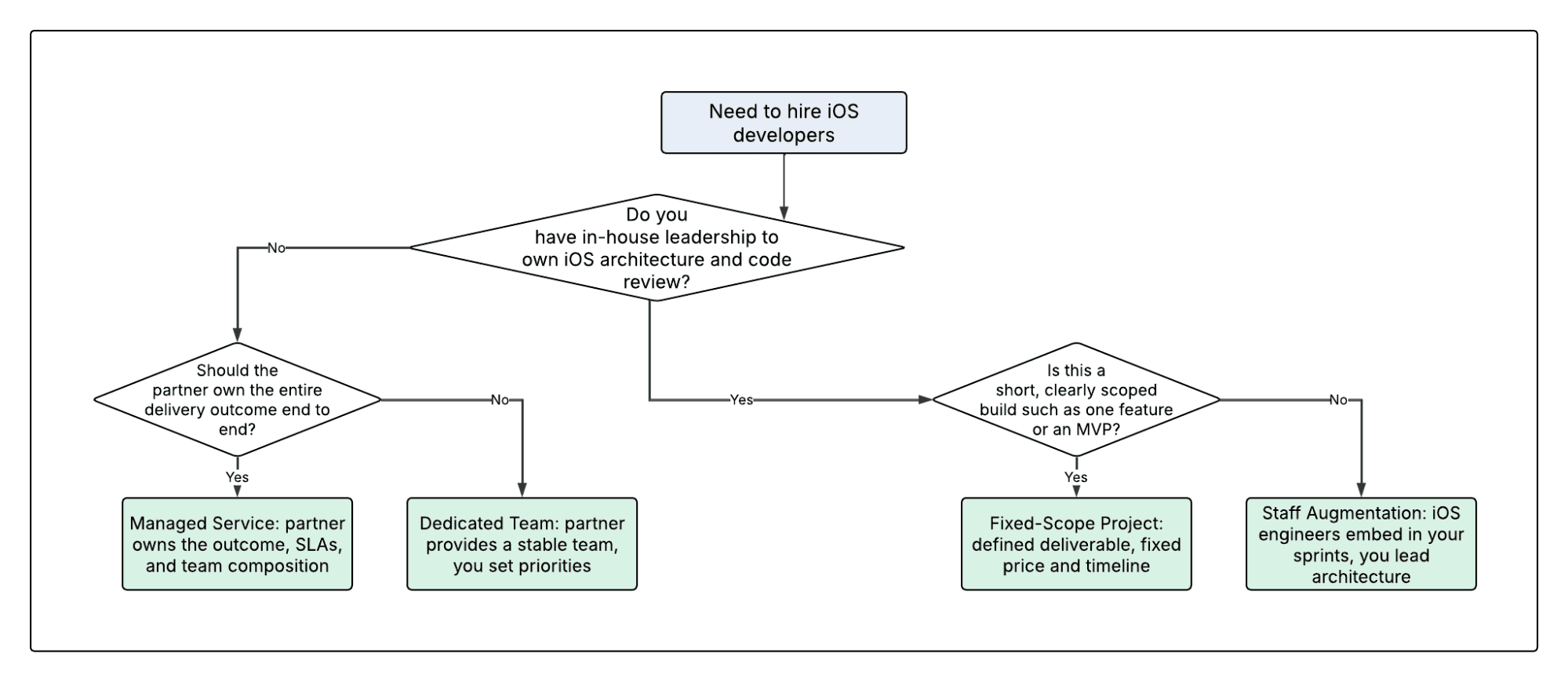
| Engagement Model | Who Directs the Work | Best Fit | Typical Commitment | Who Owns Delivery and QA |
|---|---|---|---|---|
| Staff Augmentation | Your team's leads and PM | You have in-house architecture ownership and need more hands on existing sprints | Ongoing, flexible | You |
| Dedicated Team | Your product owner sets priorities; partner manages the team | You need a stable, long-term team without hiring full-time | 3+ months, renewable | Shared, with partner managing day-to-day |
| Fixed-Scope Project | Partner, against an agreed spec | A clearly bounded build, such as one feature or an MVP | Defined start and end date | Partner |
| Managed Service | Partner, against agreed outcomes and SLAs | You want to hand off an outcome entirely, including ongoing support | Ongoing, outcome-based | Partner |
Talent scarcity is part of why staff augmentation and dedicated-team models have grown so common. Deloitte's Global Business Services survey found that technology talent gaps remain one of the most cited constraints on delivery speed, which is pushing more teams toward flexible staffing rather than waiting out a slow full-time hiring cycle. If you're also weighing outsourcing against building an internal bench, this comparison of hiring dedicated developers versus outsourcing breaks down how the competing priorities of cost, control, and speed play out by project type.
Industry teams often learn this the hard way: a retail brand building its first native checkout flow brought in a fixed-scope contractor to ship quickly, only to discover after launch that nobody owned ongoing App Store compliance updates. They ended up converting to a dedicated-team arrangement mid-project, which cost more in transition time than starting with the right model would have.
A developer who has never carried an app through App Review under their own name is a different risk than one who has done it repeatedly. Before committing, ask for specifics:
A recent example of a rejection they resolved, and what caused it (privacy manifest issues, metadata mismatches, and background permission misuse are common causes right now).
How they handle phased or staged rollouts to limit blast radius if a release has a problem.
Their process for responding when Apple changes a review requirement mid-cycle, since Apple's own App Review Guidelines are updated on a rolling basis rather than all at once.
If a candidate or partner cannot describe at least one rejection they have handled, treat that as a gap worth probing further. Weigh it against the urgency of your release timeline before deciding how much it matters.
Published rate figures vary widely by region, seniority, and engagement model, so treat any single number as a starting point rather than a quote. MentorCruise's 2026 iOS engineer salary guide places senior full-time iOS engineer compensation in established tech markets well above general software engineering averages, reflecting both the specialized skill set and the smaller applicant pool compared to web development roles.
A few factors move the number more than seniority alone:
Staff augmentation and dedicated-team arrangements typically price by role and seniority; fixed-scope and managed-service engagements price by outcome, which can be cost-effective for well-defined work but harder to compare directly.
Apps handling payments, health data, or regulated industries need developers comfortable with additional review cycles, which affects rate and timeline.
Distributed and offshore teams can offer meaningfully lower-cost access to experienced Swift developers without necessarily trading down on quality; this guide on reasons to consider hiring software developers in India covers what to check before assuming cost alone tells the full story.
Ask any prospective partner for a rate breakdown by role so you can see what you are actually paying for, rather than accepting a single blended number.
This is the term sheet detail most buyers skip until it becomes a problem. Before signing, confirm in writing:
Who owns the compiled app, the source code, and any custom tooling built along the way. Ownership should transfer fully to you at handover rather than stay licensed from the partner.
Whether third-party libraries or proprietary internal frameworks are included, and under what license.
What happens to App Store Connect access, certificates, and provisioning profiles if you end the engagement. These should live under your organization's own account rather than a contractor's personal one.
Documentation and handover obligations: architecture decisions, environment setup, and test coverage should be handed over in a form someone new can actually use.
A partner that resists putting these terms in writing, or treats them as a minor detail, is signaling how they will behave later if the relationship ends.
A few warning signs show up consistently in projects that end up needing significant rework:
No automated tests beyond the basics. If a team can't describe their unit and UI test coverage, assume technical debt is accumulating quietly.
Security treated as an afterthought. Weak handling of keychain storage, certificate pinning, or local data encryption rarely gets caught until an audit or a breach forces the issue; this checklist of mobile app security practices is a reasonable baseline to hold any partner to.
Vague answers about who owns App Store Connect access. If nobody can tell you clearly, that is itself the red flag.
Reluctance to share past rejection history. Everyone who has shipped enough apps has had one rejected. A team that claims otherwise is either inexperienced or not being candid.
Pricing that is dramatically below the range you've seen elsewhere with no explanation. It usually means scope will expand later, or quality will be the hidden cost.
None of these alone should end a conversation, but two or more together are worth treating as a real signal rather than a coincidence.
The strongest iOS hires and partners combine three things: technical judgment you can verify in a conversation, an engagement model that matches how much ownership you want to keep in-house, and contract terms that protect you if the relationship changes. A resume rarely surfaces any of that; the way a candidate or partner answers the harder questions above does.
If you're evaluating options for your next build, SayOne's iOS app development team works across staff augmentation, dedicated-team, and managed-service models, and can walk through which one fits your current stage. Get in touch with our team to talk through your project's specifics.
Cost depends mainly on engagement model and location rather than skill level alone. A full-time senior iOS engineer in an established tech market typically costs more than a dedicated-team or staff-augmentation arrangement with an experienced offshore or nearshore partner, while fixed-scope projects are priced against a defined deliverable rather than an hourly or monthly rate. Ask any partner for a role-by-role rate breakdown instead of a single blended figure so you can compare offers accurately.
Yes, demand remains strong, particularly for developers who can handle SwiftUI, structured concurrency, and App Store compliance requirements that have grown more technical over the past few review cycles. Enterprise buyers are increasingly funding native mobile builds instead of web-wrapped alternatives, which keeps experienced Swift talent in short supply relative to general web development roles.
Staff augmentation places individual developers inside your existing team, with your own leads directing their day-to-day work and owning architecture decisions. A dedicated team is a complete unit supplied and managed by the partner, with your product owner setting priorities while the partner's management handles staffing, quality, and delivery process. Choose staff augmentation when you already have strong in-house technical leadership, and a dedicated team when you need a stable unit without building that leadership yourself.
Apple's standard review typically completes within a few days once a build is submitted, but that clock only starts after the app is fully compliant with current guidelines on privacy manifests, permissions, and metadata. The real time cost usually comes from rejection-and-resubmission cycles rather than the review itself, which is why vetting a partner's track record of first-time approvals matters more than the published review-time average.
A freelancer can work well for a small, clearly scoped task with a short timeline and no ongoing maintenance need. A development company is the safer choice for anything involving App Store compliance, long-term support, or work that needs to survive a single person's availability, since it spreads knowledge across a team and typically carries contractual accountability a freelancer cannot offer. Match the choice to how much risk you can absorb if one person becomes unavailable mid-project.
Prioritize practical judgment over years of experience alone: fluency in both SwiftUI and UIKit, a clear approach to structured concurrency and offline-first data handling, and the ability to explain architecture choices for a specific app rather than defaulting to one pattern every time. Direct experience taking an app through App Store review and resolving a rejection is also a strong signal, since that process trips up developers who have only worked on side projects or internal tools.
We're committed to your privacy. SayOne uses the information you provide to us to contact you about our relevant content, products, and services. check out our privacy policy.

We collaborate with visionary leaders on projects that focus on quality