
Subscribe to our Blog
We're committed to your privacy. SayOne uses the information you provide to us to contact you about our relevant content, products, and services. check out our privacy policy.



Generating table of contents...
Most companies that make a poor choice in a managed DevOps partner do not discover the problem on day one. They discover it six months later, when their deployments are still as unpredictable as before, their team is spending more time in status calls than shipping code, and the contract they signed gives them very little room to change course. The managed DevOps services market is growing fast. Valued at $4.5 billion in 2024, it is projected to reach $54.8 billion by 2034 at a 28.4% compound annual growth rate. More vendors entering the space means more choice, and more room to pick the wrong one. This guide is written for business leaders and technical decision-makers who want a clear, structured approach to finding the right partner, without getting lost in vendor pitches or technical jargon.
The short answer is that hiring is broken. DevOps job postings have grown roughly 18% year over year since 2020, but the supply of qualified engineers has not kept pace. A senior DevOps engineer today demands $180,000 to $220,000 annually in total compensation. Build a team of three to four specialists and you are looking at $600,000 to $900,000 before benefits, bonuses, or recruitment fees. And 37% of IT leaders identify DevOps and DevSecOps skills as the primary technical gap in their teams, meaning the engineers who are available are fiercely competed for.
Beyond headcount, the complexity of modern infrastructure has raised the bar for what an in-house team needs to know. Kubernetes, Terraform, GitOps, multi-cloud architectures, compliance automation, and AI-powered observability did not all exist five years ago. Expecting one or two internal hires to cover all of it is unrealistic for most organizations. If you are weighing your options, our guide on how to build a DevOps team outlines what a well-structured internal setup actually requires.
A managed DevOps service provider fills this gap by taking operational ownership of your CI/CD pipelines, infrastructure automation, monitoring, and incident response. Your internal engineers focus on product development. The provider handles the toolchain.

Managed DevOps providers embed alongside your engineering team to own infrastructure operations.
Before evaluating vendors, it helps to understand the scope of what you are buying. This varies more than most buyers expect. A full-service managed DevOps engagement typically covers four areas.
Your provider designs, builds, and maintains CI/CD pipelines using tools like GitHub Actions, GitLab CI, Jenkins, or Azure DevOps Pipelines. When a pipeline breaks at 11pm, they fix it, not your team.
Environments are provisioned and maintained through code, using Terraform, Pulumi, or AWS CloudFormation. This eliminates configuration drift, makes infrastructure auditable, and ensures every environment from development to production is reproducible.
Monitoring stacks, alerting logic, on-call schedules, and runbooks are part of the managed service. Mean time to recovery (MTTR) against a defined SLA is a contractual commitment, not a hope.
Mature providers embed DevSecOps practices from day one. Vulnerability scanning, secrets management, container image checks, and policy-as-code run inside the pipeline rather than after deployment.
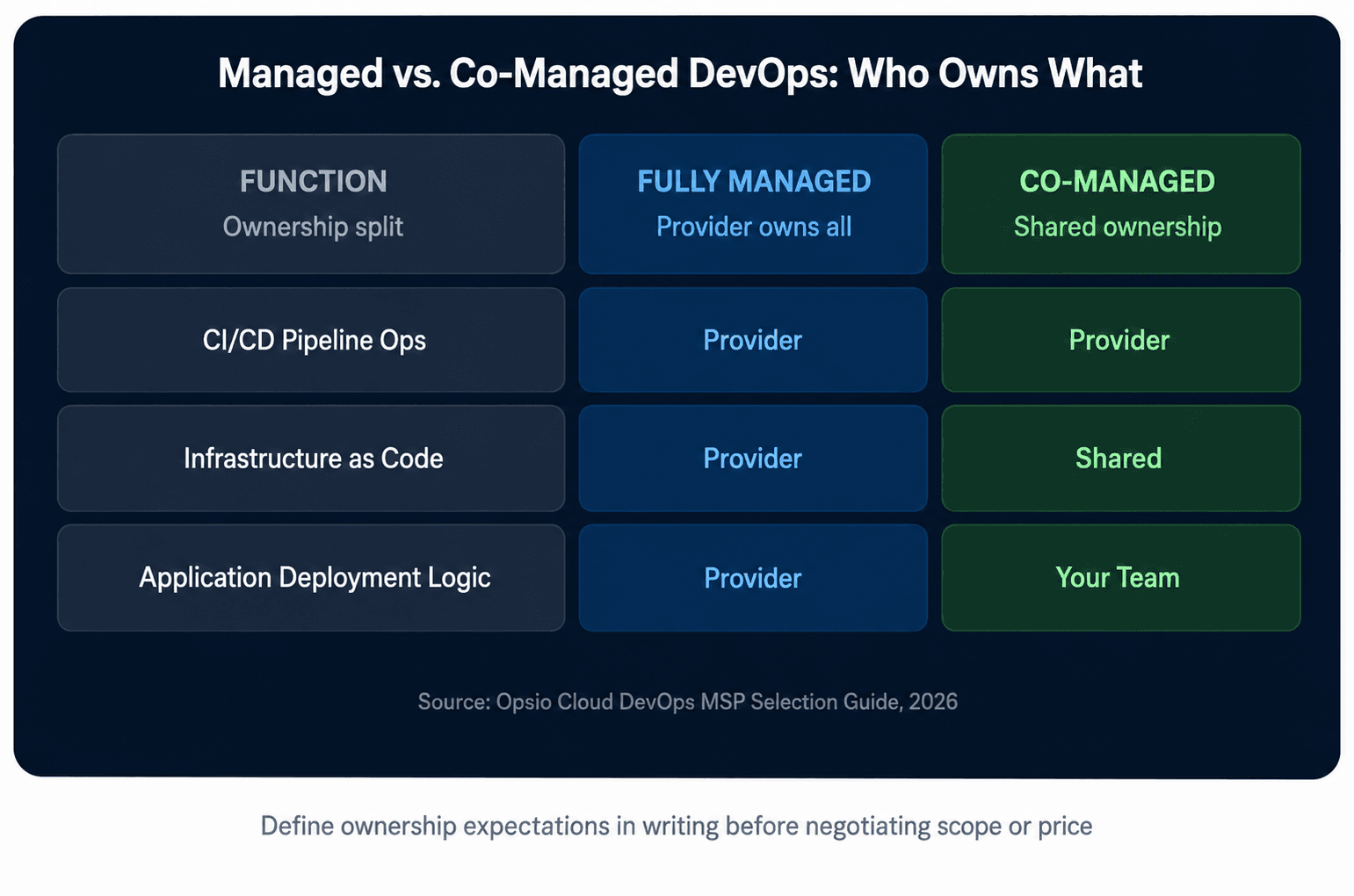
A co-managed model is also common: the provider takes ownership of specific domains, such as Kubernetes operations or security tooling, while your internal team retains ownership of application deployment logic. Understanding which model you need before starting vendor conversations saves significant time.
This is where most evaluation guides stop at technical checklists. The real differentiators are harder to measure but far more predictive of long-term success.
A provider may be exceptional on AWS and genuinely inexperienced on Azure. Or they may have strong Kubernetes expertise but thin coverage in the serverless patterns your team uses. Asking for case studies from clients with a similar tech stack is not optional. It is the most basic due diligence. Questions worth asking directly: What version of Terraform are your current clients on? How do you manage multi-cloud connectivity for clients using both Azure and AWS? What tooling do you use for secret management in Kubernetes workloads? The answers reveal depth quickly. Vague answers about "supporting all major cloud platforms" are a warning sign, not a reassurance.
A startup that needs to go from zero CI/CD to a working deployment pipeline in four weeks has different needs than an enterprise that wants to transfer operational ownership of a complex, multi-region Kubernetes cluster. Providers are better or worse fits for each scenario, and few excel at both. Look for a match between your current DevOps maturity level and the provider's typical starting point. The DORA metrics (deployment frequency, lead time for changes, change failure rate, and mean time to recovery) are a useful common language here. You can read the Opsio DevOps MSP guide for an external perspective on how mature providers benchmark against these indicators. Ask the provider what DORA benchmark their clients typically reach after 12 months of engagement.
Managed services without measurable SLAs are consulting services with a retainer fee. The difference matters. A properly managed DevOps SLA should specify: guaranteed response time for P1 incidents, target MTTR, monthly uptime commitments for managed infrastructure, and the escalation path when any of these are breached. Organizations that contain incidents within 200 days save an average of $1.14 million per breach compared to those that take longer, according to IBM's 2025 Cost of a Data Breach Report. Slow incident response is not a minor inconvenience. It carries a quantifiable financial cost. Any provider unwilling to commit to specific response times in writing is transferring that cost risk back onto you.
33% of organizations cite skills shortages as their top DevOps challenge, and security skills are the most acute gap. A managed provider that treats security as a separate workstream, rather than something embedded into pipeline execution, is operating on a model that is already out of date. Ask specifically: Do you run SAST and DAST scans inside the pipeline or as post-deployment checks? How do you handle secret rotation for service connections and API keys? What compliance frameworks have you implemented for clients in regulated industries? If the provider uses a GitOps delivery model, that is often a strong signal of operational maturity. For businesses in fintech or healthcare, the answers to these questions determine whether a provider can actually support your regulatory requirements or whether compliance becomes your team's problem to manage around their delivery.
This is the question most providers are least eager to answer directly. Many managed service models staff accounts with junior engineers executing against runbooks, supervised by a senior architect who appears on quarterly reviews. For stable, predictable environments, this works fine. For complex migrations, architecture decisions, or incident-heavy periods, it does not. Ask for the composition of the team that will actually work on your account. Understand who shows up during a P1 incident at 3am. Get names, not titles.
Evaluating purely on price is the most common error, and the most costly. Selecting the cheapest provider frequently results in poor implementations that ultimately cost more to remediate, according to Opsio's 2026 DevOps selection guide. The savings on a lower monthly retainer disappear quickly when the engagement generates rework, missed SLAs, or a pipeline failure during a product launch.
Three other mistakes appear repeatedly across failed engagements.
If you and the provider cannot agree, in writing, on what success looks like at three months and twelve months, you have no shared basis for evaluating whether the engagement is working.
The best technical provider in the world creates friction if their communication style, working hours, and escalation norms do not match your team's expectations. A 30-minute discovery call is not enough to assess this. Ask for a two-week pilot or a structured handover conversation with the team that will actually be delivering.
What happens when the engagement ends? Does the provider document everything they build, or does your infrastructure become opaque to your own team? Contracts should specify documentation standards, code ownership, and knowledge transfer timelines.
If your organization already uses Azure DevOps for pipeline management, choosing a managed provider with deep Azure expertise changes what you can expect from the engagement. Providers with genuine Azure DevOps experience will configure service connections correctly from day one, using Workload Identity Federation rather than service principal secrets that expire without warning. They will structure environment-separated connections so a development pipeline cannot accidentally touch production resources. They will build audit trails that satisfy compliance reviewers without requiring manual effort from your team. The previous blog in this series covers what Azure DevOps service connections are and why they matter for businesses. Getting these configured properly is one of the first things a skilled managed provider does. If a vendor does not bring this up unprompted during an evaluation conversation, that tells you something about the depth of their Azure practice.
Finding a managed DevOps partner is a different decision from finding a vendor. You are not buying a product. You are choosing who owns the reliability of your software delivery, the security of your deployment pipelines, and the infrastructure that your team depends on every day.
The evaluation framework matters less than the quality of the conversations it generates. The best providers welcome hard questions about SLAs, team composition, and knowledge transfer. The ones to avoid are those who pivot every answer back to a features list.
At SayOne Technologies, we work with businesses across fintech, healthcare, and SaaS to build and manage DevOps infrastructure that scales without creating operational debt. Whether you need a full managed DevOps engagement, a CI/CD audit, or help designing an Azure DevOps governance model that works at enterprise scale, our team brings hands-on delivery experience rather than advisory-only support.
If you are evaluating managed DevOps partners, we are happy to be part of that conversation. Connect with a consultant from our DevOps practice will follow up within one business day.
A DevOps Consultant will analyze your environment and propose changes. The cooperation stops after the scope of the project is completed. DevOps MSP will be responsible for the operations on an ongoing basis, running pipelines, handling incidents, maintaining infrastructure, and pushing for continuous improvements. DevOps MSPs usually measure DORA metrics as a part of their contractually defined KPIs instead of optional metrics. This is one of the biggest distinctions between these approaches from a structural point of view.
It all comes to price, time and scale. It costs from $600K to $900K per year to hire three-four DevOps engineers internally in the US market, excluding salaries and recruitment fees. Currently, it takes three-six months to hire senior DevOps professionals. When you can’t afford these expenses or timing and still need to keep your deployment process reliable, you should consider using a managed service.
The four DORA metrics – deployment frequency, change lead time, change failure rate, and mean time to recovery – are considered the standard. Besides them, you can also use trends in cloud costs, SLA achievement rates, and the number of unexpected outages quarterly. Organizations that use the same metrics to assess their managed DevOps partners' performance in advance receive significantly better results than others that use a general impression approach.
Yes, but quality is not always high enough. All providers claim that they can work with multiple clouds; however, their level of expertise is not the same on both platforms. Managed DevOps providers working in the field of cloud cost optimization achieve 20-35% saving on a monthly cloud bill through the right sizing and tagging, so ask for their customer references for the environment you need.
The typical perception of a managed DevOps service is one that takes care of server management. In reality, it is much more extensive. A reputable provider will orchestrate your CI/CD pipelines from start to finish, manage your cloud infrastructure via code, ensure 24/7 monitoring and escalation procedures, set up your security tools within the pipeline and not after, and write you documentation that actually works.
We're committed to your privacy. SayOne uses the information you provide to us to contact you about our relevant content, products, and services. check out our privacy policy.


We collaborate with visionary leaders on projects that focus on quality