
Subscribe to our Blog
We're committed to your privacy. SayOne uses the information you provide to us to contact you about our relevant content, products, and services. check out our privacy policy.



Generating table of contents...
Picking a delivery location for your next software engagement is rarely about geography on its own. It comes down to which combination of cost, overlap hours, oversight, and in-house control fits your situation.
Search for "nearshore vs offshore" and most of what comes back is written by outsourcing firms making the case for their own model. This guide sets that aside and works through onshore, nearshore, and offshore as what they actually are: three distinct ways to staff a project, each suited to a different set of constraints.
The three terms describe distance, not quality.
Onshore delivery keeps the engineering team inside your own country.
Nearshore moves delivery to a nearby country, usually within one to four time zones, close enough for a meaningful chunk of the workday to overlap.
Offshore delivery places the team in a country many time zones away, often working hours that barely overlap with your own.
Gartner groups IT talent sourcing into four options along this spectrum: onshore, nearshore, offshore, and "no-shore," where automation replaces the need for a human team at all. The grouping matters because it treats location as one input among several, alongside skill availability, cost, and how tightly the work needs to be supervised.
None of the three models is inherently better. A fintech company processing regulated transactions and a marketing agency building a campaign microsite are solving different problems, and the right delivery location follows from the problem, not the trend.
Cost is the reason most teams start this conversation, but it is also where the most oversimplified claims circulate. The honest version is that cost differences are real, but they come with conditions attached and the pattern is durable enough that the IT services outsourcing market has kept expanding steadily rather than leveling off.
Offshore engagements typically carry the lowest hourly rates, because they draw on labor markets with a lower cost of living relative to the US, UK, or Western Europe. Nearshore rates sit in the middle. Onshore rates are highest, reflecting local market wages and, often, more senior staffing by default.
What the rate card does not show is the cost of coordination. A team eight to twelve time zones away needs more structured handoffs, more written specification, and usually a dedicated point of contact to translate between business stakeholders and engineers. Those costs do not show up on an invoice, but they show up in timeline slippage when a project is ambiguous or changes direction often.
Here is how the three models compare across the dimensions that actually drive a decision, not just sticker price:
| Dimension | Onshore | Nearshore | Offshore |
|---|---|---|---|
| Typical cost level | Highest | Mid-range | Lowest |
| Daily overlap hours | Full overlap | 4-8 hours typical | 0-2 hours typical |
| Talent pool depth | Senior, locally regulated | Strong, English-fluent, smaller pool | Very large, broad skill range |
| Governance complexity | Lowest - no cross-border issues | Moderate - standard cross-border agreements | Highest - needs explicit IP and access controls |
| Best fit for | In-person work, compliance sign-off, data residency | Daily collaboration, evolving scope | Well-specified, large-scale, cost-driven work |
A good way to use this table: start from your project's two hardest constraints, not from the cost column alone. If your hardest constraints are "fixed budget, flexible timeline, well-specified work," offshore fits well. If they are "frequent stakeholder input, evolving scope," nearshore usually serves you better even at a higher rate, because the coordination overhead offshore will erase the rate advantage anyway.
Time zone overlap is the variable buyers underweight most often, and it is worth slowing down on.
A team with six to eight overlapping working hours can run daily stand-ups, pair on a tricky bug in real time, and resolve a blocked decision within the same business day. A team with zero or one overlapping hour depends entirely on asynchronous handoffs: a question raised at 4 p.m. your time waits until the next morning for an answer, and a two-way clarification can take two full calendar days to resolve.
This is not a minor inconvenience on a complex, evolving project. Academic research on cross-time-zone collaboration has found that geographic and time-zone distance measurably slows the pace of collaborative work, even when the people involved are equally skilled. The effect compounds on tasks that require back-and-forth judgment calls rather than independent execution of a clear specification.
This is exactly why nearshore delivery has grown as a category distinct from offshore outsourcing. A team in Mexico or Colombia working with a US company on the East Coast might share four or more overlapping hours. A team in Eastern Europe working with the same company might share almost none, depending on how the work schedules are set. The time zone gap is the single clearest signal for whether offshore delivery will feel collaborative or will feel like handing off work with no one available to answer follow-up questions the same day.
If your project needs daily judgment calls, scope clarification, or rapid iteration with your product team, weight overlap hours heavily. If it is a well-documented, modular piece of work with a stable specification, overlap matters far less, and offshore delivery becomes a reasonable, lower-cost outsourcing path.
Cost and overlap aside, delivery location also determines which skills are realistically available to you, and at what depth.
Offshore hubs in South and Southeast Asia have deep benches in mainstream stack work: web and mobile development, QA automation, ERP and CRM implementation, and increasingly AI and data engineering. The scale of these markets means you can usually staff up or down quickly without a long search.
Nearshore hubs in Latin America and Eastern Europe have built strong specializations too, often skewed toward senior, English-fluent engineers who have worked directly with US and Western European clients for years. The pool is smaller than the largest offshore markets, but the English-language and cultural-overlap advantage reduces onboarding friction. Many large enterprises are also layering in their own global capability centers alongside traditional nearshore and offshore partners, running proprietary delivery hubs for the work they consider too central to hand off entirely.
Onshore talent gives you access to engineers who already understand your regulatory environment, your industry's unwritten norms, and your company's internal systems without translation. That familiarity has real value for senior architecture or compliance-adjacent roles, even though it comes at the highest rate on the table above.
A useful general guideline: for a hard-to-find specialist skill, search as broadly as your budget allows, regardless of location. For a role you can staff from a deep general pool, let cost and overlap decide, since the skill itself is available everywhere.
Every delivery location carries a different governance profile, and treating them as interchangeable here is the most common mistake we see.
Onshore engagements are the simplest to govern. Contract law, IP protections, and data residency requirements are the ones you already operate under, with no cross-border complexity.
Nearshore engagements add a layer of cross-border contract and IP considerations, but most established nearshore markets have reasonably mature legal frameworks and a track record of working with US and European companies under standard service agreements.
Offshore engagements require the most deliberate governance: explicit IP assignment clauses, clear data handling terms matched to your compliance obligations, and access controls that do not assume a shared understanding of your internal risk posture. None of this makes offshore delivery unsafe. It means the governance work has to be done explicitly rather than assumed, through the same access management, audit logging, and contractual protections you would put around any external team, documented rather than taken for granted.
Communication risk follows a similar pattern. It is less about language fluency, which is strong across all major nearshore and offshore markets today, and more about how much context has to travel without a shared time zone to clarify it in real time. A detailed specification travels well across any distance, an ambiguous one does not.
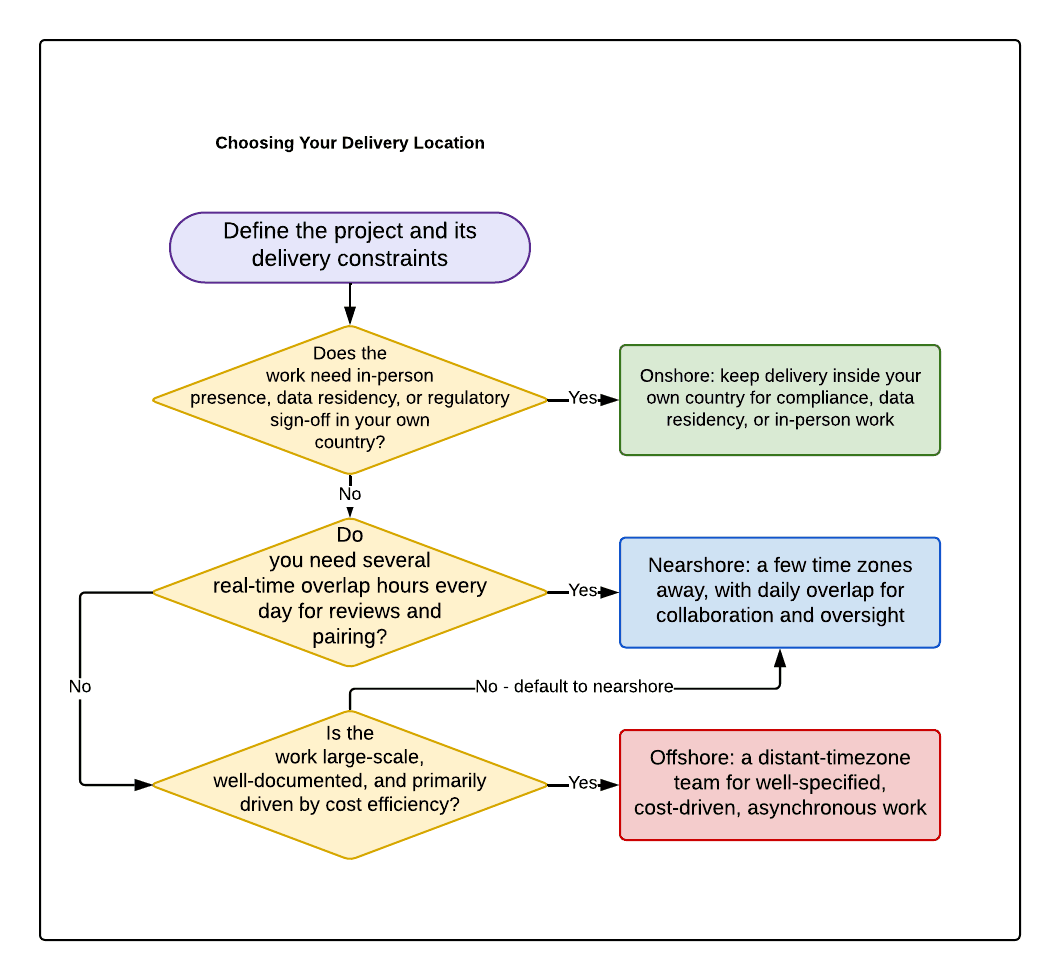 Bringing cost, overlap, talent, and governance together, the decision usually comes down to three questions, roughly in this order:
Does the work require in-person presence, data residency, or a regulatory sign-off that has to happen inside your own country? If yes, onshore is close to mandatory.
Do you need several real-time overlap hours every day for reviews, pairing, or fast iteration on an evolving scope? If yes, nearshore is usually the better fit.
Is the work large in scale, well-documented, and driven primarily by cost efficiency rather than daily collaboration? If yes, offshore delivery makes sense.
The diagram below walks through this same logic visually, including the fallback case where the answer to all three isn't a clean yes or no.
Most real engagements are not pure plays. A common, effective pattern blends models: a small onshore or nearshore core team that owns architecture and client communication, supported by an offshore team handling well-specified, high-volume implementation work. This hybrid structure, sometimes built around a dedicated staff augmentation arrangement, captures much of the cost advantage of offshore delivery while keeping judgment-heavy decisions close to overlap hours that work.
A mid-sized healthcare software client once came to us trying to offshore an entire product rebuild to cut costs, including the parts of the system that touched patient data directly. The economics looked attractive in theory. The risk did not: compliance sign-off needed a team that could sit in the same working hours as the client's internal security reviewers, and the audit trail requirements made loosely governed, fully asynchronous delivery a poor match for that specific slice of work.
The engagement that actually shipped split the work instead. The compliance-sensitive core stayed with a nearshore team that overlapped six hours a day with the client's own engineers, enabling same-day sign-off cycles. The surrounding, well-specified feature work, UI components, reporting dashboards, and test automation, went to a larger offshore team working against a detailed specification with weekly checkpoints rather than daily ones.
That split is the pattern worth taking away: match the model to what each piece of work actually demands, rather than picking one location for an entire project because it looks best in a single column of a rate card.
Start by separating your scope into the pieces that need daily, real-time judgment and the pieces that are well-specified enough to hand off asynchronously. That split alone will point you toward onshore, nearshore, or offshore for each piece, often more clearly than a single, project-wide decision would.
If you are weighing a flexible, embedded-team model against a fixed-scope outsourced engagement as part of this decision, it is worth reading alongside this guide, since the delivery-model question and the delivery-location question are related but separate choices. Our own IT staff augmentation services are built to flex across onshore, nearshore, and offshore talent depending on which piece of your roadmap we're staffing, and we're happy to walk through where your project fits before you commit to a single model.
If you'd like a second opinion on how to split your own roadmap across delivery locations, get in touch with our team and we'll work through it with you.
Nearshore outsourcing places your development team in a nearby country, typically one to four time zones away, while offshore outsourcing places the team many time zones away, often on a different working schedule entirely. The practical difference shows up in daily overlap hours, not in skill quality or language ability.
India counts as offshore for US and most European companies, since the time zone gap typically runs nine to twelve hours with little to no overlap in standard working hours. For companies based in the Middle East or parts of Asia-Pacific, the same distance can function closer to a nearshore relationship because the overlap is larger.
A US company in Chicago contracting a development team in Mexico City or Bogotá is a common nearshore example, since the time zones align closely enough to run shared stand-up meetings and same-day reviews. A UK company working with a team in Poland or Romania is the equivalent nearshore relationship in Europe.
Yes, nearshore rates typically sit above offshore rates and below onshore rates, reflecting labor costs in nearby countries compared with more distant offshore hubs. The gap is usually smaller than buyers expect, and it often narrows further once the coordination overhead that offshore delivery adds to complex or fast-changing work is factored in.
Yes, blending delivery locations within one project is common and often the most effective approach. A typical pattern keeps architecture, client communication, and compliance-sensitive work with an onshore or nearshore team while routing well-specified, high-volume implementation work to an offshore team.
Start with three questions: whether the work needs in-person presence or in-country regulatory sign-off, whether it needs several real-time overlap hours each day for collaboration, and whether it is well-documented, large-scale work driven mainly by cost efficiency. The answers point toward onshore, nearshore, or offshore respectively, and most projects end up splitting work across more than one model rather than picking a single one.
We're committed to your privacy. SayOne uses the information you provide to us to contact you about our relevant content, products, and services. check out our privacy policy.


We collaborate with visionary leaders on projects that focus on quality