
Subscribe to our Blog
We're committed to your privacy. SayOne uses the information you provide to us to contact you about our relevant content, products, and services. check out our privacy policy.



Generating table of contents...
A vague discovery phase is how a six-week build turns into a six-month one.
Before any code gets written, discovery should settle what problem you are solving, what the system needs to do, and what it will cost to build properly. Many buyers never see that work done in the open. A service provider hands over a quote while the real thinking stays behind the scenes, if it happens at all, and that gap is where budgets and timelines start to drift.
This guide covers what a discovery phase should produce, how to read a service provider's proposal for it, and when it is reasonable to shorten or skip the step.
A product discovery phase is the structured work a software team does to understand a business problem, the people affected by it, and the technical path to solving it, before committing to a scope, a price, and a delivery date.
It sits between "we have an idea" and "here is what we are building." The output is a shared, written understanding of the problem, the constraints, and the plan, something both sides can hold each other to once the build starts.
Skipping it does not remove the uncertainty. It moves the uncertainty from a planning document into a signed contract, where resolving it costs far more. The research backs this up:
PMI's Pulse of the Profession research found that 47 percent of unsuccessful projects fail to meet their goals because of inaccurate requirements management.
A study by McKinsey and the University of Oxford, covering more than 5,400 IT projects, found that large software and IT initiatives run 45 percent over budget and 7 percent over schedule on average, while delivering 56 percent less value than promised.
Most of that gap traces back to assumptions nobody tested before the build started.
A discovery phase that is doing its job ends with a set of concrete, reviewable artifacts: documents either side can point back to once the build is underway. At minimum, expect:
A written problem statement that names the business outcome the project is meant to change, not just the feature being requested.
User and stakeholder findings: who uses the system today, where the current process breaks down, and what each group actually needs from a new one.
A scope boundary that separates what the first release must do from what can wait, along with the reasoning behind each call.
A technical feasibility assessment covering integration points, data sources, and any build-versus-buy decisions.
A risk register naming the assumptions the estimate depends on and what happens if they turn out to be wrong.
A cost and timeline range tied to the scope above, with the assumptions behind it written down.
This list tracks closely with how established frameworks describe the front end of a project. "Discover" and "define" are essentially separate stages, so first understand the problem broadly, then narrow it to a specific, well-framed brief before any solution work begins. The International Institute of Business Analysis describes requirements capture the same way: a deliberate process of eliciting, confirming, and documenting what stakeholders actually need, separate from and prior to designing the solution.
If a proposal skips straight from "here's what you told us" to "here's the price," none of that framing work happens, and the number attached to it is closer to a guess than an estimate.
How much discovery a project needs also depends on the kind of organization commissioning it.
Startups validating a new idea typically need lighter, faster discovery focused on testing assumptions before committing engineering time. This is the approach behind our startup software development solutions, and it pairs well with a software development plan for a startup drafted early.
Growing SMBs adding a system to existing operations usually need discovery that accounts for the tools and processes already in place, covered under our solutions for small and medium businesses.
Large organizations integrating a new platform across departments need the most thorough version, with governance and stakeholder sign-off built in, which our enterprise software development solutions are structured around.
Discovery timelines and costs depend on project complexity, stakeholder involvement, and technical requirements. Here's what businesses can typically expect before development begins.
Discovery usually runs one to four weeks for a mid-sized custom software project. A narrow internal tool with one or two stakeholder groups sits at the shorter end. A platform touching multiple departments, external integrations, or regulated data takes longer, because there are more assumptions to test.
Discovery is usually a small fraction of the total build, often in the low single-digit percentage range of the overall project budget. It is frequently billed as a fixed, standalone engagement rather than folded into the build quote.
We have reviewed requests from teams whose previous engagement went straight from a sales call to a fixed quote, with no documented research step in between. In several of those cases, the scope assumptions turned out to be wrong once real users were interviewed: a workflow that looked like a single approval step actually had three conditional paths, or a straightforward-looking data migration depended on a legacy system with no usable export. Each gap surfaced mid-build, where fixing it cost far more than a discovery workshop would have, and reopened budget conversations nobody wanted to have twice.
That pattern shapes how we scope new engagements: a short, paid discovery phase up front consistently costs less than discovering the same problems after the contract is signed.
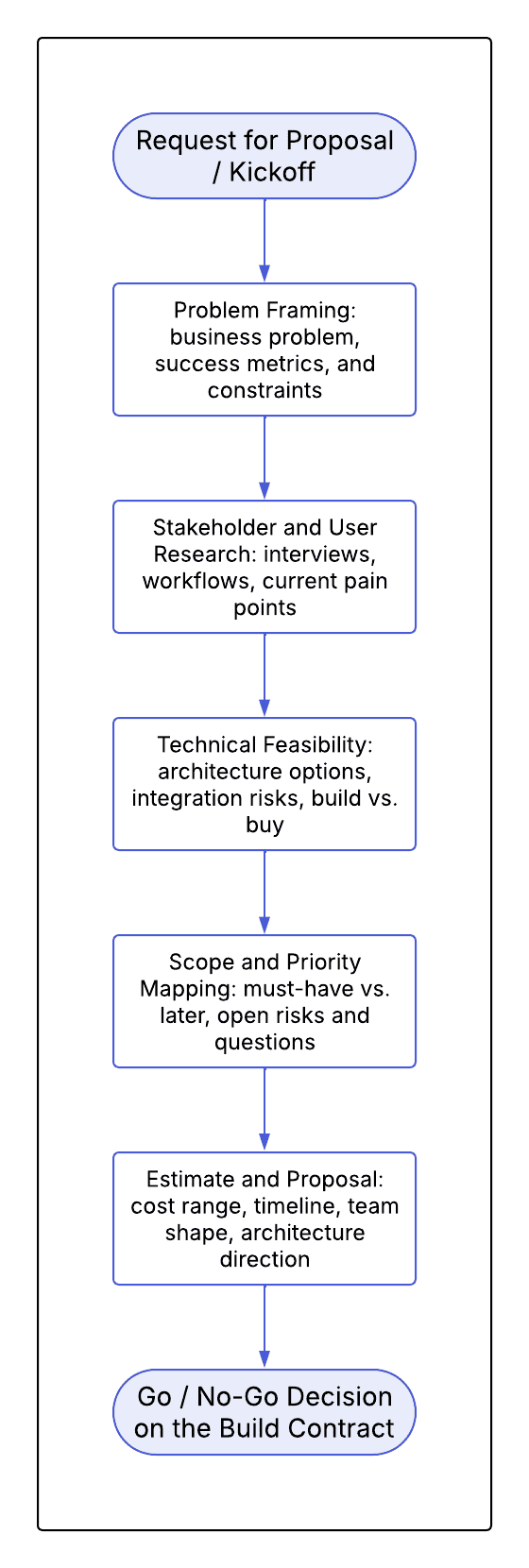 A well-run discovery phase moves through the same sequence, regardless of project size:
Framing the business problem and the metrics that will define success.
Stakeholder and user research to understand current workflows and pain points.
Technical feasibility checks, covering integration risks and any build-versus-buy calls.
Scope and priority mapping, weighing what was learned against what the project can support.
Estimate and proposal, tying cost and timeline to a specific scope.
Go or no-go decision, where the client reviews the findings before any build contract is signed.
The diagram below lays out that sequence end to end.
Not every project needs the same depth of discovery, and the right choice depends on how much is genuinely unknown. The table below compares the three approaches teams typically choose between.
| Approach | Typical Duration | What You Get | Best For | Key Risk |
|---|---|---|---|---|
| Workshop Sprint | 2-5 days | A problem statement, rough scope, and a directional estimate | Small, well-understood projects with one main stakeholder group | Estimate may miss issues that only surface with deeper research |
| Paid Discovery Engagement | 1-4 weeks | Requirements documentation, user flows, a feasibility assessment, and a scoped estimate range | Mid-to-large projects, multiple stakeholders, or any integration with existing systems | Adds time and cost before the build starts |
| Skipping Discovery | 0 days | A quote based on the sales conversation alone | Near-exact repeats of a previous, well-documented build | Scope gaps surface mid-build, where they are most expensive to fix |
A proposal for a discovery phase should read like a research plan with a price tag attached. Before you sign one, run through these checks.
What it actually produces. If the deliverables section lists meetings rather than documents, the service provider has not committed to writing anything down. A real proposal names specific outputs: a requirements document, user flows, a feasibility assessment, a scoped estimate.
Who is doing the work. The proposal should name the roles involved, such as a business analyst, a solution architect, and a technical lead, rather than a generic "our team." Discovery is cross-functional work; a proposal staffed only by developers has likely skipped the business-analysis side entirely.
Whether there is an explicit go or no-go step. A discovery phase should end with a decision point, where you review the findings and choose whether to proceed, adjust scope, or stop. If the proposal assumes the build contract is automatic once discovery wraps, the "discovery" is really a paid sales process.
Whether the estimate is a single number or a range. An estimate grounded in real research states a range and names the assumptions behind it. A single, precise-looking figure offered before anyone has interviewed a user is usually a guess.
Who owns the output. The documents, flows, and technical findings produced during discovery should belong to you, usable with another service provider if the relationship does not continue. A proposal silent on this point is worth a direct question before signing.
These same questions apply beyond discovery. Our overview of what to expect from a software development partner covers the broader red flags worth checking before any contract is signed.
Discovery does not always need to be a multi-week commitment, and it does not always need to be skipped either. The scope of the project decides which.
Safe to shorten when:
The scope is genuinely small and well understood.
The integration with an existing system is already well documented.
The project is a near-exact repeat of something the team has built before for a similar business.
A mistake to skip when:
Multiple stakeholder groups have different, possibly conflicting, needs.
The project touches a legacy system whose behavior is not fully documented.
The data involved is regulated or sensitive.
The budget and timeline are being set before anyone outside the sales conversation has looked at the actual requirements.
As a rule, the less certain the scope, the more a short discovery phase saves later. Teams that already know exactly what they are building, down to the data model and the integration contracts, can often move straight into a build with a short planning sprint instead of a full discovery engagement.
Whatever stage you are at, the goal of discovery is the same: a documented, testable plan before anyone commits a budget to it. If you want a second opinion on a proposal you have already received, or you are ready to scope a project properly from the start, get in touch with our team and we will walk through what a discovery phase for your project should include.
It is the research and planning stage that happens before a build contract is signed, where a team investigates what the business actually needs, who will use the system, and whether the proposed approach is technically sound. The result is a documented plan, not working software, that both sides can use to set a realistic scope, timeline, and budget.
For a typical custom software project, plan for somewhere between one and four weeks, with the exact length driven by how many systems and stakeholder groups are involved rather than by the size of the eventual build. A single-department tool with one clear owner can often be scoped in under two weeks, while a project crossing several departments or touching regulated data needs the full window to surface every constraint.
Expect a standalone, fixed-price fee that is a small slice of what the full build will eventually cost, commonly just a few percentage points of the overall budget. The number scales with how many people need to be interviewed and how many existing systems the new software has to work alongside, not with the size of the final product.
The unknowns in the project do not go away, they just surface later, usually after a fixed-price contract has already been signed and changing course costs far more. Industry research on IT project performance consistently ties a large share of failed or over-budget projects back to requirements that were never properly tested before the build started, which is exactly the gap a discovery phase closes.
A credible proposal spells out exactly what you will receive at the end, such as written requirements, documented user research, and a feasibility review, along with who on their team will produce it and in what rough timeframe. It should also be explicit about intellectual property: that the research and documentation belong to you, not only to the team that wrote them.
Discovery works best with input from whoever owns the business outcome, the people who will use the system day to day, and at least one technical lead who can flag feasibility issues early. Leaving out any one of these groups is how a requirements document ends up missing a workflow or an integration constraint that surfaces later, during the build.
We're committed to your privacy. SayOne uses the information you provide to us to contact you about our relevant content, products, and services. check out our privacy policy.

We collaborate with visionary leaders on projects that focus on quality