
Subscribe to our Blog
We're committed to your privacy. SayOne uses the information you provide to us to contact you about our relevant content, products, and services. check out our privacy policy.


Generating table of contents...
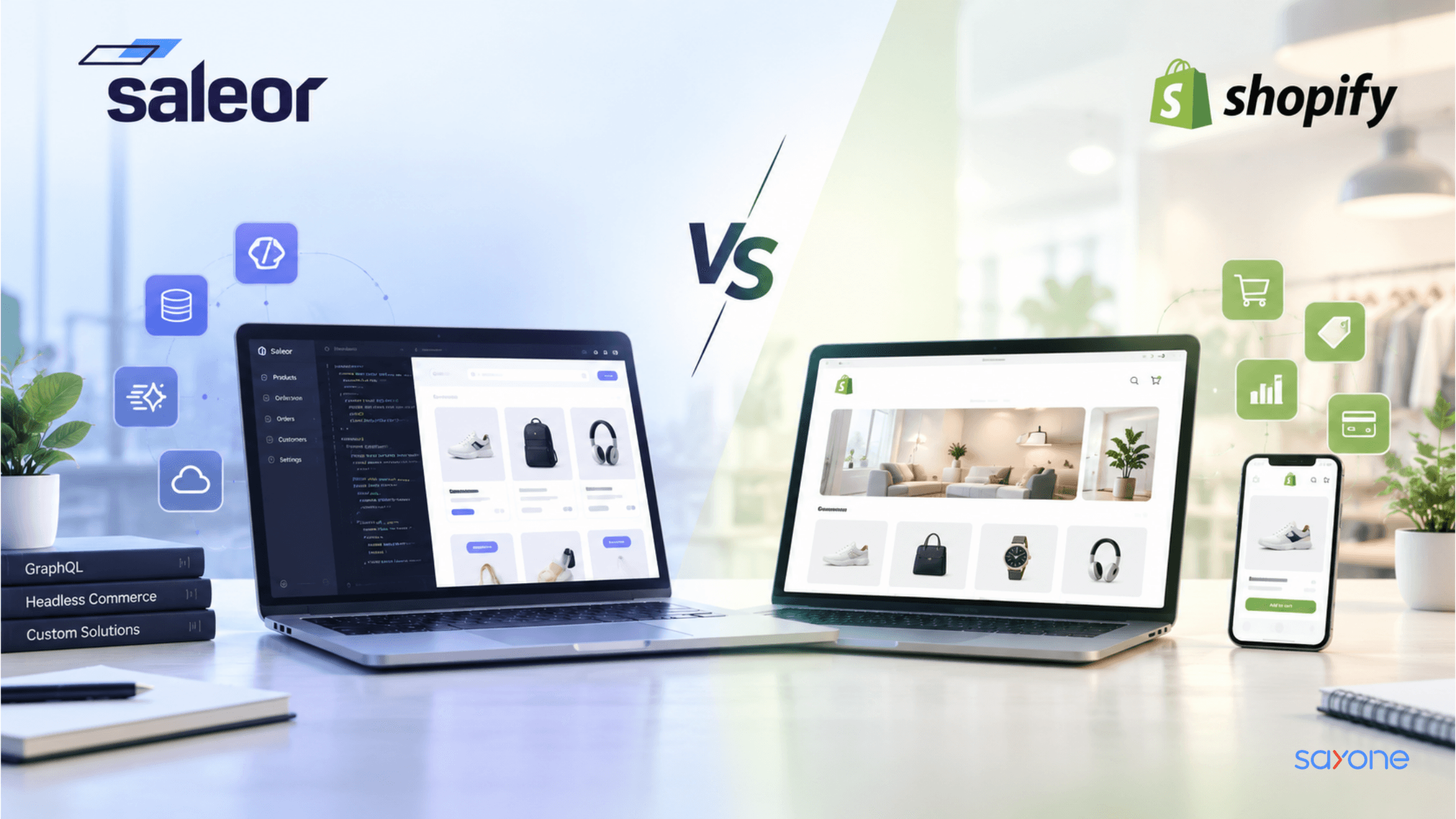
Choosing an ecommerce platform used to mean picking one all-in-one system and living with its limits. That is no longer the only choice. Saleor and Shopify now sit at opposite ends of a real architectural decision, and the right answer depends on what your team can support.
This guide compares both platforms on architecture, cost, and operational fit, so you can match the decision to your 2026 roadmap instead of to whichever platform your last agency recommended.
Shopify is a hosted, all-in-one commerce platform. It bundles storefront, checkout, hosting, and admin tools into a single managed system. Shopify's own scale is one reason it remains the default choice for many merchants: the platform posted $115.6 billion in quarterly GMV in Q2 2026 alone, up sharply year over year, and now accounts for roughly 30% of the top one million ecommerce sites globally.
Saleor is an open source, API-first commerce engine. It has no built-in storefront. Instead, it exposes a GraphQL API that a separate frontend, custom-built or framework-based, calls to render pages, manage checkout, and handle orders. This is what the industry calls a headless ecommerce platform: the backend and the customer-facing experience are built and deployed independently of each other.
In short, Shopify sells you a finished store. Saleor sells you the engine and expects you, or a development partner, to build the store around it.
Shopify fits teams that want to launch fast and keep engineering effort low. Standard themes, a large app marketplace, and built-in payments cover most direct-to-consumer use cases without custom development. For a mid-market brand running a fairly standard catalog and checkout flow, this is often the more cost-effective path to revenue.
The limits show up at the growth stage. Once a brand needs a genuinely custom storefront, such as a product configurator, a subscription flow with unusual billing logic, or a checkout embedded inside a native mobile app, Shopify's theme architecture and checkout customization ceiling start to matter. Our Shopify development team sees this pattern most often in brands that outgrew a templated build within 18 to 24 months of launch and needed deeper API-level work to keep scaling without a full replatform.
Saleor fits teams that already have, or are actively building, frontend engineering capacity and need the storefront to do something a templated platform cannot easily support: multi-brand catalogs served from one backend, a fully custom checkout, or commerce logic embedded inside a product that is not a traditional store at all.
Because Saleor is open source under a BSD-3-Clause license, a team can self-host it, audit the code directly, and avoid depending on a single company's product roadmap and release schedule. The project has drawn a genuinely active open source community: Saleor's core repository carries more than 23,000 GitHub stars and over 6,000 forks, a reasonable proxy for how many engineering teams have inspected and built on the codebase.
This flexibility carries a cost. Saleor gives a team an API, not a finished experience. Someone has to design, build, and maintain the storefront, the search experience, and the checkout interface. Our Saleor consulting engagements usually start with exactly this question: does the team have, or want to hire, the frontend capacity a headless build requires, or would a hosted platform get them to revenue faster and with less risk?
The deeper difference between these two platforms is architectural, and it shapes almost every other comparison in this guide.
Shopify is a monolith: storefront, checkout, and backend are one deployed system that Shopify operates on the merchant's behalf. Saleor is composable: a team assembles the backend, frontend, search, and payment layers as separate services connected through APIs. Gartner's forecast on MACH adoption puts a number on where this trend is headed: by 2027, at least 60% of new cloud-based B2C and B2B commerce solutions are expected to align with MACH (microservices, API-first, cloud-native, headless) architecture principles. That signals composable buying patterns are becoming standard practice for mid-market and enterprise commerce, not a niche choice reserved for large retailers.
See the comparison table below for how the two platforms line up across the factors that usually decide this call.
The table that follows breaks down hosting model, customization ceiling, required team skill set, and pricing structure side by side, so you can weigh each factor against your own catalog and team before reading the cost section in detail.
| Factor | Shopify | Saleor |
|---|---|---|
| Hosting model | Fully hosted, managed by Shopify | Self-hosted (open source) or managed cloud |
| Customization ceiling | Theme- and app-based; checkout customization is limited | Full control via API; no built-in ceiling |
| Team skill set needed | Low; themes and apps, minimal developer input | Frontend and backend engineering required |
| Starting cost model | Flat monthly fee plus a revenue-based fee at scale (Shopify Plus) | Free to self-host (OSS), or from $1,599/mo on Saleor's Cloud Select plan |
Cost comparisons between these two platforms are easy to get wrong, because the pricing models are structured differently. One is a subscription with a revenue-based fee layered on top. The other is either free to self-host or a managed cloud tier billed on transaction volume.
Shopify Plus starts at a flat monthly platform fee, with an additional fee tied to monthly sales once a merchant crosses a revenue threshold. Saleor takes a different approach: the open source core is free to self-host, with the team covering its own infrastructure and engineering time, while Saleor's cloud pricing runs from a Select plan built for smaller catalogs up to a Volume plan for high-transaction businesses, with custom Enterprise pricing quoted as low as 0.2% of monthly GMV at scale.
A few points worth budgeting around before comparing a single headline number:
Self-hosting Saleor removes the platform fee but adds hosting, DevOps, and ongoing maintenance costs that a Shopify merchant does not carry directly.
Shopify's app marketplace can replace custom development for common needs, but per-app subscription fees add up quickly on a large catalog.
A composable Saleor build usually costs more upfront in engineering time and less over time in platform fees, which makes this a multi-year calculation rather than a monthly one.
Shopify's constraints are mostly about the customization ceiling. Deep checkout changes, non-standard subscription billing, and multi-entity catalogs, such as several regional storefronts sharing one product catalog, push against the platform's built-in limits and often require third-party apps stacked on top of each other, which adds fragility over time.
Saleor's constraints are mostly about readiness. A team that adopts a headless architecture without frontend capacity in place, or without a clear owner for the storefront build, ends up with a capable backend and no functioning store. This is the single most common reason a composable migration stalls: the backend decision gets made before the frontend plan exists.
Shopify's ecosystem also solves problems that Saleor leaves to the implementation team. One brand automated its post-purchase fulfillment workflow using an integration layered on top of Shopify's existing app ecosystem and cut fulfillment time by half without a platform migration at all, a reminder that some problems people assume require a headless rebuild can be solved with automation on the platform they already run.
We worked through this exact question with a mid-market retailer that had hit a wall on Shopify. The brand needed one product catalog served across three regional storefronts, each with different pricing, tax, and promotion rules, something Shopify's theme layer was not built to handle cleanly. Moving to a composable, API-first backend solved the catalog problem. It also meant hiring or contracting frontend engineers to build and maintain three storefronts instead of relying on one hosted admin panel. That second cost is the one buyers underestimate most often, and it deserves its own line item in any migration budget, not an afterthought.
A few questions help frame the decision for your own team:
Do you have, or are you willing to hire, frontend engineering capacity to own a custom storefront on an ongoing basis?
Is your growth constraint about checkout and catalog customization, or about speed to launch?
Would a composable rebuild solve a real architectural limit, or would automation on your current platform solve the actual problem at lower cost?
Can your organization commit to a multi-year cost model, or does it need predictable monthly spend?
If your answers point toward speed and predictability, Shopify remains the more cost-effective choice for most catalogs. If they point toward customization at scale, and your team has or can build the engineering capacity to support it, Saleor's composable model is built for exactly that case.
Neither platform is the correct default for every business. The right choice depends on catalog complexity, existing engineering capacity, and how much of the total cost of ownership a business wants visible upfront versus spread across a multi-year platform relationship.
Teams researching this decision often start from a related question: how a headless, microservices-based commerce architecture actually holds up once multiple storefronts, regions, or brands are involved, since that operational complexity is what usually pushes a business from a hosted platform toward a composable one in the first place.
If you are weighing a Shopify build against a composable Saleor architecture and want a second opinion on which one actually fits your roadmap, get in touch and we will walk through the specific factors for your catalog and timeline.
Neither platform is better in every case; the right fit depends on your catalog complexity and engineering capacity. Shopify suits brands that want a fast, hosted launch with low ongoing developer involvement, while Saleor suits brands that need a fully custom storefront and already have, or plan to build, frontend engineering capacity to support it.
Yes, but only if the team can support a headless build. Saleor provides the commerce API and admin logic; a development team still has to design, build, and maintain the actual storefront, checkout experience, and search, which Shopify provides out of the box through its themes and app ecosystem.
Shopify Plus charges a flat monthly platform fee plus a revenue-based fee once a merchant passes a set sales threshold. Saleor's open source core is free to self-host, with costs shifting to infrastructure and engineering time, while its managed cloud tiers start at a fixed monthly rate and move to custom, GMV-based pricing at enterprise scale.
You need frontend and backend engineering capacity for a Saleor build, either in-house or through a development partner, because Saleor ships as an API with no built-in storefront. Shopify requires far less developer involvement for a standard store, since its themes and app marketplace cover most common ecommerce needs.
A Shopify-to-Saleor migration can preserve search rankings if URL structures, redirects, metadata, and page speed are planned before the cutover rather than after it. Because Saleor gives full control over the frontend, a well-planned migration can actually improve technical SEO factors like page speed and structured data, but a rushed one risks broken redirects and lost rankings.
We're committed to your privacy. SayOne uses the information you provide to us to contact you about our relevant content, products, and services. check out our privacy policy.


We collaborate with visionary leaders on projects that focus on quality