
Subscribe to our Blog
We're committed to your privacy. SayOne uses the information you provide to us to contact you about our relevant content, products, and services. check out our privacy policy.



Generating table of contents...
Your backlog is growing faster than your team can hire. A platform migration needs specialized skills you don't have in-house. A support queue needs round-the-clock coverage you can't staff internally.
Both situations point to the same question: do you bring in people, or hand off the outcome? That's the real choice between staff augmentation and managed services, and getting it wrong is expensive in ways that don't show up until months later.
Worldwide IT spending is set to reach $6.31 trillion in 2026, with the IT services segment alone projected to cross $1.87 trillion in spend, a 9% increase over last year. A meaningful share of that spend comes from companies choosing between exactly these two delivery models, often without a clear framework for the decision.
This guide breaks down what each model actually means, what it costs, who stays accountable for results, and how to pick between them for your next project.
Staff augmentation adds individual engineers, testers, or specialists to your existing team. You direct their work, set their day-to-day priorities, and own the outcome. It extends your headcount without extending your payroll.
Managed services hand off a defined function or outcome entirely. You agree on service levels, response times, and deliverables, and the service provider's team manages the daily work using its own processes and oversight. You own the relationship; the provider owns execution.
| Factor | Staff Augmentation | Managed Services |
|---|---|---|
| Billing model | Hourly or per-head rate | Fixed fee or outcome-based |
| Who manages the work | Your internal team | The service provider's team |
| Best for | Defined projects with a clear end date | Ongoing operational functions |
| Ramp-up time | Days to one to two weeks | Weeks, including SLA and transition planning |
| Accountability for results | Stays with your organization | Shared through contractual SLAs |
| Talent flexibility | Scale individual roles up or down | Scale the entire function as a unit |
The distinction matters because it changes who answers for a missed deadline or a security gap. With staff augmentation, that responsibility stays with your internal leadership. With managed services, it's shared with, and often owned by, the provider, backed by whatever service-level agreement you negotiated upfront.
Staff augmentation works best when you know exactly what needs to get built and you already have the technical leadership to direct it. You're not missing a process; you're missing hands.
Common scenarios where this model fits:
A product roadmap requires skills your current team doesn't have, such as a generative AI integration or a legacy-to-cloud migration
You need to hit a deadline and hiring would take too long
The work is project-based with a known end date, not an ongoing operational function
Your in-house engineering managers have the bandwidth to direct day-to-day work
Our guide on IT staff augmentation covers the onboarding timeline and screening process in more detail. In short, augmented engineers should be productive inside your existing sprint cycle within one to two weeks, not months.
The competing priority to weigh: augmentation gives you control, but it also means your team carries the management load. If nobody internally has the bandwidth to direct new hires, augmentation adds headcount without adding capacity.
Managed services fit when the work is ongoing, operational, and better handled by a team that specializes in it full time. Application maintenance, infrastructure monitoring, help desk support, and security operations are common examples.
This model makes sense when:
The function needs continuous coverage, such as 24/7 monitoring or incident response, that would be costly to staff internally
You want predictable, outcome-based pricing instead of hourly or per-head costs
Your internal team should focus on product development, not day-to-day operations
You need standardized processes and reporting across a function, not individual contributors
The Staffing Industry Analysts Staffing Trends 2026 report notes that contingent workforce growth is expected to stay flat this year, while companies increasingly look to adjacent, outcome-based services to fill operational gaps instead of adding contract headcount. That shift toward the model that owns the outcome is a large part of what's driving managed services adoption in IT operations and support functions.
Who signs off on a code change? Who gets paged at 2 a.m. when something breaks? These questions separate the two models more clearly than any pricing comparison.
With staff augmentation, your existing governance structure extends to the augmented team members. They follow your code review process, your security policies, and your reporting lines. This works well if that structure is already solid. It becomes a liability if it isn't, because adding more people to a weak process just produces more of the same problems, faster.
With managed services, you're trusting the provider's governance model instead. That means due diligence matters more upfront: ask for incident response times, escalation paths, and references from clients with a similar risk profile to yours. Deloitte's Global Business Services Survey found that organizations with a single, accountable leader over global service delivery achieved more than 20% average cost savings in over half of cases. That points to a broader pattern: clear ownership, wherever it sits, is what drives results, not the delivery model by itself.
The headline rate rarely tells the full story. Staff augmentation is usually billed per hour or per head, so your total cost scales directly with the number of people and the length of the engagement. Managed services are typically priced against a service level or outcome, which keeps the cost structure predictable but requires more upfront scoping to get the deliverables and SLA right.
A useful way to think about this: staff augmentation shifts cost risk toward how well you manage the engagement, while managed services shift it toward how well you scope the contract.
The broader market reflects that shift toward outcome-based pricing. Combined managed and cloud services contract value reached $127.4 billion for the full year, up 18% and the highest total since 2021, even as pure staffing-style contract growth slowed to under 2%.
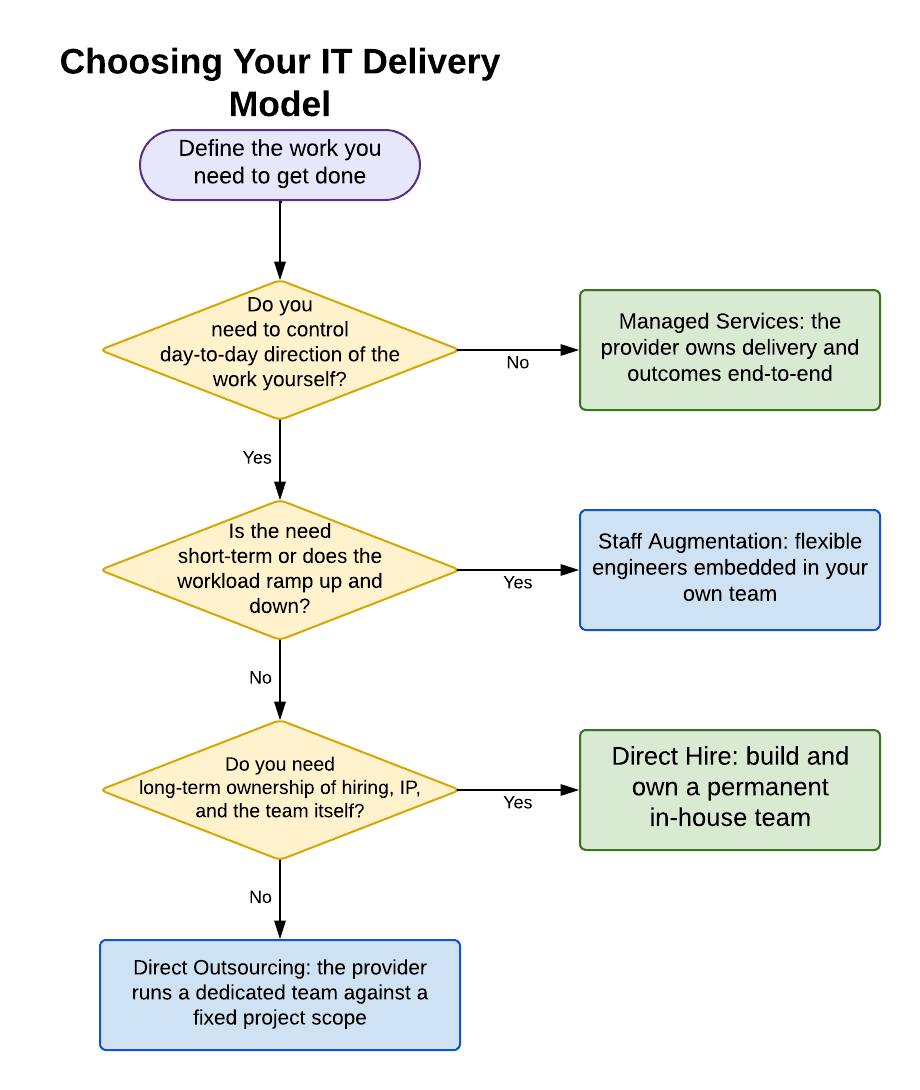 Use this sequence of questions to narrow down the right model for a specific need:
Is this a defined project or an ongoing function?
Defined projects with an end date lean toward staff augmentation. Ongoing operational work leans toward managed services.
Do you have internal capacity to direct day-to-day work?
If yes, augmentation fits. If your team is already stretched, a managed service provider absorbs that management load.
How specialized is the skill, and for how long do you need it?
Highly specialized, short-term needs, such as a one-off generative AI proof of concept, often fit augmentation better than a long-term managed contract.
What's your risk tolerance for variable cost?
If predictable monthly cost matters more than flexibility, managed services usually wins.
Many companies don't pick one model exclusively. A common pattern is augmenting the core product team for roadmap work while handing off infrastructure monitoring or application maintenance to a managed service arrangement. Our comparison of hiring dedicated developers versus outsourcing walks through a related decision for teams weighing a third delivery option: the dedicated team model.
A few patterns show up often enough to call out directly:
Choosing augmentation for a function with no internal owner.
If nobody on your team has the bandwidth to manage new engineers, augmentation just adds coordination overhead.
Choosing managed services without a clear SLA.
A vague contract with no defined response times or deliverables removes the main benefit of the model: predictable accountability.
Assuming the lower hourly rate wins.
A low-cost augmented engineer who needs heavy oversight can cost more in management time than a well-scoped managed service engagement.
Treating the decision as permanent.
Needs change. A function that starts as a project under augmentation often becomes an ongoing operational need within a year.
Consider a typical scenario in mid-sized logistics companies: modernizing a decade-old inventory system. The initial instinct is often to staff up a dedicated project team under the augmentation model. But as scoping progresses, the real problem often isn't the migration itself. It's that nobody internally has the bandwidth to maintain the new platform once it ships. The cleaner structure splits the work: augmented engineers handle the migration as a defined project, and a managed services arrangement takes over ongoing support and monitoring once the new system is live. Matching the model to each phase of the work, rather than defaulting to one approach for the whole engagement, is usually what separates a clean handoff from a support backlog nobody owns.
Our outsourcing playbook covers how to structure that kind of transition between delivery models without losing continuity on the underlying codebase.
Staff augmentation and managed services answer different problems. Staff augmentation extends your own team's capacity for the work in front of you. Managed services hand off an entire outcome for someone else to run end to end. The right choice depends on how defined the work is, how much internal capacity you have to direct it, and how much predictability you need in your costs.
If you're weighing IT staff augmentation against a managed services arrangement for your next project, our team can walk through your specific scope and recommend a structure that fits. Get in touch to talk through your delivery model options.
Not necessarily. Staff augmentation often has a lower headline hourly rate, but the total cost depends on how much internal management time it requires. Managed services carry a higher fixed or outcome-based fee that already includes oversight, so a direct rate comparison can be misleading without factoring in management overhead.
Yes. Many organizations augment their core product team for roadmap-driven work while routing operational functions like infrastructure monitoring or help desk support to a managed service provider. The two models are not mutually exclusive and often work best paired by function.
Staff augmentation places individual specialists under your direct management, while broader outsourcing, including managed services, transfers ownership of an entire function or project to an external team that manages itself. Staff augmentation is closer to extending your headcount; outsourcing is closer to delegating a result.
Most augmented engineers become productive within one to two weeks of joining an existing sprint cycle, assuming the receiving team has clear onboarding documentation and a defined backlog ready for them.
A solid SLA defines response and resolution times by severity, escalation paths, reporting cadence, and the specific deliverables or outcomes the provider is accountable for. Without these specifics, the main advantage of managed services, predictable accountability, disappears.
Early-stage startups with a lean but technically strong core team often lean toward staff augmentation for defined, time-boxed work, since it preserves control without adding permanent headcount. As operational needs like uptime monitoring or compliance reporting grow, a managed service arrangement becomes more practical.
We're committed to your privacy. SayOne uses the information you provide to us to contact you about our relevant content, products, and services. check out our privacy policy.


We collaborate with visionary leaders on projects that focus on quality