
Subscribe to our Blog
We're committed to your privacy. SayOne uses the information you provide to us to contact you about our relevant content, products, and services. check out our privacy policy.


Generating table of contents...
Artificial intelligence has evolved from simple task automation to multi-agent systems capable of completing complex workflows without human intervention. Currently, AI agents coordinate on multi-step processes by communicating with other agents through a standard communication framework called the Agent2Agent (A2A) protocol. In this blog, we’ll explore the A2A protocol in detail, what it is, why it matters, how it works, and how businesses can implement it to unlock scalable, vendor‑independent automation solutions.
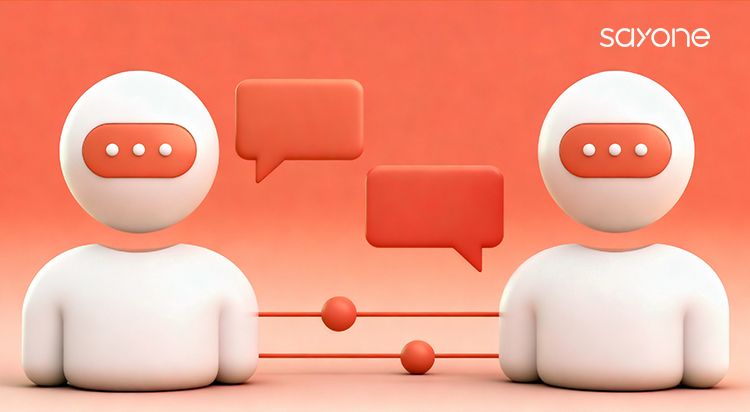
A2A protocol is a standardized framework that AI agents follow to communicate with other AI agents to drive complex tasks to completion without disruptions or gaps. The protocol was introduced by Google in 2025 to manage multi-agent systems efficiently and improve scalability. The protocol defines how two or more AI agents can:
Previously, companies adopted isolated AI agents for each task, which led to fragmented automation. Since no single agent possesses the ability to perform a complex task, like refunding an order, humans were required to hand off tasks.
Connecting two agents required manually creating API calls, and these changes required editing multiple services. Businesses couldn’t engage agents developed by different vendors, making interoperability nearly impossible.
Under the A2A protocol, AI agents with different functions, as well as vendors, work together, speeding up deployment of multi-agent workflows, avoiding vendor lock-in, and increasing scalability.
Now let’s look at how autonomous agents exchange information, coordinate decisions, and achieve collective goals through structured communication flows.
Agents publish their capabilities, such as skills, input/output schema, pricing, and SLA, to a public or private registry.
Mutual TLS + decentralized identity (DID) ensures both agents are who they claim to be.
The requesting agent sends a goal or task description. The receiving agent responds with what it can (or cannot) do, cost, estimated time, etc.
Structured messages flow back and forth using JSON-RPC over WebSocket or HTTP/2. Partial results, tool calls, and human-in-the-loop requests are supported natively.
Cryptographic receipts and audit logs are automatically generated for billing, compliance, and dispute resolution.
All communication is end-to-end encrypted and can include enterprise-grade features like data residency controls and regulatory compliance tags.
Here’s a practical roadmap outlining the key steps companies must follow in order to design, connect, and scale AI agents with the A2A protocol.
Identify manual tasks which will deliver the greatest impact on your business with automation, to determine which AI agents need to be included in the protocol.
Lay out the systems involved in the tasks to have clarity on which tools the agent has to work with.
Expose basic API endpoints, such as fetching data or updating a record, or use existing connectors to enable access to your systems.
Give agents a clear and controlled set of actions based on the tasks you have decided to automate. This ensures that the agent is powerful but predictable and safe.
Provide clear instructions on the data and tools available to the agent and actions that need human approval. Since the A2A protocol prioritizes safety at its core, you can have full control at every step.
Before deploying, test the agent in a staging environment to catch any gaps early on, such as performing allowed actions, avoiding restricted areas, providing consistent and accurate results, and so on.
After successful testing, deploy your agent across your website, chat, internal dashboards, or operational workflows. Start with a pilot and expand based on the feedback collected during the pilot phase.
Monitor how the agent performs and increase the complexity of tasks over time to generate maximum ROI.
However, there are some challenges that businesses might face during the beginning of the implementation.
Even though these challenges may occur, they can be easily overcome by partnering with the right A2A protocol implementation partner. The right partner can address these challenges by using pre-built connectors and exposing only the minimum required endpoints.
SayOne has always known the significance of A2A in today’s business environment, owing to which we have collaborated with Google’s A2A to help businesses completely automate their complex tasks with the power of advanced AI agent technology.
Reach out to explore how A2A can transform your business operations.
We're committed to your privacy. SayOne uses the information you provide to us to contact you about our relevant content, products, and services. check out our privacy policy.

We collaborate with visionary leaders on projects that focus on quality