
Subscribe to our Blog
We're committed to your privacy. SayOne uses the information you provide to us to contact you about our relevant content, products, and services. check out our privacy policy.



Generating table of contents...
83% of IT decision-makers adopt DevOps practices as a means to generate greater business value, yet many business leaders still struggle to understand what DevOps actually means.
DevOps may sound technical but basically, it is a business concept that has the potential of radically changing the way your company creates, launches, and manages its software development process. If you head a startup, manage IT operations in an enterprise, or choose technologies from vendors, in 2026, knowledge of DevOps is mandatory.
Therefore, in this article, we will try to explain this concept for non-technical people. It covers everything that is related to the DevOps definition, its importance, functioning, and implementation.
DevOps is basically the combination of "Development" and "Operations," which are two departments that always existed as separate entities within a company. Earlier, the development department would write codes and pass them to the operations department, which would deploy them and monitor them.
In DevOps, both the departments work together as a single unit during the whole process of development of software from planning to deployment and then maintenance.
Some of the major benefits that DevOps bring to businesses include faster speed to market, quality and reliability, cost efficiency and collaboration.
With a growing demand for innovations and developments, companies cannot afford to lag behind with software delivery. 49% of businesses stated reduced time to market for software and services as one of the benefits of using DevOps principles.
Companies implementing mature DevOps principles have experienced 200% improvement in terms of deployment frequency and 50% reduction in time-to-market. This implies that the process of delivering new features, updates, and fixes is accelerated with DevOps.
There is a popular myth that DevOps compromises the quality in exchange for the speed. However, the reality is quite the opposite: 61% of companies that implemented DevOps state increased quality of their products. This is due to the fact that DevOps implies constant testing, monitoring and automatic check-ups.
DevOps eliminates waste via automation of processes. Manual processes are time-consuming and ineffective. Therefore, by automating routine processes such as code building, testing, deploying of applications, one may save costs.
Siloed teams build frustration and developers point to ops for slow deployments and ops blame developers for sloppy code. DevOps creates shared responsibility and this increases quality and improves team morale.
To comprehend the essence of DevOps, one should get acquainted with some principles of DevOps:
Teamwork happens constantly, without any segregation into different stages. The development team is aware of the constraints of the operation team; the operation team is aware of the difficulties encountered by the developers.
Manual tasks are minimized. It is all automated, from infrastructure setup to testing and deployment and monitoring.
Instead of making large, risky changes every month, frequent code changes are made multiple times a day.
DevOps measures things such as the number of deployments and lead times. Data drives improvement decisions.
Exchanges of information happen constantly inside teams. When production issues occur, that knowledge feeds back into development to prevent future problems.
Knowledge of the DevOps process can help one understand why this process generates value:
Groups decide what needs to be done and align their priorities before creating plans. As opposed to planning once a year, DevOps planning is done continuously.
Developers create code through iterative processes. Code updates are committed into the repository several times a day.
Automated systems compile code and run tests automatically whenever code changes. Issues are caught before human testers even touch the code.
Approved code automatically moves to production. As changes are small and frequent, deployment risk is low.
Applications run in production while continuous monitoring collects data on performance, errors, and user behavior. This data flows back to development to inform the next cycle.
This cycle repeats constantly, rapidly, and automatically.
To appreciate DevOps' impact, compare it to traditional approaches :
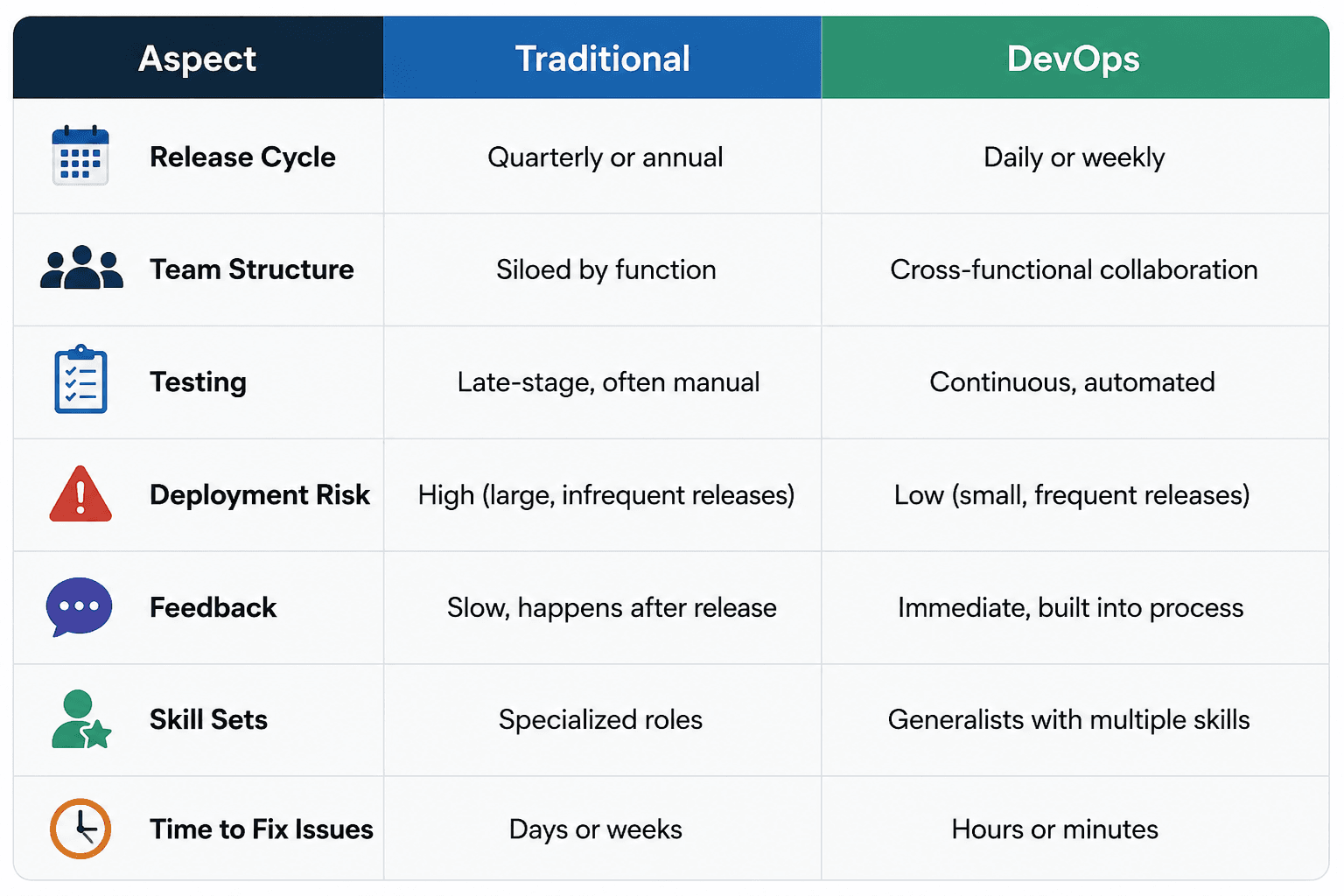
DevOps isn't about specific products, it's a philosophy. However, certain tools enable DevOps practices:
Git: Developers commit code changes; all changes are tracked and reversible. GitHub, GitLab, Bitbucket: Cloud platforms for collaborative code management.
Jenkins: Open-source automation server. GitLab CI/CD, GitHub Actions: Built into popular version control platforms. CircleCI, Travis CI: Hosted CI/CD solutions.
Docker: Packages applications with all dependencies into portable containers. Kubernetes: Orchestrates and manages containers at scale. Terraform: Infrastructure as Code tool.
Prometheus, Grafana: Monitor system metrics and visualize performance. ELK Stack: Centralize and analyze logs. Datadog, New Relic: Comprehensive monitoring platforms.
The specific tools matter less than whether they support the DevOps philosophy of automation, integration, and rapid feedback.
As DevOps matured, organizations realized security couldn't simply be added at the end. DevSecOps emerged, the integration of security throughout the entire development lifecycle.
The key difference is that DevOps focuses on speed and collaboration while DevSecOps adds security as a first-class concern, ensuring fast delivery doesn't compromise protection. In traditional DevOps, security checks often happen late.
In DevSecOps, security is automated and continuous:
If your organization hasn't adopted DevOps yet, here’s where you should start for successful adoption.
How long does it take to deploy a change? How often do you deploy? What percentage of deployments fail? These metrics establish a baseline.
Pick one application or team. Do not try to transform everything at once. Prove value with a successful pilot.
You need to build a DevOps team having people with development skills, operations knowledge, and willingness to learn.
Select tools that solve your actual problems, not tools because they're popular.
Identify the most manual, time-consuming processes. Automate those first for quick wins.
Create structures for developers and operations to work together. Cross-functional teams and shared on-call duties all help.
Track key metrics like deployment frequency, lead time, failure rate, recovery time and use these data to drive continuous improvement.
Start with a single team, focus on automation, foster collaboration, and measure results. The first step isn't buying tools, it's changing how teams work together.
No, startups often adopt DevOps before large enterprises because they don't have legacy systems to integrate. The principles work for teams of any size, though larger organizations benefit from platform engineering to standardize practices.
Not necessarily at the start. Many organizations upskill existing developers and operations staff. 78% of professionals had to learn a new skill after DevOps adoption, suggesting that learning is possible. As you scale, dedicated DevOps engineers become valuable.
It depends on your starting point and scope. Quick wins can appear in months and comprehensive transformation takes years. The best way is to start small, prove value, and expand gradually.
DevOps involves processes and practices geared towards achieving speed and automation in software development through integration of development and operations into one single pipeline. DevSecOps, on the other hand, takes it a notch higher by including security into the entire process. Unlike in DevOps where security is added at the end of the process, in DevSecOps code, dependencies, infrastructure, and containers are scanned.
DevOps pipeline is the automated process where code is moved through different phases from development to production. This involves various phases such as planning, coding, building, testing, deployment, and monitoring. Through the use of CI/CD tools and automation and feedback loops, a DevOps pipeline facilitates quick delivery and high-quality software development.
We're committed to your privacy. SayOne uses the information you provide to us to contact you about our relevant content, products, and services. check out our privacy policy.


We collaborate with visionary leaders on projects that focus on quality