
Subscribe to our Blog
We're committed to your privacy. SayOne uses the information you provide to us to contact you about our relevant content, products, and services. check out our privacy policy.



Generating table of contents...
If you think great products alone guarantee your e-commerce store high sales, the reality is different in 2026. Now, operational efficiency is an important requirement in attaining profitability and sustainable growth, and the best way for e-commerce businesses to deploy this is workflow automation.
Workflow automation is the use of technology to perform repetitive tasks within a business process without any manual intervention. The automation of workflow in an e-commerce business would mean productivity gains, reduction in errors, an enhanced customer experience, and scalability.
There are three major types of workflow automation:
This automation implements tasks consistently whenever specific conditions are met, such as automatically sending a discount email when a customer abandons their cart.
The automation triggers workflows in response to specific events or actions, which allows for real-time responses and effective handling of dynamic situations. For example, automation enables sending a shipping confirmation email immediately after an order is shipped.
The automation focuses on analytics for personalization of actions, optimization of decisions, and dynamic workflow adjustments, such as recommending products based on the customer's browsing history and purchase behavior.
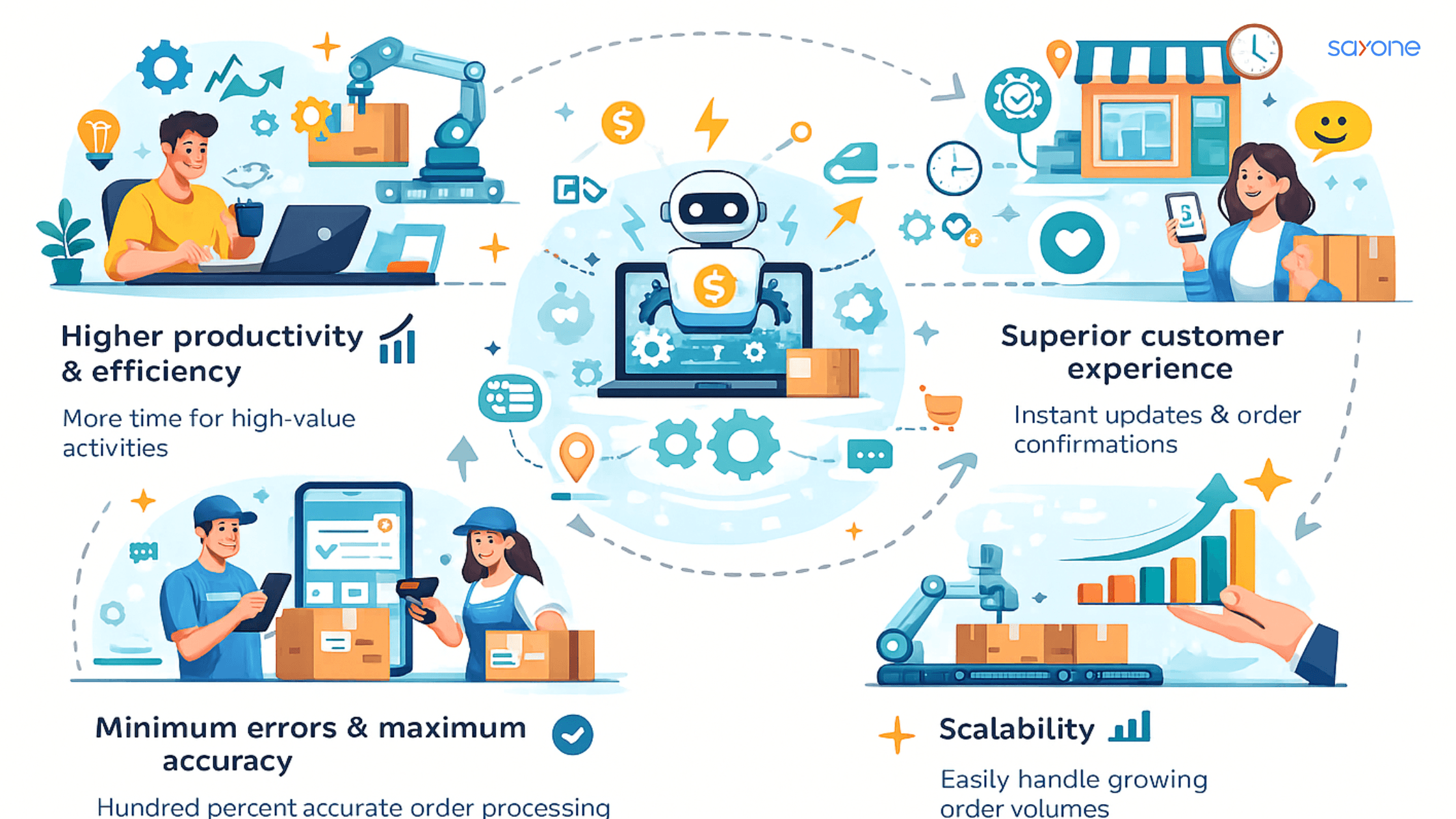 In e-commerce, workflow automation directly affects the bottom line of a business and has real and measurable results. Here’s how:
As most manual repetitive processes in e-commerce can now be automated, your team can have time to handle high-value activities that drive innovation and growth.
Automation minimizes errors in inventory management like overselling or incorrect shipments by executing tasks like inventory updates, data entry, and order processing with a hundred percent accuracy.
Automation of regular customer service tasks can be done to facilitate real-time tracking updates and instant order confirmations, hence improving the overall customer experience.
Automated workflow grows effortlessly with the business and makes it easier to manage an unexpected increase in orders without adding new staff or investing time in training.
The key to driving maximum business impact through automation is identifying the most error-prone and repetitive areas of your business.
Smooth flow of tasks from order to delivery is important for any e-commerce business operation. It is also one of the most error-prone areas of business where mistakes are immediately highlighted to your customer.
Here is how automation handles some of the challenges:
E-commerce is expanding continuously and the ability to manage operations efficiently is increasingly the point of differentiation that makes or breaks a business. Workflow automation not just saves time but builds scalability and customer trust. However, implementing workflow automation in your e-commerce business needs careful process evaluation, smooth integration, and accurate data.
Partner with SayOne, an expert e-commerce solutions partner, to design, implement, and manage a robust and end-to-end automation strategy best suited to the unique needs of your business. We take you beyond simple rules with the full power of automation to future-proof your e-commerce business. Contact us today to schedule a free consultation.
We're committed to your privacy. SayOne uses the information you provide to us to contact you about our relevant content, products, and services. check out our privacy policy.


We collaborate with visionary leaders on projects that focus on quality