
Subscribe to our Blog
We're committed to your privacy. SayOne uses the information you provide to us to contact you about our relevant content, products, and services. check out our privacy policy.



Generating table of contents...
If adding more developers guarantees faster delivery, why do so many software projects slow down right after scaling the team? You might have heard of Brooks’ law that says “Adding more developers to a late software project makes it later.” This principle is one of the most cited in software engineering, even 50 years after the observation was made. As a startup, you shouldn't be looking for more people, but for individuals who can handle diverse areas. This blog explains how including more hands to solve a problem backfires and what can be done instead.
Building a larger team is often misunderstood as the key to improving productivity; however, businesses have increasingly observed scaling to stall their outputs due to the following reasons.
New members need time to adapt to the code base, architecture, tools, and business domain. It may take several weeks or months for them to adapt to all these aspects. In this phase, they are less productive and need the guidance of senior developers; hence, the velocity of the development team gets affected for a while.
As the team expands, the number of possible communication paths grows quadratically. As meetings related to clarity, coordination, or misunderstandings compound, the time spent on development work decreases.
Contrary to most human endeavors, software development comprises many sequential and interrelated activities, such as architectural design, complex bug fixing, and integration, that cannot be parallelized. According to Brooks, some activities simply cannot be shortened by adding more people.
These are factors that contribute to mid-project team expansions, often leading to decreased productivity, more defects, and project timescales.
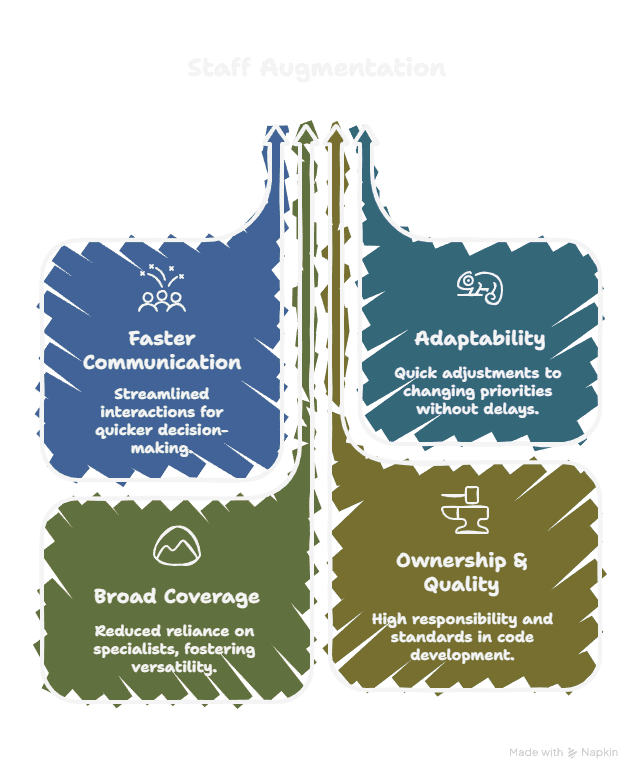
In the case of startups, where speed and agility are significant factors, scaling the team blindly is highly risky. Spending budget on permanent hires increases your burn rate considerably, owing to overhead costs. Instead, high-performing teams actually flourish with the fewest and most flexible developers with varying skill sets in the areas of frontend development, backend development, DevOps, cloud, or even in new technologies like artificial intelligence and machine learning. A small pool of well-qualified professionals with many skill sets can:
This is where IT staff augmentation comes in as a strategic shift. Through this approach, startups engage vetted professionals with diverse skills on demand, without worrying about payroll or wasting months hiring. Moreover, this comes without the commitment of a full-time employee.
Compared to traditional hiring, IT staff augmentation provides startups with the following benefits. Immediate expertise Startups often need immediate access to niche experts in areas like AI, cloud, mobile, DevOps, and many more, to introduce their product quickly to the market. While in conventional hiring, it takes months and thousands of dollars to hire the right person, staff augmentation provides fast access to experienced professionals who can start contributing to your company in 7 days, at zero onboarding costs.
Startups rarely need the same team size at every stage. Perhaps you require a bigger team when you are doing a product launch, but a smaller one after that. With staff augmentation, scaling up or down is extremely easy, without the burden of long-term contracts or layoffs.
Hiring full-time employees comes with salaries, benefits, office space, and HR overhead. For startups with limited runway, this can be unsustainable. Staff augmentation lets you pay only for the talent you need, when you need it, keeping costs to a minimum while maximizing output.
Hiring is a time-consuming process. Startups and leaders must take weeks to conduct interviews of the applicants rather than concentrating on the product and fundraising. Staff augmentation removes such distractions by providing pre-vetted talent, so leadership can stay focused on scaling the business.
No solution is perfect, and IT staff augmentation comes with potential hurdles that smart teams address upfront:
Recognizing these challenges, SayOne has designed a staff augmentation approach for startups to minimize integration challenges and accelerate impact. We offer a risk‑free opportunity to explore staff augmentation in action. Through a 2‑week trial, you can work with our vetted developers on real tasks, evaluate their fit and impact, and see firsthand how fewer, high‑impact contributors help you move faster. Ready to move your project faster with fewer and high-impact developers? Reach out today to start your 2-week free trial.
We're committed to your privacy. SayOne uses the information you provide to us to contact you about our relevant content, products, and services. check out our privacy policy.


We collaborate with visionary leaders on projects that focus on quality