
Subscribe to our Blog
We're committed to your privacy. SayOne uses the information you provide to us to contact you about our relevant content, products, and services. check out our privacy policy.


Generating table of contents...
A new AI chatbot often handles the first ten questions in a sales demonstration without issue, then breaks down the moment a real customer asks an unscripted question. That gap between demonstration and deployment is where most claims about an "AI chatbot development company" fail. What actually gets delivered is a prompt wrapped around a foundation model API, without memory, controls, and a plan for what happens when it produces the wrong answer in front of a customer.
This is a significant risk. MIT NANDA's 2025 research on enterprise AI adoption found that 95% of GenAI pilots fail to deliver measurable ROI, and a polished chatbot demonstration is one of the easiest places for that failure to hide. helps you determine whether the company in question can develop a chatbot or simply resell technologies. In addition to this, the blog provides information about how much a well-specified engagement should cost in 2026.
A serious AI chatbot development services engagement covers five distinct layers.
Every AI chatbot development company has to build these five layers to deploy a chatbot successfully. A service provider who only talks about "the model" or "the prompt" is describing a demonstration rather than a custom chatbot development engagement built to run in production. If developers hand-select questions just to do well in a demo, the production system fails as real users ask things the prompt was never grounded to answer.
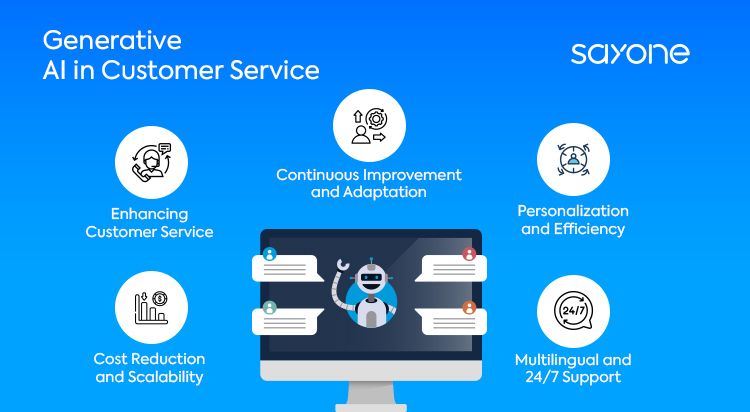
Chatbots and self-service are no longer nice-to-have bolted onto a contact center. They are becoming the contact center itself. According to the 2025 Gartner Customer Service Technology survey, self-service and live chat will take the lead from traditional phone-based communication channels and become the leading technologies used in customer service by 2027. The use of these two technologies increases the bar in terms of what is meant by “production”: uptime when dealing with real traffic, degradation in case of integration failure, and containment rate.
Here are some questions to ask before deciding on a service provider.
At SayOne, our conversational AI work spans customer support automation, sales qualification, and internal HR and operations bots.
The technical questions matter more than the marketing language ever will.
A useful proof point is whether the vendor can point to a real integration-heavy build rather than a case study with the details removed. Our AI-powered booking agent built with LangChain is one example of an agent that does not just answer questions about availability but actually reads a calendar system, checks business rules, and completes a booking end to end. That is the difference between a conversational AI development company that talks about agents and one that has actually connected an agent to a live backend system, with real consequences for getting it wrong.
An enterprise AI chatbot handles customer data, and increasingly, it takes actions on a customer's behalf as well. That combination means governance is not optional. The AI Risk Management Framework put forward by NIST provides a baseline which most enterprise customers have come to expect the service provider should be working against. It includes mapping where risks arise within the system, assessing them, and managing them on an ongoing basis, rather than conducting security testing once before go-live as a gate.
That, in turn, calls for a specific set of information from the vendor, such as:
Cost scales with how much the chatbot needs to know and how much it needs to do. The polish of the conversation has little bearing on price. The table below breaks down three engagement tiers we see most often across custom chatbot development projects.
| Engagement Tier | Best For | Core Scope | Typical Build Range (USD) |
|---|---|---|---|
| FAQ / Deflection Bot | Narrow, single-channel FAQ and status lookups | Scripted flows, basic NLU, one integration | $8,000-$25,000 |
| RAG Knowledge Assistant | Grounded answers from your own docs and catalog | RAG pipeline, vector DB, 2-3 integrations, guardrails | $25,000-$75,000 |
| Agentic / Transactional Bot | Multi-system actions at enterprise scale | Full five-layer build, governance, observability, SLAs | $75,000-$200,000+ |
These estimates are made under the assumption of a single primary channel and scope. Deployment across multiple channels (website, WhatsApp, phone), support for multiple languages, and deep ERP/CRM integration all add significant value to the initial build and the subsequent maintenance subscription fee. Ask for an estimate based on your own integration needs and expected volume of conversations, and not off a generic price point. Two clients requesting "an AI chatbot" can result in a 5x price difference after requirements are clarified. A truly custom and integration-rich implementation will usually cost somewhere around mid-five figures to low-six figures when the bot needs to read from and write to a live system and not just answer pre-coded questions. The monthly fee that is underestimated by most buyers is the cost of maintaining an up-to-date retrieval layer.
Ready-made chatbot platforms are a decent place to start when dealing with simple use-cases such as deflecting questions through FAQs, checking orders' statuses, and collecting leads. The problem is that they get slower and costlier when you need to customize anything beyond the ready-to-use templates provided by the platform.
Gartner predicts that 30% of Fortune 500 companies will offer service through only a single, AI-enabled channel by 2028. This reflects a meaningful bet on AI handling the full range of a conversation instead of a narrow slice of it. Solving that requires building for depth, a different challenge from simply configuring a template. A hybrid path, where a vendor builds on top of an existing framework instead of starting from zero, often gets you most of the speed of buying along with most of the flexibility of building. It is worth asking any AI agent development company whether they support it.
A few patterns show up again and again among AI chatbot development company engagements that face delays or be discontinued after launch. Sinch's research on chatbot failures points to a common thread: bots deployed without a clear escalation path frustrate customers into abandoning the channel entirely, which erases whatever cost savings the bot was originally meant to deliver.
A provider is worth questioning further if:
Any one of these warrants a direct follow-up question before signing an agreement.
None of these questions are intended to slow down your buying decision. They are significant to ensure the decision survives contact with real users. A properly scoped AI chatbot development company engagement should be able to answer every question in this checklist with specific detail rather than general reassurance.
SayOne builds conversational AI on that same engineering-first approach, the one behind our work in generative AI customer support and broader AI agent development. If you are evaluating partners for a chatbot or AI agent build, talk to SayOne's AI team about a scoped technical assessment before committing to a solution provider.
Do not look for proof of concepts but rather production capabilities. The vendor should be able to demonstrate a bot processing traffic in real time, provide explanations about its retrieval and integration capabilities in simple terms, and explain what happens when the bot does not have the answer or when a model API crashes. Governance is as important as the capability itself, and you must make sure of the vendor’s capability regarding these aspects.
The cost increases depending on the extent of knowledge that the bot needs to possess and the extent of its operations. For example, an FAQ bot that operates with a narrow scope on one channel would be on the lower end, whereas a bot designed for enterprise use, which entails many systems and integrations, with governance and observability falls into the middle five digits and lower six digits.
Off-the-shelf frameworks have quick deployment capabilities and can be used for small and limited applications like frequently asked questions (FAQ) diversion or order status checks. The development of a custom framework starts making sense when there is a requirement for some custom business logic, multiple system integration, or some kind of flow which cannot be achieved using the templates provided by the framework.
The process of developing a single-channel and narrowly scoped bot should take just a few weeks. However, an integration-focused enterprise implementation should take several months because of all the integrations required. The time required for integrating and testing the bot to ensure that it will behave safely on the back-end and with actual users is what normally takes more time.
Retrieval-augmented Generation (RAG) makes sure that the answers of your chatbot are based on your own documents, product catalog or knowledge base, and not on the general training data of the model. The reason why it is important is that it distinguishes between invention and response based on facts.
We're committed to your privacy. SayOne uses the information you provide to us to contact you about our relevant content, products, and services. check out our privacy policy.

We collaborate with visionary leaders on projects that focus on quality