
Subscribe to our Blog
We're committed to your privacy. SayOne uses the information you provide to us to contact you about our relevant content, products, and services. check out our privacy policy.


Generating table of contents...
Gartner expects more than 40% of agentic AI projects to be canceled by the end of 2027, and the reason is rarely the technology itself . Most cancellations trace back to a decision made months earlier: the wrong scope, an unclear pricing model, or a team that could demo an agent but never get it running in production.
The global AI agents market is on track to hit $10.9 billion in 2026, so nearly every AI development company now claims agentic AI expertise . This guide gives you a framework, a scorecard, and the questions that separate a genuine AI agent development agency from a company selling a rebranded chatbot.
The company you choose determines whether your agent reaches production or joins the 40% that get quietly shelved. McKinsey's 2025 survey found just 23% of organizations are scaling agentic AI in any function, while 39% are still experimenting and no more than 10% scale within a single function . That gap between pilot and production is exactly where vendor selection carries the most weight.
Service companies claiming AI agent development generally fall into three tiers: platform providers who sell tooling your team configures, systems integrators who deploy agents on existing platforms, and specialized studios who build bespoke systems from scratch.
Picking the right category matters more than picking the best-known name inside it. Does your workflow live inside one platform, or does it cross systems you would rather not hand to a generic tool?
Roughly three quarters of enterprise AI use cases now run on vendor-built products rather than internal builds, a reversal from a near even split just a few years ago. If your process spans your CRM, your ERP, and a compliance layer, a custom AI agent development company is usually the better fit than a self-serve platform, especially once you need multiple agents coordinating through a standard like the Agent-to-Agent protocol rather than one bot handling a single task. A contained, single-system workflow may not need custom development at all. The mistake most buyers make is comparing a platform quote against a custom quote as if they solve the same problem. They rarely do.
Once you know which category you need, score every vendor in that category against the same seven criteria.
Ask to see a live agent handling real traffic today, not a recorded walkthrough. A company that has only shipped demos hasn't solved what matters in production: latency under load, error recovery, and user trust. Request the URL, the 90-day uptime figure, and one failure the team caught and fixed, the kind of detail behind a resilient AI agent deployment that keeps running when a client's underlying systems change.
An agent built for healthcare compliance won't automatically understand manufacturing constraints or financial regulations. Ask for two case studies in your sector with named metrics: volume automated, accuracy achieved, and the time period measured. A vague claim like "we cut a client's costs in half" usually signals marketing over substance.
Most of the difficulty in agent development isn't the model. It's connecting the agent to your CRM, ERP, and data warehouse without breaking any of them. Strong vendors show a track record of integrating agents with core enterprise platforms rather than bolting agents beside them, often through a standardized layer like the Model Context Protocol instead of one-off custom connectors. Ask for a specific list of pre-built connectors and how things proceed if there is a failure in one post-deployment.
Every vendor claims to offer governance. Few can show a full decision trace for an agent action, granular per-agent permissions, or a human-in-the-loop step before a high-risk task runs. In financial services, healthcare, or the public sector, confirm exactly where the data sits before you sign anything.
Ask who will actually write your code, and whether you can speak with them before the contract is finalized. Offshore and hybrid delivery models can lower cost by 35 to 55% compared with a fully onshore team, but only when the vendor keeps the same engineers on your project from prototype through support. A team split across U.S. and India-based offices, the kind of setup behind IT staff augmentation services, can also extend support past a single time zone, which matters once an agent is live around the clock.
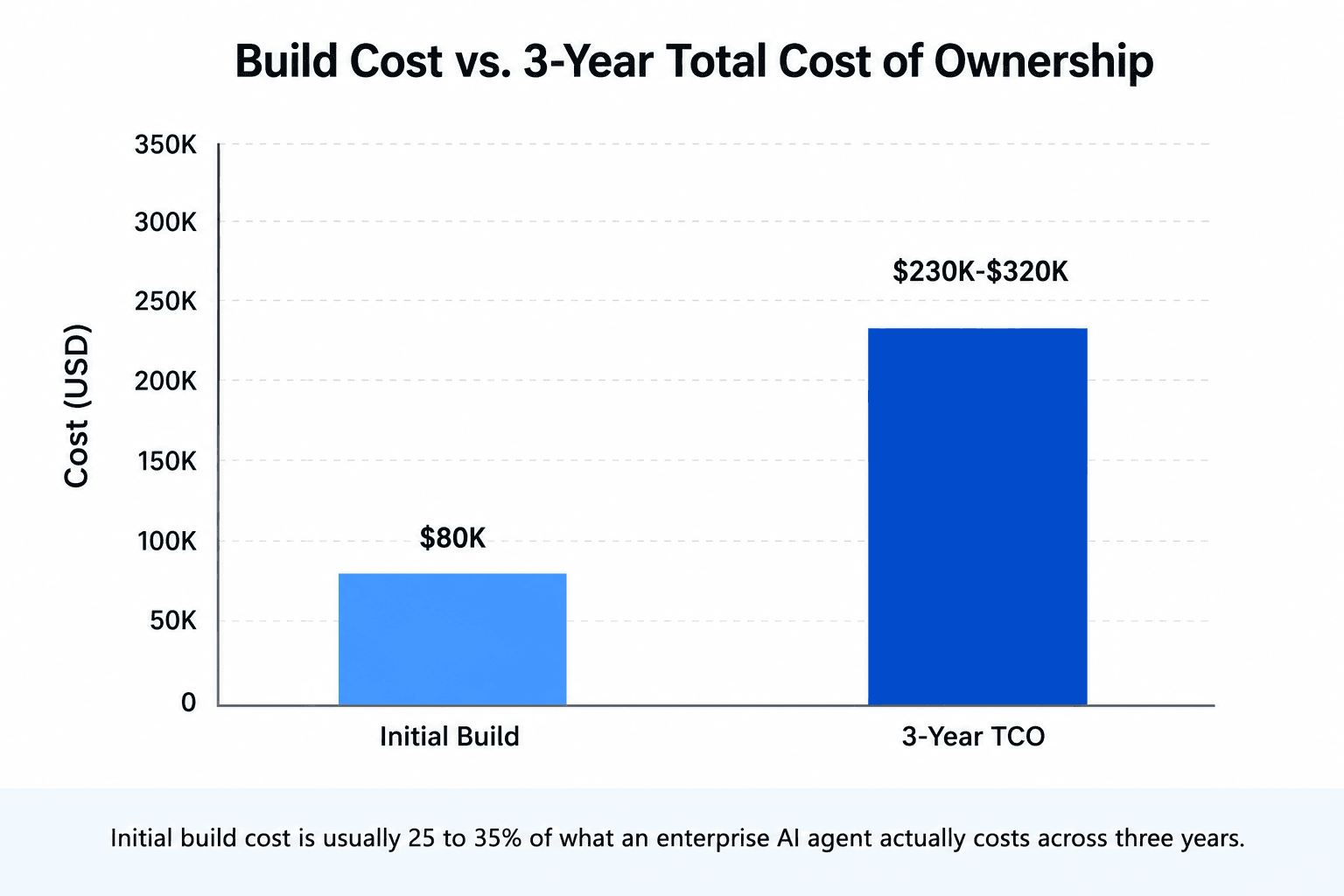
Development cost is the most visible line on a proposal and the smallest one over three years. A 2026 cost analysis puts initial build cost at only 25 to 35% of total cost of ownership once inference, monitoring, and maintenance are included. So, if the agency gives you a quote of $80,000 for building your agent, expect to spend around $230,000 to $320,000.
The criteria buyers most often underweight is what happens after launch: observability tooling, prompt governance, and ongoing optimization across whichever agentic AI frameworks the vendor builds on. Pilot-to-production transitions typically demand 250 to 400% more investment than the pilot itself, mostly from data pipeline work nobody budgeted for. A vendor who can't describe their monitoring dashboard hasn't run an agent past its first week.
A rebranded chatbot sold as an agent. Gartner's research identified widespread "agent washing," estimating only about 130 of the thousands of vendors claiming agentic capability actually deliver genuine autonomous features . No named reference customer you can call directly. A proposal that quotes a proof of concept but has no line item for production. Reluctance to name the engineers who will actually build your system. Generic security language with no specifics on permission scopes or audit logs.
A scoped proof of concept typically takes 6 to 12 weeks, a controlled pilot runs 3 to 6 months, and full production deployment takes another 6 to 12 months. The criteria that matter shift along the way. At the proof of concept stage, prioritize domain expertise and speed. During the pilot, weight integration depth and governance more heavily, since real data and real systems enter the picture. Once you approach production, team continuity and post-deployment support decide whether the system keeps running.
Choosing an AI agent development agency comes down to production proof, domain fit, and pricing you can actually plan around. Score your list based on the seven criteria mentioned above, pose the seven questions and note the red flags. This will automatically filter out most of the vendors unable to deliver.
SayOne Technologies has spent over 14 years building production software, with delivery teams across the globe that stay engaged from prototype through post-launch monitoring. Our AI agent development team has taken multi-agent systems into production for healthcare and customer service clients, including a multi-agent clinical intelligence system for a large health system and a conversational AI deployment built to cut support costs without new hiring.
If you are ready to score us against this exact framework, [connect with our team] (https://www.sayonetech.com/contact/) and fill out a short contact form. We will guide you through a live production agent, not a slide deck.
An AI agent development agency specializes in designing, developing, and deploying intelligent AI agents that can automate workflows, interact with users, analyze data, and integrate with existing business systems. These agencies help organizations implement AI solutions tailored to their operational needs.
Look for an agency with proven experience in AI technologies, successful case studies, expertise in your industry, strong security and compliance practices, transparent development processes, and ongoing support after deployment. It's also important to evaluate their ability to integrate AI agents with your existing software and infrastructure.
Some important questions include:
What AI agent projects have you delivered? Which AI models and frameworks do you use? How do you ensure data security and compliance? Can your AI agents integrate with our existing systems? What post-launch maintenance and support do you provide?
The cost depends on factors such as the complexity of the AI agent, required integrations, customization, deployment environment, and ongoing maintenance. Simple AI agents may require a modest investment, while enterprise-grade AI agent platforms with advanced automation and integrations typically involve larger budgets.
An agency with experience in your industry understands common business challenges, regulatory requirements, and customer expectations. This enables them to build AI agents that deliver faster implementation, higher accuracy, and better business outcomes while reducing project risks.
We're committed to your privacy. SayOne uses the information you provide to us to contact you about our relevant content, products, and services. check out our privacy policy.

We collaborate with visionary leaders on projects that focus on quality