
Subscribe to our Blog
We're committed to your privacy. SayOne uses the information you provide to us to contact you about our relevant content, products, and services. check out our privacy policy.



Generating table of contents...
AI may not run an e-commerce store entirely on its own yet, but is it really overhyped? Businesses adopting AI strategies see at least 20% revenue growth while cutting costs by 8%. At the same time, some stores struggle to see results even after incorporating AI into their e-commerce business. In reality, AI doesn’t instantly make a store successful, it only amplifies good business fundamentals and unlocks new opportunities for growth.
Adopting AI in e-commerce offers numerous advantages from saving cost and time to improving customer experience and brand loyalty.
AI-driven recommendation engines analyze browsing history, purchase patterns and demographics to provide suggestions.
AI chatbots respond to customer queries 24/7 through human-like conversations and track orders.
By incorporating AI into inventory management, they forecast demand considering variables like seasonality, trends and other factors. Also, they automate restocking alerts and reduce stockouts by predicting SKU level demands.
AI detects anomalies in transaction data and sends real-time alerts to prevent fraudulent activities before impacting customers.
AI helps manage catalogs efficiently by matching products' metadata with their images accurately, without spending hours. Additionally, e-commerce product images can be automatically optimized to improve quality and increase customer engagement to avoid manual efforts using AI.
AI combined with computer vision, AR and 3D modelling enables interactive shopping experience for customers by providing virtual-try on options, which also reduces return rates significantly.
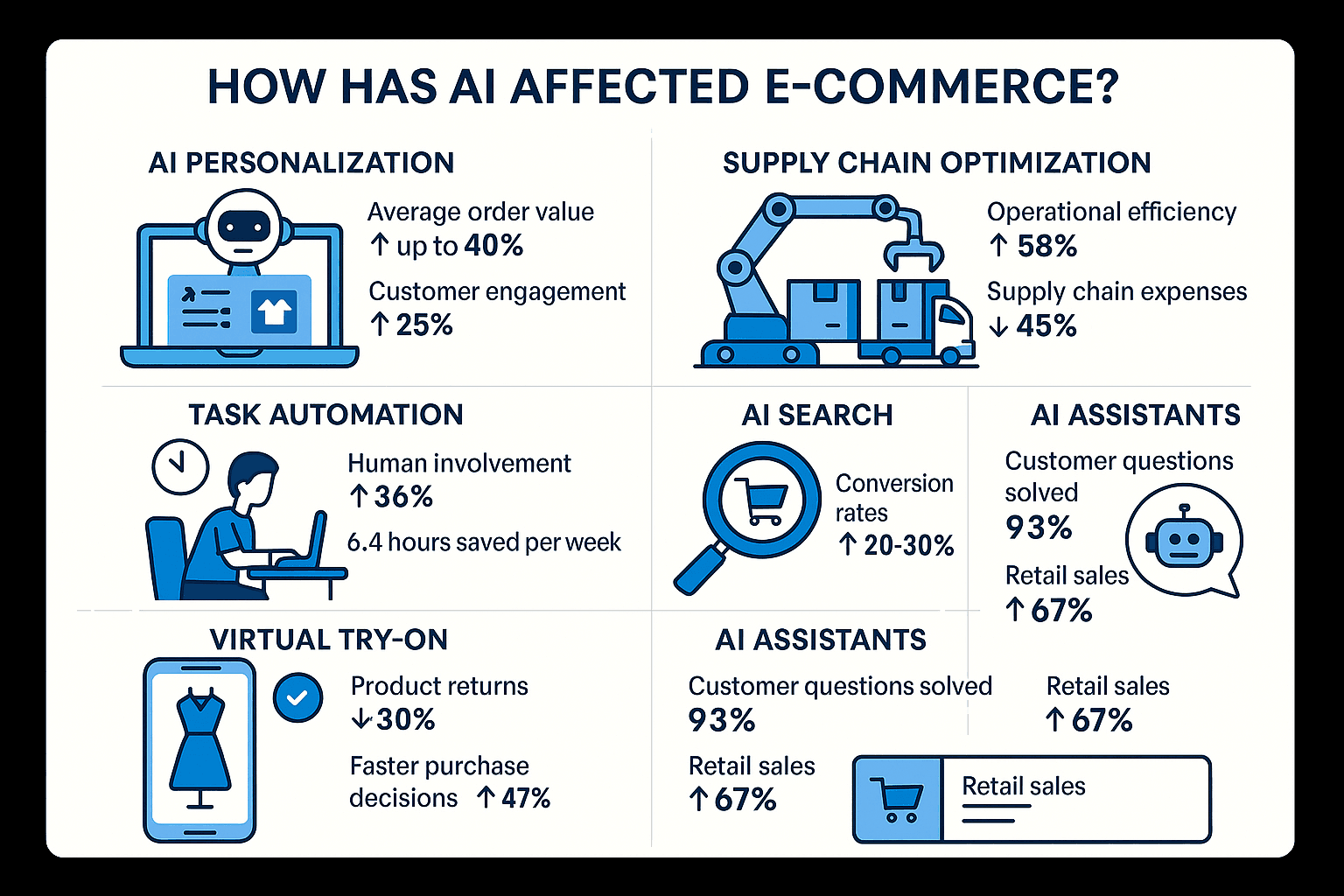
AI personalization in e-commerce is found to increase average order value by up to 40% and customer engagement by 25%. Around 91% of shoppers are more likely to buy from brands that offer personalized recommendations, according to Statista.
58% of ecommerce stores accept that using AI in the supply chain have improved their operational efficiency while 45% have significantly reduced supply chain expenses. With AI inventory management, companies have reduced stockout rates by 77% and increased inventory turnover ratio by 38%.
36% of companies have been successful in minimizing human involvement in repetitive tasks using AI. Each e-commerce professional using AI saves approximately 6.4 hours every week by automating time-intensive tasks like metadata matching. Also, automating product image optimization has translated to 80% reduction in processing time and 28% increase in monthly revenue.
By returning relevant results and personalized results through AI-assisted search, e-commerce stores achieve a 20-30% increase in conversion rates.
E-commerce stores offering AI virtual try on options have observed a considerable reduction in product returns, by 30%. Also, purchase decisions have grown 47% faster than before, which has also reduced drop-offs.
AI assistants have solved 93% of customer questions without human involvement. Chatbots alone increase retail sales by 67%, owing to better product discovery and immediate query resolution.
If you are someone who has not yet experienced the edge of AI in your e-commerce store either because you have not yet started or because you have not performed them effectively, here is a step-by-step roadmap.
Identify your e-commerce store’s core challenges that can be solved with AI like inventory forecasting, personalization, fraud detection and so on.
Collect clean, structured data from customer interactions, transactions, and browsing behavior. Invest in a data pipeline that supports real-time analytics for AI models.
Use specific AI tools based on your objectives like recommendation engines for personalized shopping experiences, chatbots and virtual assistants for customer support, virtual try on software for interactive shopping, metadata matcher for catalog management etc.
Connect AI services with your e-commerce platform, CMS, ERP and payment gateways using APIs and test workflows to avoid any disruptions.
Begin with one or two high-impact AI applications, assess their performance and retrain models consistently. Scale to advanced use cases after the foundation is stable.
Looking for the right partner to put these steps into action for your e-commerce store? Contact SayOne, and let’s overcome the challenges holding you back and solve them together.
AI integration often calls for a substantial investment on either technology acquisition, the upskilling of staff, or reorganizing workflows. Most e-commerce platforms available have plug-and-play AI solutions, but custom solutions usually require partnerships or in-house expertise. Initial costs are offset by long-term gains in efficiency and sales if deployed strategically with tested use cases.
AI needs to be retrained on a periodic basis to reflect shifting consumer behavior and trends, along with fluctuating inventory. Standard industry practice includes performance monitoring, A/B testing, and incorporating human oversight. Most AI vendors provide tools to track accuracy and flag problematic outputs for review and retraining.
Generally, AI adoption automates repetitive tasks, such as customer support and inventory reporting, but shifts employee roles toward oversight, analytics, and system management. Upskilling staff for AI-related functions is essential, and most companies find that while some roles are automated, new ones come up around digital management and customer analytics.
Compatibility often require middleware, APIs, and sometimes data migration to bind together legacy and new tools. Many such platforms offer integrations; however, assessing vendor support and technical documentation is crucial before the deployment of AI solutions. Planning for phased launch minimizes disruptions to business.
AI uses enormous user data that gives rise to severe privacy and data misuse concerns and further compliances towards regulations such as GDPR. There is a risk of data breach, unauthorized profiling, or cross-platform data leaks. To mitigate legal and ethical risks, businesses must run audits, clearly articulate consent policies, anonymize data wherever possible, and monitor algorithmic bias.
We're committed to your privacy. SayOne uses the information you provide to us to contact you about our relevant content, products, and services. check out our privacy policy.


We collaborate with visionary leaders on projects that focus on quality