
Subscribe to our Blog
We're committed to your privacy. SayOne uses the information you provide to us to contact you about our relevant content, products, and services. check out our privacy policy.


Generating table of contents...
Many businesses evaluating an Azure partner have experienced a certification-heavy proposal that did not translate into a smooth migration, or a support response that took far longer than promised during an outage. Microsoft's own partner directory lists thousands of companies under the Azure banner, ranging from two-person firms to global consultancies.
This guide breaks down what Azure consulting actually involves, what it should reasonably cost, and how to evaluate a partner's track record before you commit a budget.
Azure now holds a 21% share of the worldwide cloud infrastructure market, behind only AWS, and that share keeps growing as more enterprises standardize on Microsoft's stack for its overlap with Microsoft 365, Active Directory, and existing enterprise licensing agreements. Adoption is no longer the hard part. Running Azure well at scale is the harder, ongoing challenge.
That difficulty shows up directly in the numbers:
In addition to the spending problem, there is also a talent problem. For a few large enterprises, hiring a full internal team of Azure architects, FinOps professionals, and DevOps engineers makes sense, but most others cannot afford to do so. Particularly since a lot of the team’s time will be spent on activities such as migrating or optimizing, which typically take place within a couple of months. By working with a consulting partner, an organization can rent the expertise needed for the duration of the project before scaling down.
The label covers more ground than most buyers expect, and a partner worth hiring should be explicit about which of these they actually deliver.
Before anything moves, a competent partner inventories your current environment, maps dependencies between applications, and sizes the target Azure architecture. Microsoft's own Cloud Adoption Framework treats this assessment step as the foundation the rest of the migration is built on, not a formality to rush through.
Standing up the target environment, moving data and workloads, cutting over traffic, and validating that everything performs the way it did before, or better.
An ongoing discipline rather than a one-time audit, covering resource right-sizing, reserved capacity planning, and waste elimination against the principles laid out in Azure's own Well-Architected Framework.
CI/CD pipeline setup, infrastructure as code, and ongoing monitoring once the environment is live.
71% of organizations have now established a formal Cloud Center of Excellence to manage exactly this kind of complexity, making governance and cost control a baseline requirement for any serious Azure engagement rather than an optional add-on.
Identity and Access Management (IAM), network segmentation, and compliance needs unique to your industry such as healthcare, finance, and government should be designed into the target architecture at the very beginning, rather than being implemented post-production. A service provider who treats security as an afterthought at the end of the project will likely be the same one forced to rebuild your environment after six months of production.
Most businesses ask for "Azure consulting" without realizing that it covers three fairly different engagements, each with its own trigger, deliverables, and timeline.
| Engagement Type | Typical Trigger | What's Included | Timeline |
|---|---|---|---|
| Migration | Workloads still on-premises or on another cloud | Assessment, migration planning, cutover, post-migration validation | 6-16 weeks, depending on workload count |
| Cost Optimization | Cloud bill growing faster than usage | Resource right-sizing, reserved capacity planning, waste elimination | 2-6 weeks for an initial pass |
| Managed Services | Ongoing operations after go-live | 24/7 monitoring, incident response, patching, governance | Ongoing, monthly retainer |
Getting this distinction right before you start scoping conversations saves you from paying for a full migration engagement when what you actually need is a two-week cost audit, or vice versa.
The cost will vary greatly depending on the workloads, application complexity, and whether the engagement is a project or retainer. So, someone who gives you a quote without knowing your environment should be considered with caution. An optimization pass over an existing Azure footprint will be both the least expensive and fastest option to begin with, and it often pays for itself through the savings it generates.
A full migration will take longer and be more expensive, based on the number of applications, dependencies, and rearchitecture required of the target environment. Once you are live, managed services will generally be a monthly retainer based on the number of managed resources and the SLA response-time requirements.
The number that matters more than the quote itself is what happens to your Azure bill months after the engagement ends. Without internal responsibility for enforcing discipline, a migration or optimization project typically regresses into the overspending patterns noted before.
A related question buyers often skip is how a partner structures the commercial relationship itself.
Yet a partner who refuses to commit to either and proposes an open-ended hourly arrangement without a defined limit should be carefully examined prior to entering into an agreement.
Here are some focused questions that help distinguish an experienced delivery partner from one still building its track record:
Partner and individual certifications from Microsoft is a good way to start filtering, although they are a proxy for training completed rather than delivery experience. What is really critical is how they deal with problems that arise once something goes live, because at that point experience matters more than certification.
Get specific examples of success stories along with the numbers behind the success: what migration schedules have actually been met, what savings have actually been achieved, what uptime has actually been sustained.
Experienced partners track and share these numbers readily.
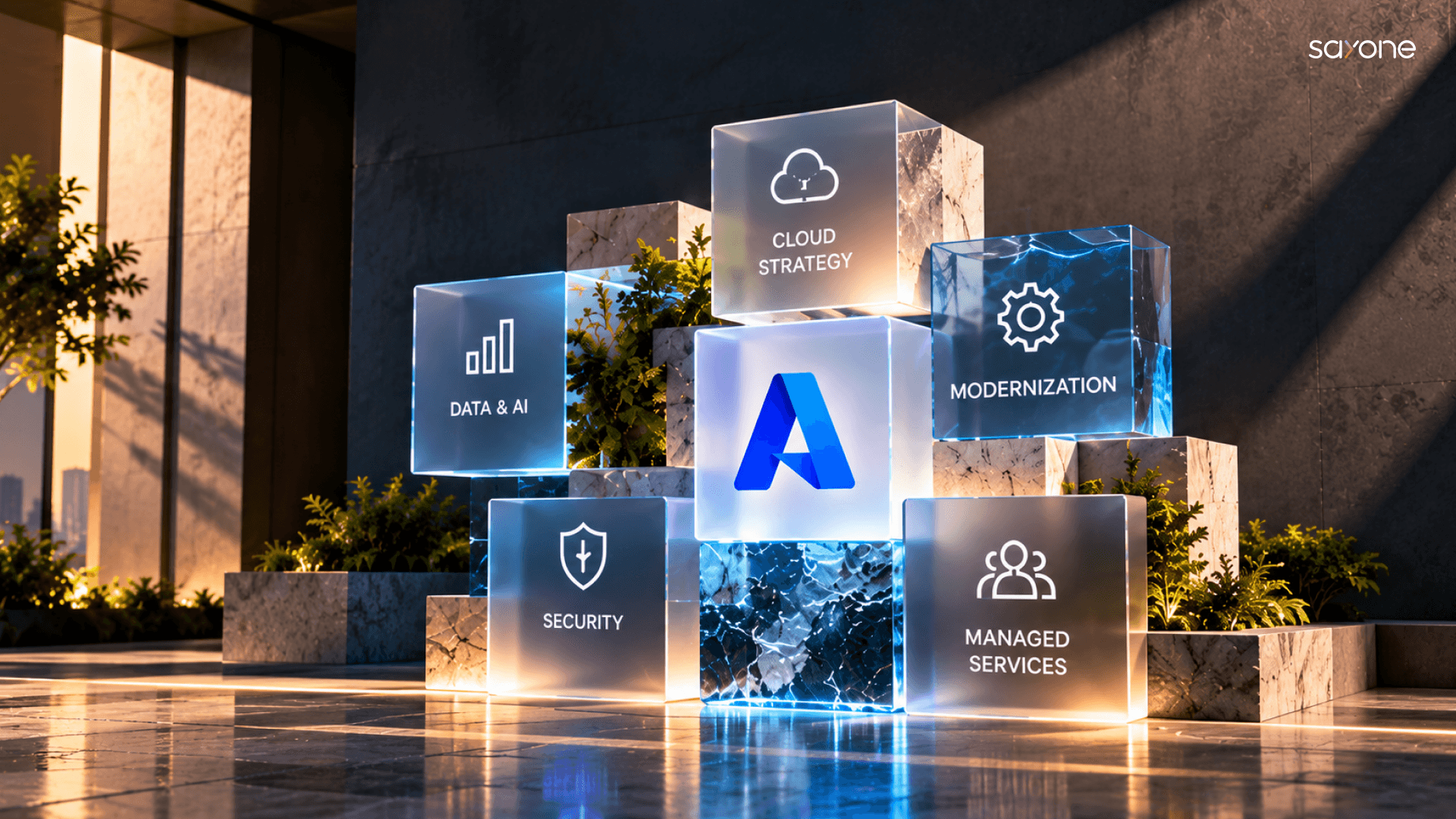
We treat Azure engagements as operational commitments. Our Microsoft Azure consulting services cover workload assessment, virtual machine and storage architecture, serverless design with Azure Functions, and AI-driven monitoring for ongoing operations. When the engagement is primarily about moving workloads, our cloud migration services handle the assessment-through-cutover process end to end, and our DevOps consulting services pick up CI/CD, infrastructure as code, and Kubernetes orchestration for teams that need the operational layer built out alongside the cloud environment itself.
If governance and provider selection is where you are stuck, our take on choosing a managed DevOps provider and on controlling cloud infrastructure costs covers ground that applies directly to an Azure environment too.
SayOne treats every Azure engagement, migration, cost turnaround, or ongoing managed operations, as an operational commitment, and prefers to recommend the option that actually fits your situation rather than the largest engagement we could scope. If you are evaluating Azure consulting partners right now, talk to our cloud team before you sign anything.
The honest range is wide enough that a single number is not useful without context, what matters more is how the pricing is structured. A fixed-bid migration protects you from scope creep but usually means a more thorough, and slower, assessment phase before the quote is finalized. Time-and-materials engagements move faster to a start date but need a cap or checkpoint built in, or the final bill can run well past what you expected going in. Ask which model a prospective partner defaults to before you ask for a number.
Ask a candidate partner to describe a project that did not go according to plan and what they changed as a result. A partner with real delivery history will have a specific, honest answer. One that claims every engagement has gone smoothly is either inexperienced or not being straight with you, and neither is a great sign for how they'll handle it when your migration suffers an issue.
Inquire about how they manage identities and access, whether they offer support for any compliance framework applicable to your business sector, like HIPAA, SOC 2, and PCI DSS. Also, ask who will have administrative access to your Azure environment after your engagement with them ends.
It is because, the skill set required to run Azure does not fall neatly into one specific job role. A company could employ great developers or a good systems administrator but no one who actually works as the person responsible for monitoring the cost of the cloud, forecasting the capacity needs, and keeping track of the always changing platform. Instead of hiring multiple individuals in specific roles that may not be full-time positions, many companies find it more cost-effective to outsource the skill set and then reevaluate if an internal position would make sense.
If workloads remain in a data center or another cloud, migration is the necessary starting point. If workloads already run on Azure and internal discussions have shifted from exploring expansion to questioning rising costs, the engagement is cost optimization, not re‑architecture. Confusing the two leads to scoping a larger engagement than the problem requires.
We're committed to your privacy. SayOne uses the information you provide to us to contact you about our relevant content, products, and services. check out our privacy policy.

We collaborate with visionary leaders on projects that focus on quality