
Subscribe to our Blog
We're committed to your privacy. SayOne uses the information you provide to us to contact you about our relevant content, products, and services. check out our privacy policy.


Generating table of contents...
The global artificial intelligence market is expected to reach USD 3,497.26 billion by 2033, at a rate of 30.6%. While generative and agentic AI are rapidly adopted by enterprises, AI is no longer used in the experimental phase but in core business infrastructure for faster growth and efficiency. Thus, AI adoption has become critical for businesses to emerge as an intelligent enterprise to stay relevant and survive fierce competition.
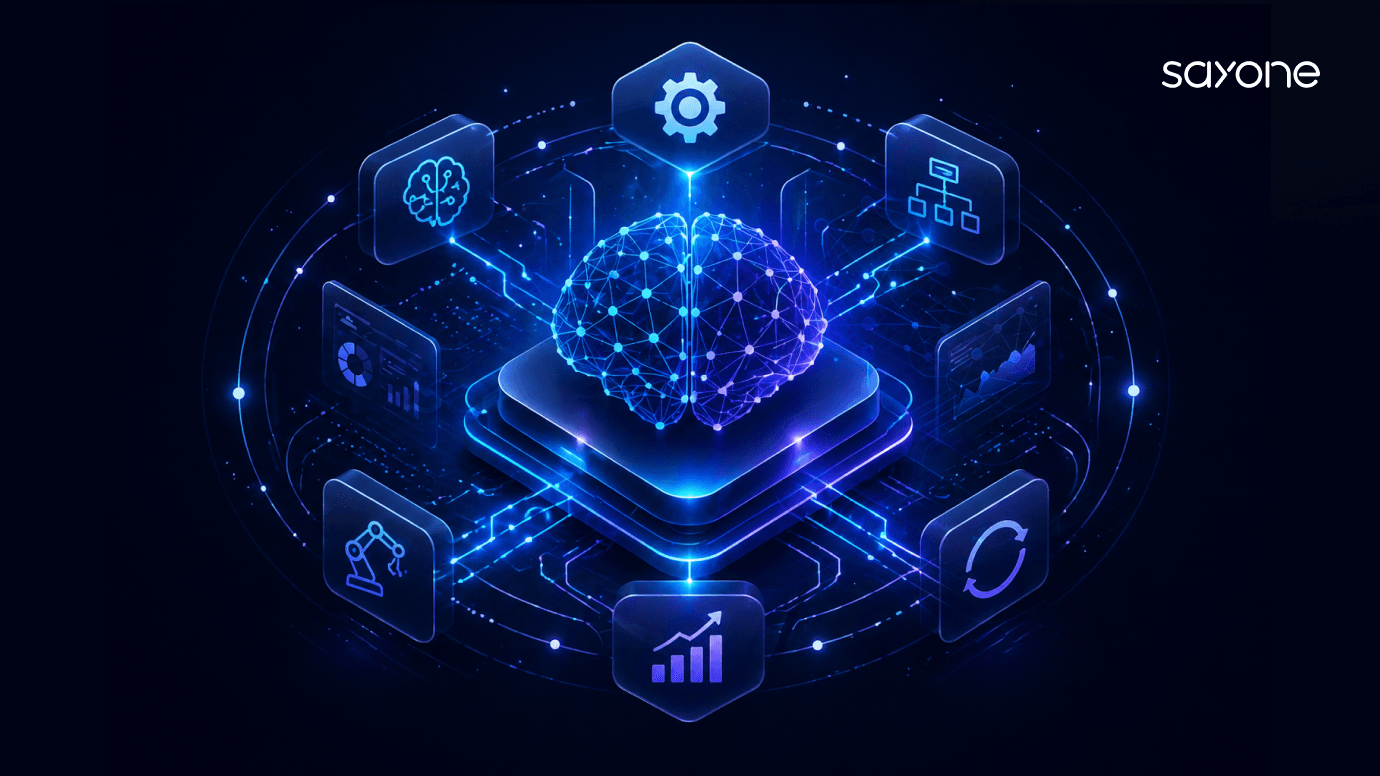
Enterprise intelligent enterprise means combining AI, machine learning, and automation to make smart, autonomous decisions. Rather than replacing humans, this allows the best use of their abilities and efficiencies on strategy and growth. Intelligent automation solutions are considered a top priority by 83% companies in their business plans.
Intelligent automation is achieved through four cognitive technologies used for transforming businesses.
AI is the component that simulates human-like decision-making by analyzing structured and unstructured data. With AI, automation no longer works with rigid rules but by making context-aware judgments and executing decisions.
Automation becomes adaptive with ML as it enables the system to learn from historical data and improve over time. This helps systems to detect patterns and trends, predict demand, risk, and behaviour, and refine decisions.
Read more: Difference between AI and Machine Learning (Uses, and Benefits & More)
RPA is the component that makes automation operational by handling the execution of tasks across systems by imitating human actions. It lets businesses reduce manual effort and automate repetitive tasks and work across multiple applications.
Acts as the orchestration layer, defining and managing the end-to-end workflow in which the other three layers operate. It structures processes and decision flows, coordinates between AI models, humans, and systems, and makes automation scalable.
While the first three components make automation intelligent, BPM is the one that makes it work together effectively as one system.
Many businesses adopt AI just to keep up with their competitors or to follow the hype, without really understanding why it is really critical for their business. AI automation becomes critical when your business can’t keep up with complexity, speed, and scale with traditional automation. Here is the reality of automation at present:
Business workflows today do not follow a neat and rule-based path. Traditional automation, which follows predefined rules, fails in such environments as decisions here depend on context rather than conditions.
Automating tasks is possible, while scaling decisions are not possible with rule-based automation. That’s when the ability of AI to scale decision-making as the business grows becomes significantly useful.
Businesses have access to a significant amount of data on customer behaviour, operational metrics, transaction history, and so on, in their dashboards and reports. These data, when analyzed smartly, provide valuable insights that positively influence decision-making ability.
The operations inefficiencies affect customer experiences in the form of slow responses, repeated information requests, and disconnected systems. Intelligent automation can fill gaps in operations that affect efficiency and offer a connected and context-aware experience.
Today, businesses react to issues or fix problems after the damage has already been done. Instead of reacting, businesses need to act proactively to predict and act before issues occur.
Read more: Conversational AI for Customer Support: Reduce Costs and Scale Without Hiring
Businesses have three paths forward to adopt intelligent automation, based on their requirements and technical depth.
Engaging individual experts on an on-demand basis rather than a service provider company as a whole also reduces timelines, gives you control over the design and processes, and reduces internal burden, and enables continuous optimization.
Read more: Extended Team Model: Harness Global Expertise with a Proven Delivery Workflow
When businesses are equally invested in automating their process with AI, what sets one company apart from others is no longer innovation; it's execution speed.
Whatever execution path your company takes, speed should be the ultimate deciding factor. Businesses today have taken a strategic shift from outsourcing to engaging on-demand developers. This way, they gain access to pre-vetted, expert developers who work for them, similar to an in-house team, only on your demand. Through this, businesses cut implementation time by 60% through easier communication and better planning.
Join us for a free 30-minute call to work with SayOne’s experienced engineers who have transformed diverse businesses with intelligent automation.
Intelligent automation combines AI, machine learning, robotic process automation (RPA), and business process management (BPM) to automate complex workflows. Unlike traditional rule-based automation, it adapts to context, learns from data, and makes smarter decisions, helping enterprises scale efficiently.
The cost of business automation varies widely depending on scope, tools, and industry. Low-code platforms may start with affordable subscription models, while enterprise-grade intelligent automation platforms can require significant investment. Costs should be evaluated against expected ROI, efficiency gains, and scalability.
Yes, modern intelligent automation platforms are designed to integrate with existing systems using APIs, connectors, and RPA bots that mimic human actions. This allows businesses to modernize workflows without replacing existing infrastructure, reducing disruption and cost.
ROI from automation depends on process complexity and scale. Many businesses see initial efficiency gains within 6–12 months, especially when starting with repetitive, high-volume tasks. Full ROI from enterprise-wide intelligent automation may take 18–24 months but often delivers long-term competitive advantage.
Not always. Many intelligent automation platforms offer low-code or no-code tools that allow business users to design workflows. However, for complex integrations, scaling across systems, or AI model customization, developers or automation experts may be required to maximize impact. Companies like SayOne allow businesses to engage their pre-vetted developers on demand, which saves time and improves working efficiency.
We're committed to your privacy. SayOne uses the information you provide to us to contact you about our relevant content, products, and services. check out our privacy policy.

We collaborate with visionary leaders on projects that focus on quality