
Subscribe to our Blog
We're committed to your privacy. SayOne uses the information you provide to us to contact you about our relevant content, products, and services. check out our privacy policy.


Generating table of contents...
Python is easy to hire for and hard to hire well. Thousands of resumes list it as a skill, but few show whether that person can write code your team will still trust a year from now. A weak Python hire gets expensive fast, since the technical debt it creates rarely stays contained to one project.
This guide covers what to test before you hire, which engagement model fits your situation, what your contract should cover, and the red flags that show up long before a bad hire becomes a costly one.
Yes, and the usage data backs it up rather than just the job postings. Python remains one of the most widely used languages among professional developers, with continued growth in data science, automation, and AI-integration work, according to JetBrains' 2025 State of Python survey.
What's changed is what "a strong Python developer" means day to day. The 2025 Stack Overflow Developer Survey found that a large majority of professional developers now use AI coding assistants as part of their regular workflow. Fluency with Python syntax matters less than it used to. Judgment about when to trust, rewrite, or reject what a model generates matters more.
Start by naming the job, not the language. "Python developer" covers backend engineers building APIs, data engineers moving information between systems, automation specialists scripting internal tools, and ML engineers wiring models into production. Each role rewards a different test.
A practical skills check for most roles should cover:
Code review, not just code writing. Give the candidate a real pull request from a past project, with sensitive details removed, and ask them to find the bugs, the missing tests, and the parts they would refactor.
A scoped take-home task, mirroring real work rather than a puzzle. A broken API endpoint to fix, a slow query to optimize, or a script to make idempotent all tell you more than a sorting-algorithm exercise.
A short pairing session on their submission. Watching someone explain their own decisions surfaces gaps that a solo exercise hides.
A direct question about AI-assisted code. Ask them to walk through a recent piece of code they wrote with an AI assistant's help and explain what they changed and why.
For a longer list of the specific technical areas worth probing, from exception handling to packaging and testing frameworks, see our breakdown of core Python developer skills.
Tech-talent supply continues to lag demand in specialist areas even after rounds of layoffs elsewhere in the industry, which is exactly why the engagement model you choose matters as much as who you hire. Four models cover almost every situation:
In-house hire
A full-time employee on your payroll, embedded in your team long term. Highest control, highest cost, and the longest time to productivity once you count sourcing, interviewing, and onboarding.
Staff augmentation / dedicated developer
A vetted engineer who joins your team and takes direction from your own managers, without the overhead of a full-time hire. This is the middle ground most growing teams choose, and it is the model behind our own IT staff augmentation services.
Freelancer or marketplace hire
Fast to start and well suited to short, narrowly scoped work such as a script, a prototype, or a one-off bug fix. The compromise is that you carry more of the oversight and quality-control burden yourself.
Delivery partner / managed engagement
A service provider takes ownership of architecture, delivery, and the outcome, not just the hours worked. This fits best when you need a result delivered rather than a seat filled.
The right call depends less on your budget and more on how much of the delivery risk you want to hold yourself. Our comparison of hiring dedicated developers versus outsourcing goes deeper into that distinction if you are weighing a dedicated hire against a fully outsourced build.
Remote and distributed hiring has also stopped being the exception. The World Economic Forum's Future of Jobs Report 2025 points to continued growth in cross-border digital and remote roles as employers look for skills wherever they sit. Ruling out a strong candidate purely over time zone is a constraint fewer teams can afford to keep.
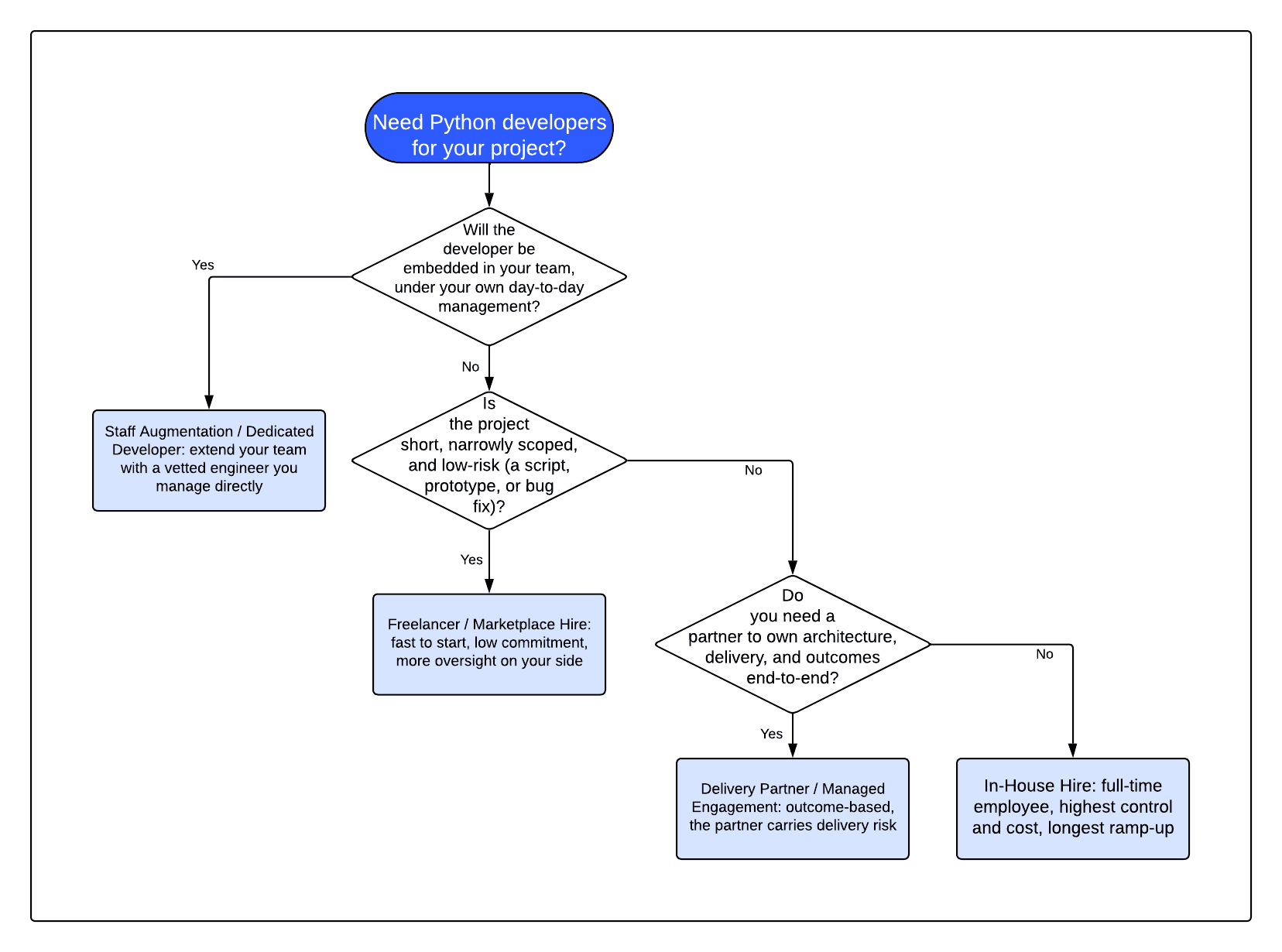
A few patterns hold across most engagements. Staff augmentation gives you the fastest path to a productive Python developer without inheriting full-time overhead. Freelance hires start the quickest but need the most hands-on management. Delivery partners cost more per hour on paper, but the number that matters is cost per outcome, not cost per hour, once you factor in the time your own team would otherwise spend managing the work.
If you are budgeting before the work is fully scoped, a rough ordering holds across most markets: a junior-to-mid freelancer sits at the lower end of hourly rates, a vetted staff-augmentation hire sits in the middle with more consistency per hour billed, and a managed delivery engagement runs highest per hour but often lowest in total internal oversight cost once the system is non-trivial. Get a fixed quote or a capped estimate in writing before work starts, regardless of model; an open-ended hourly arrangement with no ceiling is where budgets quietly double.
| Engagement Model | Cost Structure | Your Control | Ramp-Up Time | Best Fit |
|---|---|---|---|---|
| In-House Hire | Salary, benefits, and overhead | Highest, direct management | Weeks to months | Long-term, core product work |
| Staff Augmentation / Dedicated Developer | Hourly or monthly rate, no benefits overhead | High, developer follows your direction | Days to 1-2 weeks | Scaling an existing team quickly |
| Freelancer / Marketplace Hire | Hourly or fixed project fee | Moderate, you manage quality directly | Days | Short, narrowly scoped tasks |
| Delivery Partner / Managed Engagement | Fixed-fee or milestone-based | Lower day-to-day, partner owns delivery | Days to weeks for scoping | Outcome-critical builds, limited internal bandwidth |
Whichever model you choose, the contract should answer four questions before work starts:
Who owns the code?
Intellectual property should transfer to you on payment, in writing, including any libraries or internal tools built during the engagement.
What happens at handover?
Source code, documentation, environment configuration, and credentials should all be named as deliverables, not assumed.
How is performance measured?
Define response-time commitments for staff augmentation, or milestone-based acceptance criteria for a managed delivery engagement, before the engagement starts.
What's the exit plan?
A termination clause with a defined notice period and a knowledge-transfer requirement protects you if the engagement needs to end early.
A few warning signs tend to show up well before a hire turns costly:
A portfolio with no public code and no willingness to walk through a past project in detail.
A service provider that won't name the actual engineer who will do the work, or substitutes a different one after the contract is signed.
Vague answers about testing practices. "We test everything," with no mention of a specific framework or coverage target, usually means the team doesn't write tests.
Pressure to skip a paid trial task or a short paid engagement before a longer commitment.
No clear answer on who owns the code if you walk away.
If you are evaluating a development partner rather than an individual hire, our guide on identifying a genuine Python development company covers the proof points worth asking for before you sign.
Consider a pattern that plays out across growing engineering teams more often than most admit. A company hires a freelance Python developer to build an internal inventory-sync script under deadline pressure. The script passes testing and ships. In production, it silently drops records whenever two warehouses submit updates within the same few seconds, because the original build never accounted for concurrent writes. Nobody notices for six weeks, until inventory counts stop matching physical stock.
Fixing it means more than patching the script. It means auditing six weeks of warehouse data, rebuilding the counts by hand, and adding the integration tests that should have existed from the start, a rebuild that runs longer than the original project did. The engagement model was not the root problem. Skipping the step where someone qualified reviews concurrency handling before code reaches production is what turned a two-week script into a six-week outage.
Not every Python hire needs a full delivery partner. A well-scoped internal script might only need a freelancer and a careful code review. But when the work touches production data, customer-facing systems, or anything with a real cost of failure, the calculus changes: Python syntax matters less than judgment under conditions no take-home test replicates.
That is the gap staff augmentation and managed delivery engagements are built to close: vetted engineers, reviewed code, and an accountable team behind the work rather than a single point of failure. If you are weighing whether your next Python hire should be a seat on your team or a result someone else is accountable for, contact our team and we will help you scope it properly.
Cost depends mainly on the engagement model, not the language itself. A freelance hire for a narrow task typically sits at the lower end of the hourly range, a dedicated staff-augmentation developer costs more per hour but needs less day-to-day oversight, and a managed delivery engagement is usually quoted as a fixed fee or a milestone price rather than an hourly rate. Ask for a written quote or a capped estimate before work starts so the number stays predictable.
Yes. Python continues to rank among the most widely used languages for backend services, data engineering, and AI integration work, and that usage keeps expanding rather than shrinking. The bigger shift is in what counts as developer skill: judgment about AI-assisted code now matters as much as syntax knowledge.
A freelancer typically works independently on a defined task with you providing most of the oversight, while a staff-augmentation developer joins your team under your own management and follows your existing processes. Freelancers suit short, narrowly scoped work; staff augmentation suits ongoing work where you want a team member's reliability without a full-time hire's overhead.
Test them on a real scenario rather than a theoretical puzzle. A short, scoped take-home task based on the kind of problem your team actually faces, followed by a code review and a conversation about their decisions, shows far more than a resume or a whiteboard exercise ever will.
Code ownership should be settled in writing before work starts, not assumed afterward. For most engagements, intellectual property transfers to the hiring company on payment, and that term, along with handover of source code, documentation, and credentials, belongs explicitly in the contract rather than left to goodwill.
Ask who specifically will do the work, what their testing practices look like in concrete terms, what a fixed quote or capped estimate includes, and what happens if the engagement ends early. A service provider that gives vague answers to any of these questions is a reason to keep looking.
We're committed to your privacy. SayOne uses the information you provide to us to contact you about our relevant content, products, and services. check out our privacy policy.


We collaborate with visionary leaders on projects that focus on quality