
Subscribe to our Blog
We're committed to your privacy. SayOne uses the information you provide to us to contact you about our relevant content, products, and services. check out our privacy policy.


Generating table of contents...
Robotic process automation has run enterprise back offices for almost two decades. It is dependable, cheap to license, and easy to explain to an auditor. It is also the reason so many automation teams keep hiring people to fix bots that break the moment a vendor changes an invoice layout. Forrester's research shows that around half of RPA initiatives reach a plateau once processes become too variable for a script to follow.
That is the gap agentic AI was built to close. This guide helps you understand what actually separates AI agents from traditional automation, where each one earns its keep, and how a business decides which model or which combination fits a given process.
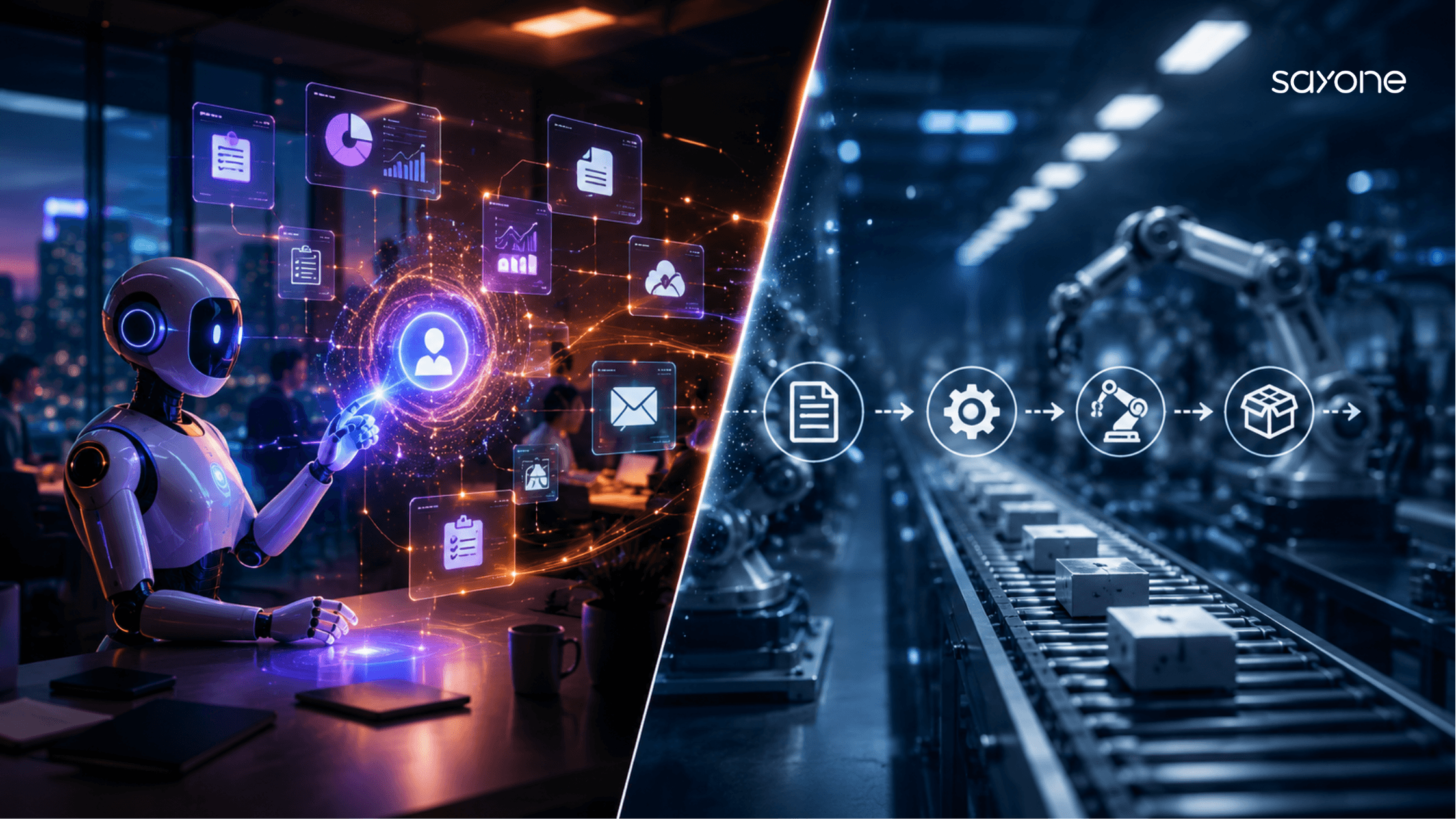
With traditional automation such as RPA, the task is programmed by a person to perform in a predefined series of steps. Once you give it a structured and stable process, it will perform that same process for thousands of iterations without a problem. But, changing one field on a form, the same bot can stop cold.
AI agents work from a different premise. Unlike programming to follow a series of lines of code, the agent understands a target and what is required to achieve that target. Our own explainer on agentic AI frameworks, workflows, and use cases goes deeper into how that planning and tool use actually works under the hood. What matters for this comparison is the outcome: RPA executes; AI agents decide, then execute. This is also where the two technologies part ways on cost of change. Updating an RPA workflow usually means opening the bot and rewriting steps. Updating an AI agent usually means adjusting the goal, the guardrails, or the tools it can call, which is a smaller and faster change in most production environments.
RPA bots mimic the clicks, keystrokes, and screen reads a human employee would perform. They are effective because they are deterministic: given the same input, a bot produces the same output every time, which is exactly what a compliance team wants to see in an audit trail. That determinism has a ceiling, though. Forrester analyst Craig Leclair's often-cited "Rule of Five" holds that once a process involves more than five decision points or applications, RPA alone tends to struggle, and a business typically needs a different technology layered on top. Unstructured inputs, handwritten forms, and free-text customer messages sit outside what a rule-based bot can reliably parse.
Ernst & Young's research puts RPA underperformance in the same range: roughly 30 to 50 percent of early RPA programs fail to deliver the expected return, and the cause is rarely the software itself . More often, a team automated a process that only looked repeatable on paper.
The maintenance burden tells the rest of the story. As per a 2025 analysis of 247 enterprise RPA deployments, exception handling alone accounts for 35 to 60 percent of total maintenance workload. Teams end up spending more time focusing on the bot than the manual process ever required. Loan documents that come in unusual formats, compliance regulations that shift on a quarterly basis, and customer correspondence that does not have a set template are the common examples that Forrester gives for why around 50% of RPA programs fail. None of this means RPA is a bad investment. It means RPA was designed for a narrower job than most vendors admitted, and businesses that scoped it correctly still see strong returns, sometimes 30 to 200 percent ROI in year one. The failures cluster almost entirely around processes that were never a good fit to begin with.
The AI agent, which is connected to the right AI agent development framework, can read an unstructured document, determine its meaning, select the proper action to follow based on this meaning, and even explain its thought process after the fact. The last part, an audit trail for a decision rather than just a log of clicks, is what lets agentic automation move into workflows RPA was never built to touch. Microsoft's Agent Factory series describes how Fujitsu replaced a manual sales proposal process with specialized agents for data analysis, market research, and document assembly, reducing production time by 67 percent. No single script could have covered that many judgment calls. A coordinated set of agents could, because each one reasoned about its slice of the task instead of following a fixed path.
Gartner and Forrester both point to 2026 as the year multi-agent deployments move from pilot to production at scale, with specialized agents collaborating under a shared orchestration layer rather than operating as isolated point solutions. That coordination layer is also where new risk shows up: McKinsey's analysis warns that as many as 40 percent of agentic initiatives could be abandoned by 2027 because of governance gaps rather than technical shortfalls. Autonomy without oversight is not a strategy either.
Not every process deserves an agent, and pretending otherwise wastes budget. Traditional automation is still the right call when:
AI agents earn their cost when a process involves judgment, unstructured data, or cross-system coordination that a script cannot anticipate. That includes:
Yes, and for most businesses, this is how it happens rather than replacing everything. AI provides the intelligence and ability to adjust what is missing in a rules-based bot, while RPA still performs the same mundane tasks that it does effectively.With a combined approach, an AI bot could analyze an incoming document, categorize it, and choose how to proceed with the task and pass it on to an RPA bot for performing the repetitive task. This is also where standards matter. Agents that need to call tools, delegate tasks to other agents, or interact with enterprise systems are using protocols such as MCP and A2A instead of fragile and ad hoc integration approaches. Our guide for scaling technology business operations using AI-driven automation will explain how engineering teams can already combine both models for code review, documentation, and incident management.
A short framework helps avoid an expensive false start:
Document the actual steps, including every exception the team currently handles manually.
Under roughly 20 percent and stable over time points toward RPA. Frequent, unpredictable exceptions point toward an AI agent.
Highly regulated, deterministic processes may still favor RPA, or a hybrid model with an agent for triage and RPA for the compliant execution step.
Factor in that exception handling can absorb over a third of an RPA program's ongoing effort.
Many businesses searching for an AI agent development company are really asking who can help them scope the right mix, not just write code. A partner who has shipped both RPA and agentic systems will usually spot the hybrid opportunity a purely technical vendor misses.
SayOne builds both traditional automation and agentic AI systems for enterprises across fintech, healthcare, and logistics, so the recommendation you get is based on what your process actually needs, not on which technology we happen to sell. Our teams have delivered AI agent development work that automates document review, customer workflows, and cross-system coordination for clients that need to move past the limits of rule-based bots. Working with us on this decision typically starts with a short discovery conversation about your current automation stack, moves into process mapping and exception analysis, and ends with a concrete recommendation, whether that is RPA, an AI agent built using frameworks like OpenClaw, or a hybrid of both. If you are evaluating an AI agent development company because a rule-based process keeps breaking, or you simply want a second opinion before committing budget to either path, connect with our team by filling out our contact form and we will respond within one business day.
It is the least likely to occur in the immediate future. RPA will continue to remain an effective solution for stable, rules-based and voluminous processes, whereas the AI agent will take care of all the decision-making exceptions that the RPA cannot do at scale.
Governance is identified as one of the biggest risks. McKinsey's research suggests up to 40 percent of agentic AI initiatives could be abandoned by 2027 due to unclear accountability and weak oversight, not because the underlying technology failed.
Good processes are high volume, rule-based, and stay under roughly a 20 percent exception rate over a sustained period. If the process regularly involves more than five decision points or applications, RPA alone typically struggles, per Forrester's guidance.
The upfront build can cost more, but the comparison should include maintenance. RPA programs often lose 35 to 60 percent of their ongoing effort to exception handling alone, a cost that a well-scoped agent can avoid for the right process.
Both sides have different time frames depending on the project at hand, but there is a predictable trend that holds throughout. Deployment of an AI agent responsible for one workflow will take one to two weeks, whereas deployment of a multi-system AI agent will take three to eight weeks.
We're committed to your privacy. SayOne uses the information you provide to us to contact you about our relevant content, products, and services. check out our privacy policy.

We collaborate with visionary leaders on projects that focus on quality