
Subscribe to our Blog
We're committed to your privacy. SayOne uses the information you provide to us to contact you about our relevant content, products, and services. check out our privacy policy.


Generating table of contents...
Everyone uses the term "AI agent" to describe everything from a scripted chatbot to a fleet of coordinating, decision-making systems. Part of that confusion traces back to [generative AI and agentic AI](https://www.sayonetech.com/blog/generative-ai-vs-agentic-ai-key-differences-benefits/) getting used as if they were the same thing, when they solve different problems. If you're evaluating a build, that ambiguity is expensive: the wrong architecture for your use case means rework, blown budgets, or a pilot that never leaves the sandbox.
An AI agent is a system that perceives its environment through data, decides on an action based on that data, and acts with a varying degree of autonomy to reach a goal. That's the textbook definition, and it's also where most sales conversations stop. [IBM's technical breakdown of AI agent types](https://www.ibm.com/think/topics/ai-agent-types) is a useful primary reference here, and it makes the point plainly: the meaningful differences between agents aren't in what they're called, but in how they decide.
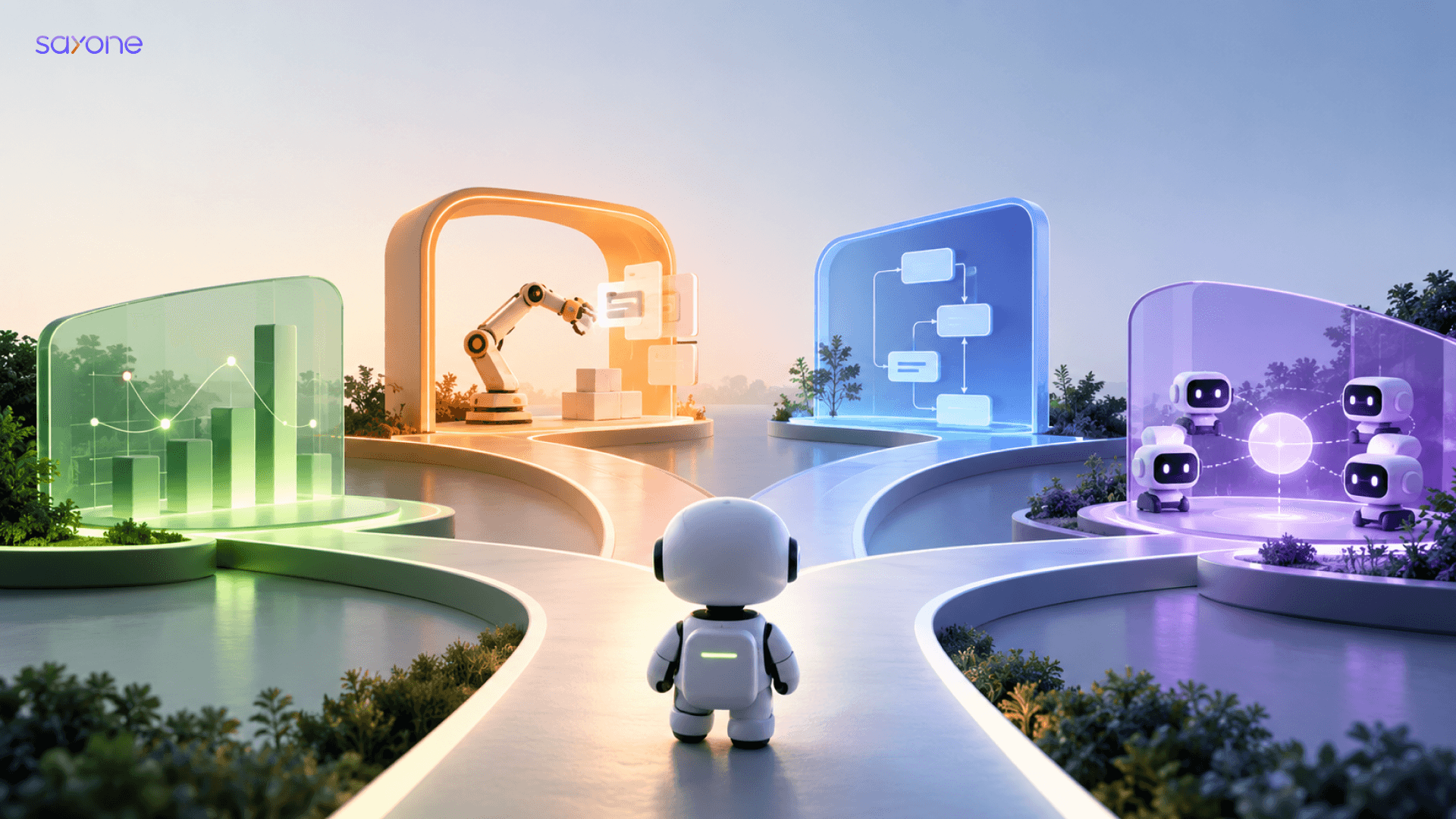
Six architectures account for almost every agent on the market today: simple reflex, model-based reflex, goal-based, utility-based, learning, and multi-agent (hierarchical) systems. [Google Cloud's own agent primer](https://cloud.google.com/discover/what-are-ai-agents) groups these along a similar spectrum, from fixed-rule automation to autonomous, self-improving systems. Each step up that spectrum buys more flexibility and costs more to build, govern, and maintain, which is exactly why matching the type to the problem, is the first decision that matters.
Simple reflex agents act on condition-action rules: if this input, then that output. No memory, no planning, no model of the world beyond the current input. They're the oldest form of "agent" in production â think thermostat logic, basic chat-flow bots, or a fraud rule that blocks a transaction over a fixed dollar threshold.
Model-based reflex agents add one capability: an internal model of the parts of the world the sensors can't see directly, so the agent can act sensibly even with incomplete information. A warehouse robot that remembers which aisles it already scanned is a model-based reflex agent; a script that only reacts to the current frame is not.
Both types are low-cost to build and easy to audit, which is exactly why they're still the right answer for a large share of automation work. The mistake we see most often in scoping calls is a team reaching for a multi-step, "smart" agent to solve a problem a reflex rule would have handled in a fraction of the time and cost.
Goal-based agents evaluate multiple possible action sequences against a defined goal and choose the path that gets there. This is where planning and search enter the picture. A routing agent that maps several delivery sequences and picks the one that hits a deadline is goal-based.
Utility-based agents go a step further: instead of a single goal, they weigh competing outcomes against a utility function â cost against speed, risk against reward â and pick the option that scores best overall, not just the option that technically satisfies the goal. This is the architecture behind most pricing, resource-allocation, and portfolio-style agents, because real business decisions almost always involve weighing competing priorities rather than meeting a single pass or fail condition.
The tell for whether you need goal-based or utility-based reasoning is simple. If there's exactly one right answer, you need goals. If there's a "best available" answer among several imperfect ones, you need utility.
Learning agents add a feedback loop: a performance element that acts, a critic that evaluates the outcome, and a learning element that adjusts future behavior based on that evaluation. This is the architecture behind recommendation engines, dynamic fraud models, and increasingly, LLM-based agents that refine their own prompts or tool selection based on past task outcomes.
Learning agents are also the hardest to govern, because their behavior shifts after deployment. [McKinsey's State of AI research](https://www.mckinsey.com/capabilities/quantumblack/our-insights/the-state-of-ai) puts current enterprise adoption of live, task-performing agents at roughly one in ten business functions today â still early, and concentrated in the organizations that have already built the monitoring and evaluation discipline a learning system requires.
Most production AI agent deployments in 2026 aren't a single agent at all. They're a coordinated set of specialized agents, each handling one part of a workflow and passing context to the next. A support system might have one agent that classifies intent, another that retrieves account data, and a third that drafts the reply for human approval. That's a multi-agent, or hierarchical, architecture.
The advantage is modularity: you can upgrade, retrain, or replace one agent in the chain without rebuilding the whole system. The cost is added coordination work â orchestration, shared memory, and identity and permission scoping between agents become real engineering problems, not afterthoughts. We've covered what a disciplined build looks like in practice in [our guide to evaluating an AI agent partner](https://www.sayonetech.com/blog/how-to-choose-an-ai-agent-development-agency/), and walked through real deployments in [our roundup of agentic AI examples](https://www.sayonetech.com/blog/agentic-ai-examples-solving-real-business-problems/).
The table below is the version of this comparison we actually use with clients scoping a build: what each architecture is good at, and where it tends to fall over.
| Architecture | Decision Basis | Memory / Learning | Best-Fit Use Case | Build Complexity |
|---|---|---|---|---|
| Simple Reflex | Fixed condition-action rules | None | High-volume, low-ambiguity tasks (chat flows, threshold alerts) | Low |
| Model-Based Reflex | Rules + internal world model | Short-term state only | Tasks needing hidden context (inventory bots, monitoring) | Low-Medium |
| Goal-Based | Search/planning toward a defined goal | Task-level planning | Routing, scheduling, multi-step completion | Medium |
| Utility-Based | Weighted trade-offs across outcomes | Planning + scoring | Pricing, resource allocation, prioritization | Medium-High |
| Learning | Feedback-driven adaptation | Continuous, persistent | Recommendations, fraud detection, self-improving agents | High |
| Multi-Agent / Hierarchical | Coordinated specialist agents | Shared / distributed | Complex workflows spanning multiple systems or teams | High |
The evaluation question that actually matters isn't whether to use AI agents at all. [Gartner expects task-specific AI agents to appear in 40% of enterprise applications by 2026, up from under 5% in 2025](https://www.gartner.com/en/newsroom/press-releases/2025-08-26-gartner-predicts-40-percent-of-enterprise-apps-will-feature-task-specific-ai-agents-by-2026-up-from-less-than-5-percent-in-2025), so the "whether" question is largely settled. The question is which architecture, at what scope, solves the specific bottleneck you actually have.
As a practical framework, start with the decision you're automating. A single, well-defined decision with clear rules is a reflex-agent problem. A decision with several acceptable outcomes that requires weighing competing priorities is utility-based. A workflow that spans multiple systems, data sources, or teams is a multi-agent problem, whether or not anyone in the room is calling it that yet. Our take on how these categories map onto real infrastructure decisions is in [our comparison of managed AI agents versus traditional automation](https://www.sayonetech.com/blog/managed-devops-ai-agents-vs-traditional-automation/), which walks through a goal-based-to-multi-agent progression inside a single operations function.
The architecture mismatch shows up almost immediately in the numbers. [A separate industry report](https://www.gartner.com/en/newsroom/press-releases/2025-06-25-gartner-predicts-over-40-percent-of-agentic-ai-projects-will-be-canceled-by-end-of-2027) attributes the majority of agentic AI project cancellations to escalating costs, unclear business value, or inadequate risk controls, not to the underlying models being incapable. In our own delivery work, the projects that stall are almost always the ones where a learning or multi-agent architecture was chosen for a problem that a goal-based or even reflex agent would have solved at a fraction of the governance overhead.
SayOne has built and governed AI agent systems across that full spectrum, from single-purpose reflex automations to coordinated, multi-agent production systems. If you're scoping an AI agent build and want a second opinion on which architecture actually fits your problem before you commit budget to the wrong one, [our AI agent development team](https://www.sayonetech.com/data-ai/ai-agents/) can walk through your specific use case and give you a straight answer. [Get in touch](https://www.sayonetech.com/contact/) to start that conversation.
Most AI agents fall into six architectures: simple reflex, model-based reflex, goal-based, utility-based, learning, and multi-agent (hierarchical) systems. Each represents a step up in autonomy, complexity, and what it costs to build and govern, from fixed if-then rules to coordinated fleets of specialized agents.
A goal-based agent picks whichever path gets it to a defined objective, treating all successful outcomes as equally good. A utility-based agent goes further, scoring multiple acceptable outcomes against competing priorities like cost, speed, or risk, and choosing the highest-scoring option rather than just any option that works.
A multi-agent (or hierarchical) system is a set of specialized agents that each handle one part of a workflow and pass context to the next, rather than one agent trying to do everything. It adds coordination work but makes it possible to upgrade or replace one piece of the workflow without rebuilding the whole system.
Start with the decision you're trying to automate, not the architecture. A single, well-defined decision with clear rules usually only needs a reflex agent; a decision involving competing priorities needs a utility-based agent; and a process spanning multiple systems or teams is usually a multi-agent problem, whether or not it's been framed that way yet.
Industry research attributes most agentic AI project cancellations to escalating costs, unclear business value, or inadequate risk controls, not to model capability. In practice, this often comes down to choosing a learning or multi-agent architecture for a problem a simpler goal-based or reflex agent would have solved at a fraction of the cost.
We're committed to your privacy. SayOne uses the information you provide to us to contact you about our relevant content, products, and services. check out our privacy policy.

We collaborate with visionary leaders on projects that focus on quality